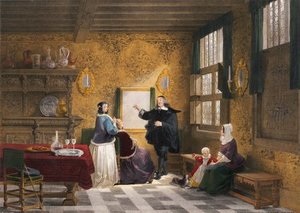
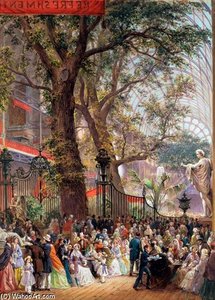
Louis Haghe: Pioneer of Victorian Colour Lithography
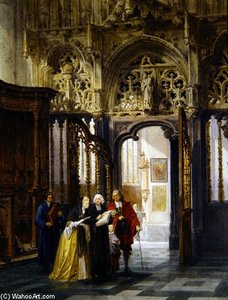
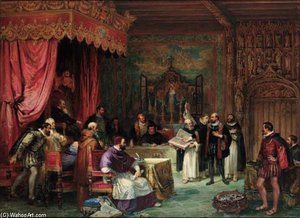
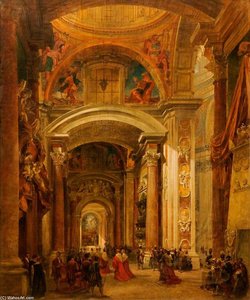
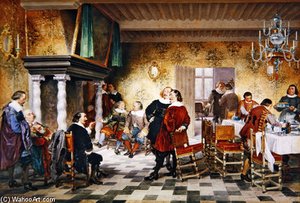
Louis Haghe (1806-1885) stands as a pivotal figure in the history of nineteenth-century art, particularly renowned for his groundbreaking contributions to lithography and watercolour painting. Born in Tournai, Belgium—a city steeped in architectural heritage—his artistic journey began amidst the burgeoning fascination with scientific illustration and captivated by the transformative potential of new printing techniques. Trained initially in watercolour under Jan de Jonghe and Chevalier de la Barrière, Haghe swiftly embraced lithography when the first press arrived in his hometown, marking him as one of the earliest adopters of this revolutionary medium.- Early Life & Training: Haghe’s formative years were shaped by his family's architectural lineage—a legacy that instilled within him a profound appreciation for detail and precision. His formal watercolour training honed his observational skills, preparing him for the challenges of capturing complex visual narratives.
- London Calling: Recognizing the opportunities presented by London’s artistic milieu, Haghe emigrated to England in 1823, establishing himself as an assistant lithographer at Day & Haghe—a partnership that would propel him to international acclaim.
The Day & Haghe Partnership: A Triumph of Collaboration
Around 1830, Louis Haghe joined forces with William Day, forming a formidable creative alliance that swiftly ascended to prominence as the foremost Victorian firm specializing in lithographic printing. Their collaborative spirit fostered innovation and propelled them to produce an astonishing array of prints encompassing diverse subjects—hunting scenes, architectural vistas, topographical depictions, and genre narratives—all executed with unparalleled artistry. Notably, they spearheaded the development of chromolithography—a technique that allowed for vibrant colour reproductions—and hand-tinted lithographs—further elevating the aesthetic quality of their output. The appointment of Day & Haghe as ‘Lithographers to the Queen’ in 1838 solidified their position at the apex of artistic achievement, marking a watershed moment in British art history.David Roberts' Holy Land: A Monumental Undertaking
Perhaps Haghe’s most ambitious project was his involvement in David Roberts’ *The Holy Land, Syria, Idumea, Arabia, Egypt & Nubia*, a monumental undertaking comprising 250 lithographs meticulously crafted to document the landscapes and architectural grandeur of the Middle East. Roberts himself lauded Haghe's skill and artistry—though John Ruskin famously criticized the project as “forced”—underscoring the difficulty in capturing the essence of a complex cultural environment through printmaking alone. The sheer scale of this endeavour demonstrated Haghe’s dedication to artistic excellence and cemented his reputation as a master of topographical illustration.Watercolor Landscapes: Capturing Northern European Beauty
Following Roberts' departure from the firm in 1845, Haghe redirected his energies towards watercolour painting—a medium he had cultivated since his youth—achieving considerable success and establishing himself as a celebrated interpreter of northern European scenery. His watercolors—characterized by meticulous detail and luminous tonal palettes—became sought-after acquisitions for museums like the Victoria and Albert Museum, reflecting his enduring fascination with capturing the sublime qualities of nature. He served as president of the New Society of Painters in Watercolours from 1873 to 1884, furthering his influence within the artistic community.Legacy & Recognition
Louis Haghe’s artistic legacy extends beyond his prolific output—spanning over two centuries—and continues to inspire admiration for his technical virtuosity and aesthetic sensibility. Despite overcoming significant physical challenges stemming from a congenital deformity in his right hand, he persevered in his pursuit of artistic excellence, leaving behind an indelible mark on the history of Victorian art and establishing himself as one of the most influential lithographers and watercolorists of his era. His brother Charles Haghe continued his work at Day & Haghe after Louis’s departure, ensuring that Haghe's artistic vision endured into the late nineteenth century.Q&A
Louis Haghe의 작품 중 몇 점을 둘러보실 수 있나요?
전체 작품 보기 페이지에서 Louis Haghe의 작품 작품 34점점을 만나보실 수 있습니다.
Louis Haghe가 그린 모든 주제를 한눈에 볼 수 있는 개요가 있나요?
Louis Haghe의 작품은 작가의 주제별 작품 모음 페이지에서 주제별로 찾아보실 수 있습니다.
Louis Haghe은(는) 어느 시대의 작품을 남겼나요?
Louis Haghe은(는) 19th Century 시대에 활동했습니다. 이 시기는 역사적 맥락 속에서 작가의 예술적 위치를 보여줍니다.