The Sculptor’s Vision: The Life and Legacy of Maurice Frederick Codner
In the vibrant tapestry of early twentieth-century British art, few figures possessed the dual mastery of form and light as Maurice Frederick Codner. Born in London on September 27, 1888, Codner emerged as a versatile force, navigating the delicate boundary between the tactile permanence of sculpture and the ephemeral beauty of portraiture. His artistic journey was one of profound observation, driven by an enduring fascination with the grandeur of the English countryside and the nuanced character of the individuals who inhabited it. Through his hands, the stillness of stone and the fluidity of oil paint both conspired to capture a specific, dignified era of British history.
Codner’s artistic foundation was laid within the prestigious halls of the Slade School of Fine Art, an environment that nurtured his technical precision. During these formative years, he studied alongside luminaries such as William Orpen and Henry Tonks, engaging in a creative dialogue that would shape his approach to composition and light. Under the guidance of Bertram MacDowell, Codner mastered the principles of tonal harmony and atmospheric perspective—elements that would later allow him to imbress his landscapes with a sense of living breath. This rigorous training provided him with more than just skill; it instilled a deep respect for traditional techniques that he would eventually marry with the experimental spirit of Impressionism.
A Mastery of Form and Surface
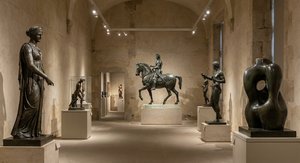
While many recognize Codner for his ability to capture the human likeness, his contributions to the sculptural arts remain a cornerstone of his legacy. His reputation reached international heights through monumental commissions for the Bode Museum in Berlin, Germany. In works such as “The Shepherd,” Codner demonstrated an extraordinary ability to translate Impressionistic ideals—the play of light and the texture of nature—into three-dimensional reality. He approached sculpture not merely as a study of anatomy, but as an exploration of surface and emotion, much like his approach to painting.
In his paintings, Codner often employed a technique reminiscent of sculptural depth, utilizing textured impasto to create palpable irregularities on the canvas. This thick application of paint allowed him to mimic the rugged textures of the natural world, lending his landscapes an extraordinary level of detail and emotional weight. Whether he was working in the medium of clay or oil, his goal remained constant: to capture the essence of a subject through a sophisticated interplay of light, shadow, and physical presence.
The Portraitist to the Elite
Beyond the sweeping vistas of the countryside, Codner’s brush was frequently called upon to document the faces of his age. He became one of Britain's most sought-after portrait painters, possessing a rare ability to convey both the social stature and the inner humanity of his subjects. His portfolio serves as a historical record of mid-century British society, featuring an array of notable figures including:
- King George VI, captured with the dignity befitting his reign;
- Queen Elizabeth, the Queen Mother, in a portrait that stands as a testament to his skill in capturing grace;
- The celebrated singer Kathleen Ferrier;
- Prominent theatrical figures such as Athene Seyler and Evelyn Laye;
- Distinguished leaders like Lord Alexander of Tunis and Gwilym Lloyd-George.
This prolific career in portraiture was supported by his active involvement in prestigious artistic institutions. As a member and former honorary secretary of the Royal Society of Portrait Painters (RP), as well as a member of the Royal Academy (RA), the New English Art Club (NEAC), and the Paris Salon, Codner was deeply embedded in the professional fabric of the art world. His work did not merely exist within galleries; it lived within the halls of power and the hearts of the public, bridging the gap between high art and historical commemoration. When he passed away on March 10, 1958, he left behind a body of work that remains a vital window into the soul of a bygone Britain.
Q&A
Maurice Frederick Codner의 작품을 분위기별로 모아둔 곳은 어디인가요?
Maurice Frederick Codner의 작품은 각 작품이 지닌 분위기에 따라 분류된 무드 룸 페이지에서 무드별로 감상하실 수 있습니다.
Maurice Frederick Codner의 작품 중 몇 점을 둘러보실 수 있나요?
전체 작품 보기 페이지에서 Maurice Frederick Codner의 작품 작품 17점점을 만나보실 수 있습니다.
Maurice Frederick Codner 작가의 작품 관련 통계 정보는 어디에서 확인할 수 있나요?
Maurice Frederick Codner 작가의 작품 통계 정보는 방문 통계 페이지에서 확인하실 수 있습니다.