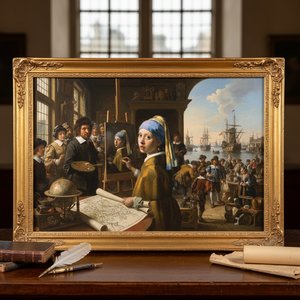
The Legacy of a Delft Master
Born into the vibrant, industrious atmosphere of Delft in 1673, Nicolaas Verkolje was destined for a life defined by the precision of the brush and the depth of the burin. As the son of the respected painter Johannes Verkolje I, his early years were steeped in the technical rigors of the Dutch artistic tradition. This familial apprenticeship provided far more than mere instruction; it offered a profound connection to a lineage of masters, fostering an environment where technical mastery was as much a birthright as a learned skill. Alongside his brother Jan II, Nicolaas mastered not only the delicate application of oil on canvas but also the intricate, velvety depths of mezzotint printmaking. This dual mastery allowed him to navigate both the intimate world of portraiture and the expansive realm of graphic arts, eventually establishing a successful studio in Amsterdam that would command attention across the Netherlands.
A Symphony of Detail and Science
Verkolje’s artistry was characterized by an almost scientific devotion to the natural world, reflecting the burgeoning curiosity of the Enlightenment era. While many of his contemporaries embraced the sweeping, emotive brushwork of the high Baroque, Nicolaas pursued a path of unwavering precision. His works often functioned as windows into the minute wonders of nature, capturing the delicate textures of flora and fauna with a clarity that bordered on the botanical. This meticulousness was not merely a technical feat but an emotional one; he sought to convey the very essence of his subjects, translating the tactile reality of a petal or the subtle sheen of silk into a visual language of remarkable accuracy. His style was a sophisticated tapestry woven from the influences of the great Dutch masters, including:
- Gerard Dou, whose legendary fine-grained detail informed Verkolje's precision;
- Godfried Schalcken, and his evocative mastery of light and shadow;
- Adriaen van der Werff, whose classicistic elegance shaped his later compositions.
Through this synthesis of styles, Verkolje developed a "velvet touch"—a technique that allowed him to blend the sharp edges of scientific observation with the soft, luminous atmosphere required for grander, more poetic narratives.
Grandeur in Allegory and Light
As his career progressed, Verkolje demonstrated a remarkable versatility, moving from the quiet intimacy of portraiture to the monumental scale of history painting. He became a storyteller of the divine and the heroic, capable of breathing life into complex mythological and biblical narratives with a dynamic energy that felt both fresh and timeless. His ability to handle large-scale compositions was perhaps most brilliantly realized in his allegorical works commissioned by powerful institutions like the Dutch East India Company (VOC). In masterpieces such as the Apotheosis of the Dutch East India Company, he utilized rich color palettes and complex symbolism to transform political tribute into high art. By merging the classicistic restraint of his training with a burgeoning sense of movement and drama, Nicolaas Verkolje secured his place as a pivotal figure in the transition from the Baroque era to the refined elegance of the 18th century, leaving behind a legacy of beauty, accuracy, and profound narrative depth.
질의응답
주제별로 Nicolaas Verkolje의 작품을 탐색할 수 있나요?
주제별 아틀라스 페이지에서는 Nicolaas Verkolje의 작품들을 주제별로 찾아보실 수 있습니다.
Nicolaas Verkolje의 작품 중 몇 점을 둘러보실 수 있나요?
모든 작품 보기 페이지에서 Nicolaas Verkolje의 작품 작품 41점점을 만나보실 수 있습니다.
Nicolaas Verkolje의 출생 도시와 국가는 어디인가요?
Nicolaas Verkolje은(는) Netherlands의 Delft에서 태어났습니다.