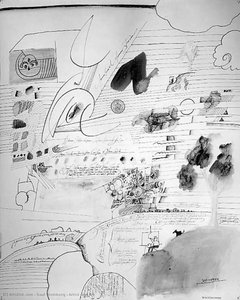
The Writer in Line: The Visionary World of Saul Steinberg
To encounter the work of Saul Steinberg is to step into a realm where the boundaries between thought and line, between reality and metaphor, begin to dissolve. Often described by the man himself as “a writer who draws,” Steinberg did not merely illustrate; he used the tip of his pen to reason on paper, constructing complex philosophical inquiries through the deceptively simple medium of ink. His journey began in Râmnicu Sărat, Romania, born into a family of Russian Jewish descent, and was shaped by a life defined by movement, displacement, and an ever-watchful eye for the absurdities of modern existence. This profound sense of observation would later become the heartbeat of his most iconic contributions to The New Yorker, where he transformed the printed page into a stage for surrealist exploration.
His artistic foundation was built upon a unique intersection of literature and architecture. After initial studies in Bucharest, Steinberg moved to Milan in 1933 to study at the Polytechnic University, graduating with honors in 1940. This architectural training provided him with an unparalleled mastery of spatial reasoning—a skill that allowed him to manipulate perspective and scale with breathtaking wit. He understood how a single line could define a horizon or collapse a city into a mere scribble. However, the rising tide of antisemitic legislation in Europe forced him into a life of transit, leading him through the Dominican Republic before he finally reached New York City in 1942. This period of upheaval instilled in his work a deep sensitivity to the fragility of structures, both physical and social.
A Cartography of the Mind
Steinberg’s career is inextricably linked to the golden age of American illustration, yet his work transcends the traditional boundaries of cartooning. While he gained widespread fame for his whimsical and often biting commentary in The New Yorker, his true subject was the human condition. He possessed an uncanny ability to capture the masquerades of modern life, using a cast of characters that ranged from ordinary citizens to surrealist creatures like crocodiles and cats, often interspersed with punctuation marks and architectural monuments. In masterpieces such as View of the World from 9th Avenue, he achieved a legendary status, creating a visual metaphor for how our personal perspectives shape our understanding of the vast, chaotic world.
His technique was characterized by a brilliant economy of means. He could convey profound social commentary through visual puns and intricate, layered compositions that invited the viewer to linger. His work often functioned as a riddle, where:
- Simple, expressive lines masked deep intellectual complexity.
- Abstract forms merged with recognizable urban grit to create a sense of "urban surrealism."
- The use of negative space and architectural elements created a tension between the void and the populated world.
Legacy and Artistic Significance
The historical significance of Saul Steinberg lies in his ability to bridge the gap between high art and popular illustration. He was a fixture in the prestigious galleries of New York, exhibiting alongside giants like Arshile Gorky and Robert Motherwell, yet he remained a beloved figure in the pages of mass-circulation periodicals. This duality allowed him to influence a generation of graphic artists, teaching them that the line could be both a tool for humor and a vessel for profound existential inquiry. His marriage to the painter Hedda Sterne further enriched his creative environment, placing him at the center of a vibrant, interconnected mid-century art scene.
Even as the world changed around him, Steinberg’s dedication to the act of reasoning on paper remained steadfast. He left behind an immense body of work that continues to resonate in museums and collections worldwide, from the Smithsonian American Art Museum to the archives of the most storied publications. His legacy is found in every artist who dares to use a simple stroke of ink to challenge our perceptions of space, identity, and the very nature of reality. He remains a master of the visual metaphor, reminding us that even in a fragmented world, there is a profound, interconnected beauty to be found in the way we choose to see it.
Q&A
Saul Steinberg의 출생지와 출생 연도는 어떻게 되나요?
Saul Steinberg은(는) 1914년 Râmnicu Sărat에서 태어났습니다.
Saul Steinberg의 작품 중 몇 점을 둘러보실 수 있나요?
전체 작품 보기 페이지에서 Saul Steinberg의 작품 작품 13점점을 만나보실 수 있습니다.
Saul Steinberg의 다른 이름이나 별칭에는 무엇이 있나요?
Saul Steinberg은(는) Saul Erik Steinberg, ساول شتاينبرغ, ソール・スタインバーグ, Сол Стейнберг, 索尔·斯坦伯格(으)로도 알려져 있습니다.