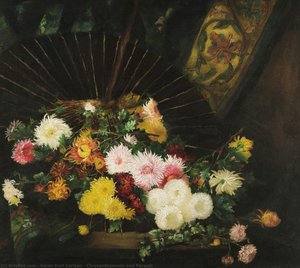
Early Life and Artistic Foundations
Søren Emil Carlsen, born in Copenhagen around October 19, 1848, embarked on a journey that would lead him from the structured world of architectural study to become one of America’s most esteemed still life and landscape painters. Though biographical details remain somewhat elusive, his early upbringing within an artistic family—his mother was a painter, and accounts suggest a cousin held a directorial position at the Danish Royal Academy—clearly fostered an initial inclination toward visual expression. Carlsen initially pursued architecture at the Royal Danish Academy for four years, a discipline that undoubtedly instilled in him a keen sense of form and spatial relationships, qualities that would later become hallmarks of his compositions. However, by 1872, a compelling desire to dedicate himself fully to painting prompted his emigration to the United States, specifically settling in Chicago.
Upon arriving in America, Carlsen made a curious decision—altering his birth year to 1853, a change that has persisted in many publications. This subtle act perhaps signaled a conscious effort to forge a new identity within his adopted homeland. He quickly established himself as an educator, becoming the first teacher of drawing and painting at the Chicago Academy of Design. Yet, Carlsen’s ambition extended beyond teaching; he sought further refinement of his skills, leading him on a pivotal journey to Paris in 1875.
The Influence of Chardin and Early American Impressions
Carlsen's time in Paris proved transformative. He came under the spell of Jean-Baptiste-Siméon Chardin, the celebrated French still life master. Chardin’s influence is readily apparent in Carlsen’s early work—a quiet intimacy, a meticulous attention to detail, and a profound respect for the dignity of everyday objects. Upon his return to the United States, he initially settled in New York City, attempting to establish himself as a painter within a burgeoning art scene. However, financial struggles were persistent, prompting a move to Boston where he found some temporary success.
Despite these challenges, Carlsen remained committed to still life painting, even as the broader art community showed limited appreciation for the genre. He befriended fellow artists like John Francis Murphy and Childe Hassam, forging connections that would shape his artistic trajectory. His early compositions—often referred to as “kitchen still lifes”—featured arrangements of fish or birds alongside humble cookware, evoking a sense of domesticity and suggesting the unseen presence of life beyond the canvas. These works, while rooted in Dutch and Spanish traditions, began to reveal Carlsen’s distinctive sensitivity to color, light, and composition.
A Steadfast Vision: Landscapes and Seascapes
After a period in Paris beginning in 1884, Carlsen relocated to San Francisco in 1887, assuming the directorship of the San Francisco Art Association School before returning to New York in 1891. It was during this final decade of the nineteenth century that his artistic vision truly crystallized. Despite encouragement to explore more commercially viable subjects like landscapes and seascapes, Carlsen remained steadfast in his dedication to still life. He sensed he was on the cusp of something significant—a deeper exploration of form, texture, and the emotional resonance of shadow.
Gradually moving away from traditional arrangements, Carlsen became captivated by the interplay of light on metallic surfaces—copper, bronze, brass, and silver vessels taking center stage. His compositions grew increasingly decontextualized, valuing objects not for their function but for their singular presence. Removed from ordinary use and bathed in subdued light, they existed within a contemplative realm where even darkness seemed to radiate color. This period marked a turning point—a shift toward a more cerebral and metaphysical approach to still life painting.
Recognition and Legacy
Financial success eluded Carlsen for much of his career, arriving only in the 1910s and 1920s. However, he consistently earned the respect of his peers, being elected to membership in the prestigious National Academy of Design. For over forty years, he was a respected teacher in Chicago, San Francisco, and New York, shaping generations of artists with his patient guidance and unwavering commitment to artistic principles.
At his death in 1932, Carlsen stood at the height of his popularity. He left behind a body of work that redefined the potential of still life painting—elevating it from a mere depiction of objects to a profound exploration of form, light, and emotion. His son, Dines Carlsen, continued the family artistic legacy, further exploring color, light, and texture in his own distinctive style. Today, Emil Carlsen is recognized as one of the most important American painters of the late nineteenth and early twentieth centuries—a master of subtlety whose work continues to captivate and inspire.
- Key Influences: Jean-Baptiste-Siméon Chardin, Dutch still life masters, Lauritz Holst
- Major Themes: Still Life, Landscapes, Marine Painting, Tonalism, American Impressionism
- Notable Achievements: Election to the National Academy of Design, Respected Art Educator, Redefined the potential of still life painting.
Q&A
Søren Emil Carlsen의 전 작품에 걸친 색채 활용을 살펴볼 수 있을까요?
Søren Emil Carlsen의 팔레트 지놈에서는 작가의 작품 세계를 구성하는 컬러 프로필을 확인하실 수 있습니다.
Søren Emil Carlsen의 작품을 컬러 팔레트별로 둘러볼 수 있나요?
특정 색상 팔레트의 Søren Emil Carlsen 작품을 찾으시려면, 작가의 컬러 팔레트별로 보기 페이지를 이용해 보세요.
Søren Emil Carlsen의 작품을 색상별로 정렬해서 볼 수 있나요?
Søren Emil Carlsen의 작품은 작가의 컬러 인덱스 페이지에서 색상별로 감상하실 수 있습니다.