George Hyde Chambers (1803 – 1840): A Victorian Mariner’s Eye
George Hyde Chambers was born in London on October 23, 1803, the son of George Chambers Sr., a solicitor, and Eliza Jane (née Smith). His early life remains somewhat obscure, but he demonstrated an aptitude for drawing from a young age, fostering a passion that would define his artistic career. Despite facing considerable challenges during his formative years—including a debilitating illness that threatened to curtail his ambitions—Chambers persevered with unwavering determination, ultimately establishing himself as a respected watercolorist specializing in maritime subjects and urban landscapes of Victorian London.- Early Life & Education: Chambers’s formal education was interrupted by polio at the age of seven, leaving him with significant mobility limitations. However, his parents recognized his artistic talent and encouraged him to pursue drawing diligently despite physical obstacles.
- Training & Influences: He studied under John Ruskin in Oxford, absorbing Ruskin's profound appreciation for nature and its role in moral contemplation—influences that would permeate Chambers’s artistic vision. Ruskin championed the importance of capturing the sublime beauty of the natural world with honesty and sensitivity, a principle Chambers wholeheartedly embraced.
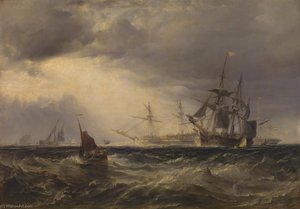
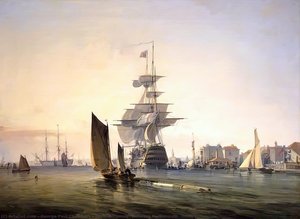
- Maritime Artistry: Chambers gained renown for his meticulous depictions of Dutch ships and London harbors. His canvases conveyed not merely visual accuracy but also an emotional resonance—a palpable sense of atmosphere and movement that transported viewers into the bustling ports of Victorian England.
Notable Works & Artistic Style
Chambers’s artistic style was characterized by a remarkable blend of realism and tonal subtlety. He meticulously observed details of ship construction, rigging, and crew activity, rendering them with painstaking precision. Simultaneously, he employed atmospheric perspective—a technique pioneered by Ruskin—to create depth and luminosity within his paintings. Chambers skillfully manipulated color palettes to evoke mood and emotion, favoring muted hues that conveyed the solemn grandeur of maritime vistas and the gritty textures of urban life.- “Fire at the Theatre, Skate Lane” (1823): This dramatic watercolor captures a devastating blaze that engulfed Skate Lane in London. Chambers’s masterful use of chiaroscuro—the interplay between light and shadow—heightens the emotional impact of the scene, conveying both terror and resilience.
- “A Dutch Pinck and Other Vessels” (circa 1840): This evocative painting exemplifies Chambers's dedication to capturing the essence of maritime life. The artist’s meticulous rendering of the ship’s hull, sails, and rigging conveys a profound understanding of naval engineering and craftsmanship.
Legacy & Historical Significance
George Hyde Chambers died unexpectedly in 1840 at the young age of 36, leaving behind a legacy of approximately sixty paintings—primarily watercolors—that continue to captivate audiences today. His work stands as a testament to Victorian artistic idealism and Ruskinian influence, embodying the Romantic spirit’s fascination with sublime landscapes and its commitment to portraying reality with unflinching honesty. Chambers's meticulous observation and tonal mastery cemented his place among the foremost watercolorists of his era, securing his enduring recognition as a pivotal figure in British art history. His paintings offer invaluable insights into Victorian society and maritime culture—a poignant reminder of a bygone age rendered with exquisite artistic skill.Further Exploration
For more information about George Hyde Chambers’s life and work, consult resources such as Art UK (질의응답
Sr George Paul Chambers의 작품을 색상별로 정렬해서 볼 수 있나요?
Sr George Paul Chambers의 작품은 작가의 색상별 인덱스 페이지에서 색상별로 살펴보실 수 있습니다.
Sr George Paul Chambers 작가 작품의 컬러 프로필은 어디에서 확인할 수 있나요?
Sr George Paul Chambers의 팔레트 지놈는 작가의 작품 세계를 구성하는 컬러 프로필을 보여주는 페이지입니다.
Sr George Paul Chambers의 작품을 팔레트별로 모아둔 곳은 어디인가요?
특정 색상 팔레트의 Sr George Paul Chambers 작품을 찾으시려면, 작가의 컬러 팔레트별 페이지를 이용해 보세요.