A Childhood of Shadows and Watchmaking
In the coastal town of Kragerø, a young boy named Theodor Kittelsen learned early that life could be as unpredictable as the sea. Following the death of his father, the family faced lean years, and at only eleven years old, the boy was apprenticed to a watchmaker. This period of precision and small, mechanical movements perhaps prepared him for the meticulous detail found in his later drawings. Though he spent his days among gears and springs, his eyes were always wandering toward the edges of the woods and the depths of the fjords.
His path changed when a patron, Diderich Maria Aall, recognized the raw talent hidden within the young apprentice. This support allowed him to enter Wilhelm von Hannø’s drawing school in Christiania. He eventually traveled to Munich to refine his craft, though the weight of financial necessity often pulled him back to the practicalities of survival. For a time, he worked as a draftsman for German newspapers and magazines, a disciplined existence that sharpened his ability to communicate through line and shadow.
The Breath of the Norwegian Wild
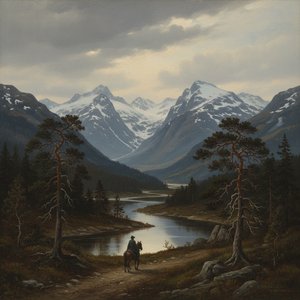
A scholarship to Paris in 1882 brought new light to his work, exposing him to the techniques of Impressionism. Yet, it was the return to Norway that truly defined his spirit. In the Lofoten Islands, living near the Skomvær Lighthouse, he found a landscape that spoke to him with a voice of its own. The rugged coast and the shifting northern light became more than mere scenery; they became characters in a larger story. He began to write texts alongside his drawings, weaving prose into the very fabric of his visual world.
His most enduring contribution emerged through his long collaboration illustrating Norwegian folktales. By bringing creatures like trolls and gnomes into a realistic natural setting, he bridged the gap between the seen and the unseen. He possessed a rare ability to place a supernatural entity within a recognizable forest or mountain, making the fantastic feel heavy and real. His work often balanced at the edge of reality, where a twisted tree trunk might suddenly reveal itself as a sleeping beast.
A Legacy Written in Ink and Oil
The later years of his life were spent at Lauvlia, an artist studio near Prestfoss, where he produced some of his most significant work. Despite the honors bestowed upon him, such as being named a Knight of the Royal Norwegian Order of St. Olav, his personal circumstances grew difficult. Failing health and financial struggles eventually forced the sale of his beloved studio in 1910. He passed away in Jeløya, leaving behind a body of work that had become inseparable from the identity of his homeland.
His artistic output was diverse, spanning many methods:
- Oil paintings that captured the somber moods of Victorian portraits and landscape scenes.
- Graphite and pen drawings used to illustrate the legends of Asbjørnsen and Moe.
- Watercolor and charcoal works that explored the textures of the Norwegian wilderness.
Through his eyes, the Norwegian landscape was never empty; it was a place inhabited by memory, myth, and a quiet, haunting beauty.
질의응답
Theodor Kittelsen 작가 작품에 대한 통계 정보는 어디에서 확인할 수 있나요?
Theodor Kittelsen 작가 작품에 관한 통계 정보는 작가의 통계 페이지에서 확인하실 수 있습니다.
특정 매체로 분류된 Theodor Kittelsen의 모든 작품을 어떻게 찾을 수 있나요?
모든 매체 페이지에서는 Theodor Kittelsen의 작품을 기법별로 모아볼 수 있습니다.
Theodor Kittelsen의 연도별 활동 기록이 있나요?
Theodor Kittelsen의 작품 세계를 시간순으로 정리한 기록은 아티스트 연대기 페이지에서 확인하실 수 있으며, 이곳에서는 각 시기별로 분류된 챕터를 따라 작품들을 제작 순서대로 만나보실 수 있습니다.