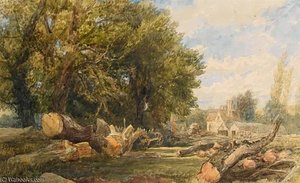
The Quiet Mastery of Thomas Collier
In the annals of English landscape painting, few names evoke the serene and unpretentious beauty of the countryside quite like Thomas Collier. A master of the watercolour medium, Collier possessed a rare ability to capture the atmospheric essence of the natural world without ever succumbing to the need for theatricality or popular pandering. Born in Glossop, Derbyshire, he was the son of a prosperous grocer and tea dealer, a background that provided him with the financial independence necessary to pursue his artistic passions on his own terms. This freedom allowed him to wander through the landscapes of the Suffolk countryside and the lush terrains of northern Wales, seeking out those quiet, evocative moments that define the true spirit of the British landscape.
His artistic journey was deeply shaped by his early training at the Manchester School of Art. Inspired by the legendary David Cox, Collier sought to emulate a sense of naturalism and light that felt both grounded and ethereal. During the years between 1864 and 1869, he resided in Betws-y-Coed, a period that undoubtedly deepened his connection to the rugged beauty of the Welsh landscape. His technical prowess was not merely about the application of pigment but about the layering of washes to create depth, light, and a palpable sense of atmosphere. This dedication to the craft eventually led to his election to the New Water Colour Society in London around 1870, marking his emergence as a significant figure within the professional art community.
A Legacy of Light and Landscape
Collier’s work is characterized by an industrious yet refined approach. While he was not a prolific exhibitor, those who encountered his paintings often found themselves captivated by his ability to render the subtle nuances of nature. His friendships with fellow artists, such as Edmund Morison Wimperis and Charles Stuart Millard, created a vibrant circle of influence that enriched the landscape tradition of his era. He was a painter who could find profound beauty in a simple forest scene or an expansive view of sheep on a track, imbuing even the most modest subjects with a sense of timelessness.
His achievements were recognized far beyond the borders of England. In 1878, his talent earned him the prestigious distinction of being made a Chevalier of the Legion of Honour following the presentation of a painting to the Paris International Exhibition. This international acclaim underscored the universal appeal of his vision. Even as he established a grand studio at Hampstead Hill Gardens in 1879, Collier remained focused on the intrinsic qualities of his subject matter. His life and work remain a testament to the power of the landscape watercolour to convey the profound tranquility and enduring charm of the natural world.