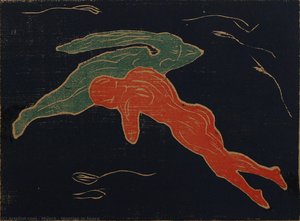
Acrylic On Canvas.

§ 1Catalogue data

§ 2Abstract
Kolekcinio objekto aprašas
This artwork is a black and white portrait of a woman by Edvard Munch, embodying Expressionism’s focus on emotion.
 Skaityti daugiau
Autoriaus biografija
Pažinkite Edvardą Munchą (1863–1944), ekspresionizmo pionierį! Atraskite jo ikoninius kūrinius, pavyzdžiui, 'Šauksmą', bei meno tyrinimus apie nerimą, mirtį, meilę ir psichologines temas. Norvegų dailininkas, paveikęs XX a. avangardą.
§ 3Commentary
A Somber Reflection: Edvard Munch’s ‘Untitled (3515)’
Edvard Munch's “Untitled (3515)” stands as a haunting emblem of Expressionism, capturing the pervasive dread and psychological turmoil characteristic of its era. Painted around 1899, this monochrome portrait delves into the depths of human emotion with unsettling precision—a testament to Munch’s unwavering commitment to conveying inner experience rather than merely representing external reality.
Composition & Technique: Embracing Fluidity
The painting employs a deceptively simple frontal composition. A woman dominates the vertical space, flanked by two indistinct figures that heighten the sense of isolation surrounding her central presence. Munch’s masterful technique—loose brushstrokes and subtle blending—creates an atmosphere of palpable unease. The canvas is treated with oil paints, layering them to achieve textural depth and capturing the ethereal quality of Munch's vision.
Color Palette & Lighting: Absence Speaks Volumes
Strikingly devoid of color, “Untitled (3515)” relies on shades of black, grey, and white—a deliberate choice that amplifies the painting’s emotional impact. The diffused lighting casts shadows across the woman's face and body, emphasizing her expression and contributing to a dramatic mood. This subdued palette underscores Munch’s preoccupation with darkness and melancholy, mirroring the anxieties he sought to portray.
Symbolic Resonance: Fear and Vulnerability
Beyond its formal elements, “Untitled (3515)” resonates with profound symbolic significance. The woman's gaze—direct yet melancholic—suggests a confrontation with inner turmoil. The two figures on either side symbolize the inescapable presence of external forces shaping our internal landscape. Munch’s exploration of themes like fear and vulnerability aligns perfectly with the broader anxieties of the fin de siècle, cementing “Untitled (3515)” as an enduring masterpiece.
Historical Context & Legacy
Created during Munch's formative years—influenced by Nietzschean philosophy and personal experiences marked by illness and loss—the painting embodies the spirit of Expressionism. Its impact extends far beyond its time, inspiring artists and writers alike to grapple with existential questions. Today, reproductions of “Untitled (3515)” continue to captivate audiences worldwide, serving as a poignant reminder of Munch’s ability to distill complex emotions into unforgettable visual imagery.
Klausimai ir atsakymai
Ką vaizduoja „untitled (3515)“ – Edvardas Munkas ir kokią nuota sukelia?
„untitled (3515)“ – Edvardas Munkas sujungia woman, portrait, darkness, isolation, melancholy, shadows, atmosphere ir Dramatic atmosferą.
Ar „untitled (3515)“ kūrijas Edvardas Munkas žinomas에도 kitais vardais?
Kiti Edvardas Munkas, „untitled (3515)“ kūrybos autoriaus, vardai apima Edvard Munch, E. Munkas.
Kur rekomenduojama eksponuoti „untitled (3515)“ Portrait formatą?
„untitled (3515)“ – Edvardas Munkas formatas Portrait rekomenduojamas Living Room erdvėje. Formatas ir erdvė kartu padeda tinkamai išdėsti reprodukciją.


 Perjungti į spausdinamus版作品


 Dėl meno kūrinių ar reprodukcijų, kurių bet kuri pusė yra didesnė nei 105 cm (apie 41 inch), rėmas bus siunčiamas kaip išskaidytas surinkimo rinkinys. Šis metodas užtikrina saugų pristatymą ir apsaugo nuo transportavimo metu galimos žalos.