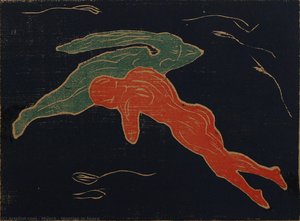
Acrylic On Canvas.

§ 1Katalogo duomenys


§ 2Abstraktus
Kolekcinio objekto aprašas
The meta description focuses on key elements: the artwork's subject matter, artistic style (expressionism), and emotional themes (distress, isolation, anxiety).
 Skaityti daugiau
Autoriaus biografija
Ekspresionizmo pionierius Edvardas Munchas sukūrė ikonikos „Šauksmą“. Atraskite jo šiurbius nerimo ir emocijų šedevralius jau šiandien.
§ 3Komentaras
The Haunting Echo of Anxiety: An Exploration of Edvard Munch's "Untitled (4776)"
Edvard Munch’s “Untitled (4776),” a stark black and white depiction of a woman with her hands clasped to her head, isn’t merely a portrait; it’s a visceral embodiment of existential dread. Created around the turn of the 20th century, this work stands as a cornerstone of Expressionism, capturing not just an image but a profound emotional state—a feeling of overwhelming distress and isolation that continues to resonate powerfully with viewers today. The painting's power lies in its deliberate ambiguity; we don’t know the woman’s story, her specific source of anguish, yet her posture and the desolate landscape surrounding her speak volumes about the universal experience of suffering.
Munch, a figure deeply scarred by personal tragedy – the early deaths of his mother and sister from tuberculosis, coupled with his own struggles with mental illness – channeled these experiences into his art. His life was a relentless confrontation with mortality, disease, and the fragility of human existence, themes that permeate nearly every aspect of his oeuvre. “Untitled (4776)” is arguably one of the most potent expressions of this preoccupation, a raw and unflinching portrayal of psychological torment. The composition itself contributes to this sense of unease: the central figure dominates the frame, her face obscured, drawing our attention solely to her contorted hands and the palpable tension radiating from her body.
A Symphony of Color and Distortion: Munch’s Expressionist Technique
Despite its monochrome palette, “Untitled (4776)” is far from a simple black-and-white rendering. Munch masterfully employs tonal variations – subtle shifts in shade and texture – to create a sense of depth and movement. The background trees, rendered with swirling brushstrokes, seem to writhe and twist, mirroring the turmoil within the central figure. This deliberate distortion of form is characteristic of Expressionism, an artistic movement that sought to convey subjective emotions rather than objective reality. Munch’s technique isn't about precise representation; it’s about capturing the *feeling* of a moment—the suffocating weight of anxiety and despair.
The use of dry brushstrokes adds another layer of intensity, emphasizing the rawness and immediacy of the scene. Notice how Munch avoids smooth transitions, opting instead for abrupt shifts in tone that heighten the sense of agitation. This technique, combined with his masterful manipulation of light and shadow, creates a visual experience that is both unsettling and strangely compelling. The painting’s surface feels almost tactile—as if we could reach out and feel the woman's distress.
Symbolism and Context: Echoes of Munch’s World
The presence of the two figures in the background – one seated, the other standing – adds a layer of complexity to the painting. They represent an external world that seems oblivious to the central figure's suffering, further amplifying her isolation. These secondary figures could be interpreted as symbols of societal indifference or perhaps even the artist’s own feelings of alienation. The setting itself—a bleak, windswept landscape—reinforces this sense of desolation and loneliness.
Considering Munch’s biography, it's clear that “Untitled (4776)” is deeply rooted in his personal experiences. His father’s strict religious beliefs and his own struggles with mental illness created a climate of fear and uncertainty, themes that frequently appear in his work. The painting can be seen as a visual manifestation of Munch’s lifelong battle against anxiety, grief, and the pervasive sense of mortality that haunted him.
Bringing "Untitled (4776)" to Life: A AllPaintingsStore Reproduction
AllPaintingsStore is proud to offer meticulously crafted hand-painted reproductions of Edvard Munch's “Untitled (4776).” Our artists replicate the painting’s nuanced tonal variations, expressive brushstrokes, and haunting atmosphere with unparalleled skill. We use only archival-quality materials to ensure that your reproduction will last for generations to come. Whether you are a seasoned art collector, an interior designer seeking to evoke a sense of dramatic intensity, or simply someone captivated by Munch's profound vision, our reproductions provide a beautiful and authentic way to experience this iconic work of art. Explore the full detail and quality of our reproduction at here.
Klausimai ir atsakymai
Kam rekomenduojamas naudojimui „untitled (4776)“ spausdinys?
Rekomenduojamas naudojimo būdas kūriniui „untitled (4776)“ – Edvardas Munchas yra Statement. Jis taip pat gali būti naudojamas kitoms paskritis.
Ar „untitled (4776)“ – Edvardas Munchas priklauso viešosios teisės domenui?
Kalbant apie autorišką teisę, „untitled (4776)“ yra yra viešosios erdvės dalis – jo autorinė teisė pasibaigusi.
Kokio Edvardas Munchas kūrybos etapo dalis yra „untitled (4776)“?
„untitled (4776)“ atspindi Edvardas Munchas kūrybinį laikotarpį Mature Period.


 Perjungti į spausdinamus版作品


 Dėl meno kūrinių ar reprodukcijų, kurių bet kuri pusė yra didesnė nei 105 cm (apie 41 inch), rėmas bus siunčiamas kaip išskaidytas surinkimo rinkinys. Šis metodas užtikrina saugų pristatymą ir apsaugo nuo transportavimo metu galimos žalos.