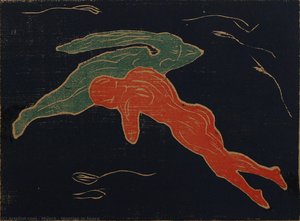
Oil On Canvas.

§ 1Katalogo duomenys

§ 2Abstraktus
Kolekcinio objekto aprašas
Explore Edvard Munch’s "untitled (6704)", a serene coastal landscape in an Impressionistic style. Discover its melancholic beauty & symbolic depth – a key piece of Norwegian art history.
 Skaityti daugiau
Autoriaus biografija
Pažinkite Edvardą Munchą (1863–1944), ekspresionizmo pionierį! Atraskite jo ikoninius kūrinius, pavyzdžiui, 'Šauksmą', bei meno tyrinimus apie nerimą, mirtį, meilę ir psichologines temas. Norvegų dailininkas, paveikęs XX a. avangardą.
§ 3Komentaras
A Coastal Reverie: Exploring Munch’s Untamed Landscape
This evocative landscape by Edvard Munch transports us to a serene yet melancholic coastal scene, likely captured during the fleeting moments of dusk or dawn. The artwork presents a sweeping vista – an elevated viewpoint overlooking a tranquil sea dotted with distant islands. It's a composition built on contrasts: the strong horizontals of water and land are punctuated by the verticality of trees and foliage, creating a dynamic tension within the peaceful setting.Impressionistic Echoes & Expressionist Roots
The painting’s style resides comfortably between Impressionism and Post-Impressionism, leaning heavily towards the emotional intensity that would come to define Munch's signature *Expressionism*. Loose, expressive brushstrokes dominate, eschewing precise realism in favor of capturing a feeling – an atmosphere. Shapes are organic, mirroring the natural world, and texture is richly apparent through visible paint application. The flattened perspective and atmospheric perspective (where distant objects appear paler and less defined) contribute to a dreamlike quality, inviting contemplation rather than literal interpretation.A Palette of Mood & Atmosphere
Munch masterfully employs a cool color palette – blues, purples, and greens – to establish the painting’s mood. These hues evoke serenity but also carry an undercurrent of melancholy. The diffused lighting, typical of twilight, casts soft shadows and subtly highlights the contours of the landscape. This technique enhances the sense of tranquility while simultaneously hinting at a deeper emotional resonance. The wet-on-wet technique is evident in the blending of colors, creating seamless transitions that further soften the scene.Munch’s Life & The Language of Landscape
To understand this work fully, it's crucial to consider Edvard Munch’s biography. Born into a world marked by loss and familial illness (his mother and sister both succumbed to tuberculosis), Munch grappled with themes of mortality, anxiety, and psychological distress throughout his life. While not overtly depicting these struggles here, the landscape itself becomes a vessel for them. The vastness of nature can be interpreted as reflecting the immensity of human emotion, while the solitude of the scene evokes feelings of isolation and contemplation – emotions deeply familiar to Munch’s own experience. His early exposure to nihilist philosophy encouraged him to express inner turmoil through art, rejecting academic conventions.Symbolism & Emotional Resonance
Beyond its aesthetic qualities, this painting resonates with symbolic weight. The coastal setting often represents the boundary between the known and the unknown, life and death – themes central to Munch’s oeuvre. The tranquil scene can be seen as a yearning for peace amidst inner turmoil, or perhaps a poignant acceptance of solitude. It's a landscape that doesn’t simply depict a place; it *feels* like a state of mind.Collecting & Interior Design Considerations
A reproduction of this artwork would be a stunning addition to any collection, particularly for those drawn to emotionally resonant landscapes. Its cool palette and atmospheric quality make it exceptionally versatile in interior design. It would complement spaces aiming for a calming, contemplative atmosphere – bedrooms, libraries, or living rooms with neutral color schemes. The painting’s subtle drama also lends itself well to modern interiors seeking a touch of artistic depth and sophistication. Consider pairing it with natural materials like wood and stone to enhance the connection to its coastal subject matter.Klausimai ir atsakymai
Kaip kūrinys „untitled (6704)“ dera su Edvardas Munkas temomis ir stiliumi?
„untitled (6704)“ kartu su kitais Edvardas Munkas kūriniais pasižymi Post-Impressionism stiliumi ir tamsiomis temomis: expressionist anxiety, symbolic landscape", nostalgia & solitude, psychological depth, scandinavian moods, precursor to scream, exploring inner turmoil.
Koks yra rekomenduojamas „untitled (6704)“ spausdinimo formatas – koks dydis ir orientacija?
Large dydis, Landscape orientacija: tai rekomenduojamas spausdinimo nustatymas kūriniui „untitled (6704)“ – Edvardas Munkas.
Kaip galiu peržiūrėti „untitled (6704)“ – Edvardas Munkas reprodukciją?
„untitled (6704)“ Peržiūra interjere puslapio funkcija leidžia peržiūrėti kūrinį prieš užsakant.


 Perjungti į spausdinamus版作品


 Dėl meno kūrinių ar reprodukcijų, kurių bet kuri pusė yra didesnė nei 105 cm (apie 41 inch), rėmas bus siunčiamas kaip išskaidytas surinkimo rinkinys. Šis metodas užtikrina saugų pristatymą ir apsaugo nuo transportavimo metu galimos žalos.