Acrylic On Canvas.

§ 1Catalogue data

§ 2Abstract
Kolekcinio objekto aprašas
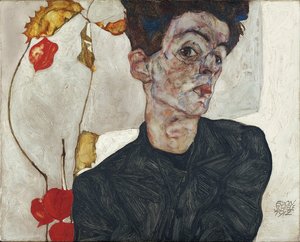
Explore Egon Schiele’s "untitled (9656)", a provocative ink drawing embodying Expressionism's raw emotion & dynamic lines. Discover this unique piece & Schiele’s legacy.
 Skaityti daugiau
Autoriaus biografija
Egon Šylė – Austrių ekspresionizmo dailininkas. Žiūrėkite į jo reikšmę Vienoje ir pasaulyje! Ekspresionistinio meno srovės atstovas, žinomas dėl savo psichologinės gilumo ir išraiškos.
§ 3Commentary
A Study in Sensuality and Line: Exploring Egon Schiele’s Untitled Figure
This captivating work by Egon Schiele is a prime example of his distinctive style – a potent blend of Art Nouveau's flowing lines with the raw emotionality that foreshadowed Expressionism. Executed with striking confidence, this untitled piece (9656) presents a female nude not as an idealized form, but as a powerfully present and psychologically charged figure.Subject & Composition
The composition focuses intently on the torso and legs of the subject, emphasizing the curves of the body through dynamic posing. It’s a deliberate cropping that heightens the intimacy and immediacy of the image. The pose itself is provocative, suggesting both vulnerability and defiance – a recurring theme in Schiele's oeuvre. Rather than aiming for anatomical precision, Schiele prioritizes capturing the *feeling* of the form, resulting in an intentionally distorted yet compelling representation.Style & Technique
Schiele’s masterful use of black ink against a pale yellow/cream background creates a dramatic contrast that accentuates the figure's contours. The lines are not merely outlines; they *are* the form, fluid and gestural, conveying movement and energy. Varying line weights and hatching techniques build depth and texture, adding visual interest despite the overall flatness of perspective. The technique suggests a rapid execution, almost as if Schiele were compelled to capture the image directly from his inner vision. It’s likely watercolor washes subtly enhance the shading and tonal variations within the ink drawing.Historical Context & Influences
Born in 1890, Schiele lived a tragically short life but left an indelible mark on early 20th-century art. He was part of a generation grappling with societal upheaval and exploring new modes of expression. Influenced by Gustav Klimt – whom he initially met as a student – Schiele quickly developed his own unique voice, pushing boundaries further into psychological territory. His work often courted controversy due to its frank depiction of sexuality and the human body, challenging conventional artistic norms. He was associated with the Vienna Secession movement, which rejected academic traditions in favor of experimentation.Symbolism & Emotional Impact
While not overtly symbolic, the artwork’s emotional resonance is undeniable. The subject's gaze (implied, though her face isn’t fully visible) and body language suggest a complex inner life – perhaps one of longing, vulnerability, or even rebellion. Schiele was deeply interested in exploring the psychological state of his subjects, and this piece embodies that fascination. The work evokes a sense of raw honesty and emotional intensity, inviting viewers to contemplate the complexities of human experience.Collecting & Interior Design
A reproduction of this artwork would be a striking addition to any collection focused on Expressionism or early 20th-century art. Its bold lines and dramatic contrast make it a visually arresting piece that can serve as a focal point in a variety of interior design schemes. It pairs well with minimalist décor, providing a powerful counterpoint to clean lines and neutral palettes. Alternatively, it complements more eclectic spaces, adding depth and sophistication. The artwork’s intimate scale makes it suitable for smaller rooms or as part of a gallery wall arrangement.Further Exploration
- Explore other works by Egon Schiele to understand the breadth of his artistic vision.
- Investigate the Vienna Secession movement and its impact on Austrian art.
- Consider artists like Broncia Koller-Pinell and Heinrich Böhler, contemporaries who shared similar stylistic concerns.
- Visit museums such as the Leopold Museum in Vienna or the Egon Schiele Art Centrum in Český Krumlov to experience his work firsthand.
Klausimai ir atsakymai
Ar „untitled (9656)“ – Egon Šylė yra portretinė, peisžinio tipo ar kvadratinė kompozicija?
„untitled (9656)“ – Egon Šylė kūrinio formatas yra Landscape. Formatas aprašo kompozicijos proporcijas.
Kuriame namų kambaryje gerai tiktų „untitled (9656)“ reprodukcija?
„untitled (9656)“ reprodukcija puikiai tinka į Living Room.
Iš kokios šalies kilęs Expressionism kūrinys „untitled (9656)“?
„untitled (9656)“ kūrybinę vadovavo Egon Šylė, gimęs/usi Austrija, remiantis Expressionism stiliaus tendencijomis. Kūrėjo kilmė sujungia šį kūrinį su Expressionism kryptimi, kurios atstovai iš Austrija taip pat laikosi.


 Perjungti į spausdinamus版作品


 Dėl meno kūrinių ar reprodukcijų, kurių bet kuri pusė yra didesnė nei 105 cm (apie 41 inch), rėmas bus siunčiamas kaip išskaidytas surinkimo rinkinys. Šis metodas užtikrina saugų pristatymą ir apsaugo nuo transportavimo metu galimos žalos.