- Home

- Op canvas afdrukken
- Benvenuto Cellini
- Study for a seal

 Voorvertoning
 Verstuur
 Delen
Delen
 Details bekijken

 Download
 Vergelijkbare werken
 Röntgenonderzoek
 Diavoorstelling
Study for a seal
 Acrylic On Canvas
- WallArt
- Renaissance Mannerism
 1560
1560 315.0 x 125.0 cm
 Louvre
 Lees meer
Giclée / Kunstafdruk
Giclée- of canvasafdruk van museumkwaliteit met snelle productie en flexibele afwerkingsopties. ( Schakel over naar handgeschilderd kunstwerk Wissel naar afbeelding)




P118B $10

P118H $10

P118W $10

P438Z $10

P508JH $12

P508YH $12

P805H $10

P805Z $10

P919BZ $10

P919G $10

P919XJ $10

P959ZH $10

P968JZ $12

W106C $8

W218G $10

W218JH $8

W218Y $10

W307PJ $10

W316G $10

W316PJ $8

W316Y $10

W398PJ $8

W4111J $10

W500HY $15

W500JH $15

W692G $12

W849H $8

W940BG $15

W953PJ $8




Kies uit onze vooraf ingestelde maten die overeenkomen met de originele verhoudingen van het kunstwerk.

U kunt uw eigen afmetingen opgeven om in een specifieke lijst of ruimte te passen. Als de door u gekozen maat niet overeenkomt met de proporties van het originele kunstwerk, zullen wij de afbeelding bijsnijden of uitbreiden met een gespiegelde of effen rand. Een digitaal mockup wordt ter goedkeuring naar u verzonden voordat de productie begint.
Houd er rekening mee dat de preview op het scherm de werkelijke bijsneding of uitbreiding niet weergeeft. Alleen de mockup toont de uiteindelijke compositie nauwkeurig.
Hoewel aangepaste maten beschikbaar zijn, raden wij aan een afmeting uit de vooraf bepaalde lijst te kiezen om de originele proporties te behouden.
Wereldwijde levering () binnen 2 weken in plaats van de standaard 4/5 weken. (30 juli)

Gratis wereldwijde expressverzending

Hoogwaardig linnen canvas

Volledige verzendverzekering

Garantie op terugbetaling van invoerrechten

Garantie op exacte kleurweergave

60 dagen retourbeleid (alleen bij defecten)

100% Geld-terug-garantie

Korting bij meerdere afnames
 De optie voor glas is alleen beschikbaar bij een formaat kleiner dan 110 cm.

Study for a seal
Giclée / Kunstafdruk
Afmetingen reproductie
-


Eindtotaal
$ 64
Beschrijving verzamelobject
Benvenuto Cellini’s “Study for a Seal”: A Glimpse into Renaissance Genius
The world of 16th-century Florence pulsed with artistic fervor, a crucible where innovation and tradition intertwined to forge masterpieces that continue to captivate us centuries later. Among the giants of this era stands Benvenuto Cellini, not merely a goldsmith or sculptor, but a polymath—a writer, musician, soldier, and above all, an intensely self-aware artist who meticulously documented his life and work in his celebrated autobiography. Within this rich tapestry of creativity lies “Study for a Seal,” a remarkably intimate pen drawing executed around 1560 and currently residing within the hallowed halls of the Musée du Louvre. This seemingly modest piece offers a profound window into Cellini’s artistic process, revealing a meticulous mind grappling with form, symbolism, and the very essence of Renaissance aesthetics.
The drawing itself is deceptively simple: an angelic or mythological figure, rendered in delicate pen lines, stands poised upon what appears to be a stylized serpent. The creature possesses a distinctly human-like quality—a noble face, expressive eyes—yet simultaneously boasts features that transcend the purely mortal; notably, its feathered wings and the suggestion of divine attributes. This deliberate ambiguity is characteristic of Cellini’s work – he frequently blurred the boundaries between the earthly and the celestial, reflecting his own complex personality and a fascination with both the tangible beauty of craftsmanship and the intangible realm of spiritual significance. The background remains strikingly minimalist, composed of geometric shapes and lines that serve not as mere decoration but rather to frame and elevate the central figure, drawing our attention entirely to this enigmatic being.
A Master’s Process: Technique and Materials
Cellini's mastery is immediately evident in the execution of “Study for a Seal.” The work is executed entirely with pen and ink on paper, a medium that allowed him unparalleled control over line weight and detail. Observe how he employs hatching to create subtle gradations of tone, suggesting volume and texture without resorting to shading. The precision of his lines speaks volumes about his dedication to craft; each stroke is deliberate, imbued with the artist’s considered hand. The paper itself bears the marks of time – slight discoloration and warping—testaments to its age but also adding a layer of authenticity and historical resonance. It's not simply a drawing; it’s a tangible record of a creative journey, offering a rare glimpse into the mind of a master at work.
Symbolism and Context: The Seal of Florence
The “Study for a Seal” is inextricably linked to the burgeoning artistic and political landscape of Florence in the mid-16th century. In 1562, the Accademia del Disegno—the Florentine Academy of Drawing—was formally established, marking a pivotal moment in the development of Renaissance art theory and practice. The academy sought to establish standards for artistic training and patronage, and naturally required an official seal to authenticate its documents and represent its authority. Cellini, already a celebrated artist with connections to powerful figures like Francis I of France, was commissioned to design this emblem. The drawing itself is believed to be a preliminary study for the final seal, offering insights into Cellini’s initial conceptualization of the design.
The symbolism embedded within the image is rich and layered. The central figure, often interpreted as an angelic or mythological being, likely represents a deity or allegorical figure associated with wisdom, justice, or divine grace—themes frequently explored in Renaissance art. The serpent beneath suggests both temptation and transformation, reflecting the complex moral landscape of the era. The geometric background may allude to architectural principles, reinforcing the idea that art was not merely decorative but also served as a means of communicating profound philosophical and spiritual truths. It’s important to note that Cellini himself meticulously documented his artistic process in his autobiography, revealing a deep engagement with the intellectual currents of his time.
A Legacy of Craftsmanship: Reproduction Possibilities
“Study for a Seal” stands as a testament to Benvenuto Cellini's extraordinary talent and enduring legacy. Its intricate detail, evocative symbolism, and historical significance make it a truly remarkable work of art. For those seeking to experience the beauty and artistry of this masterpiece firsthand, high-quality reproductions are available through AllPaintingsStore.com. These meticulously crafted oil paintings capture the essence of Cellini’s original drawing, allowing you to bring a piece of Renaissance genius into your home or office. Consider this reproduction not merely as an image but as a portal—a connection to a world of artistic innovation and profound human expression.
Vergelijkbare kunstwerken


Biografie van de kunstenaar
Benvenuto Cellini: Een Renaissance Genie
Benvenuto Cellini, geboren in Florence in 1500 en overleden in 1571, was meer dan slechts een kunstenaar; hij belichaamde de geest van de Italiaanse renaissance. Een goudsmid, beeldhouwer, soldaat, musicus én schrijver – zijn leven was een bruisende mix van passie, ambitie en avontuur, vastgelegd in een autobiografie die even kleurrijk is als zijn kunstwerken. Cellini staat symbool voor het maniërisme, een stijlperiode die volgde op de hoogrenaissance en zich kenmerkte door dramatische flair, complexe composities en een verfijnde elegantie.
Van Muziek naar Metaal: Een Artistieke Opleiding
Cellini’s jeugd was doordrenkt van muziek; zijn vader was een befaamd musicus en instrumentmaker. Aanvankelijk toonde hij zelf ook muzikale aanleg, maar op vijftienjarige leeftijd koesterde hij een onwrikbare passie voor het goudsmidwerk. Tegen de bedenkingen van zijn vader in, werd hij leerling bij Antonio di Sandro, beter bekend als Marcone. Deze beslissing zou zijn leven vormgeven. Zijn vroege jaren waren niet zonder tegenslag; een schermutseling op zestienjarige leeftijd leidde tot ballingschap uit Florence en een periode werken onder de goudsmid Fracastoro in Siena. Deze ervaringen, hoewel turbulent, scherpten zijn vaardigheden en versterkten zijn vastberadenheid.
Meesterwerken in Goud en Brons: De Kunst van Cellini
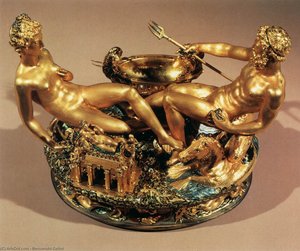
Cellini’s artistieke nalatenschap is rijk en divers. Zijn goudwerk, met name het beroemde zoutvat voor koning Franciscus I van Frankrijk, getuigt van een ongeëvenaarde beheersing van detail en compositie. Het zoutvat, nu te bewonderen in het Kunsthistorisches Museum in Wenen, is meer dan slechts een functioneel object; het is een sculpturale tour de force vol dynamische figuren en ingewikkelde decoraties. Maar Cellini’s bekendste werk blijft wellicht ‘Perseus met het hoofd van Medusa’, een bronzen beeldhouwwerk dat in de Loggia dei Lanzi in Florence staat. Dit monumentale kunstwerk, gegoten in één stuk – een technisch hoogstandje – toont Perseus triomfantelijk over de verslagen Medusa. De expressie van beweging en emotie die Cellini wist vast te leggen in het metaal is werkelijk adembenemend.
Een Leven Vol Avontuur: Soldaat, Schrijver en Self-Made Man
Cellini was niet alleen een kunstenaar; hij was ook een soldaat, die deelnam aan belegeringen en beweerde een cruciale rol te hebben gespeeld bij de verdediging van Rome. Hij was een begaafd musicus, die cornett en fluit bespeelde aan het pauselijk hof. Maar het is zijn autobiografie die hem echt onderscheidt. Dit openhartige en soms opschepperige verslag biedt een unieke kijk op de kunstwereld, de cultuur en de samenleving van de renaissance. Het boek is gevuld met anekdotes over beschermheren, rivalen en persoonlijke avonturen, waardoor we een levendig beeld krijgen van het leven van deze uitzonderlijke man.
Een Erfenis voor de Eeuwen: Cellini’s Plaats in de Geschiedenis
Benvenuto Cellini stierf in 1571 en liet een onuitwisbare indruk achter op de kunstwereld. Zijn technische vaardigheid, zijn artistieke innovatie en zijn boeiende autobiografie blijven kunstenaars en liefhebbers inspireren. Hij belichaamt het ideale van de renaissance: een veelzijdig genie, gedreven door ambitie en niet bang om zijn individualiteit te uiten. Zijn werken worden bewonderd om hun schoonheid, vakmanschap en dramatische kracht, waardoor hij terecht wordt beschouwd als een sleutelfiguur in de westerse kunstgeschiedenis.

Benvenuto Cellini
1500 - 1571 , Italië
Belangrijkste feiten
- Artistic Movement Or Style: Maniërisme
- Artists Who Influenced This Artist: ['Michelangelo']
- Date Of Birth: 1 november 1500
- Date Of Death: 13 februari 1571
- Full Name: Benvenuto Cellini
- Nationality: Italiaans
- Notable Artworks:
- Zoutvat
- Perseus met Medusa
- Leda en de Zwaan
- Place Of Birth: Florence, Italië
Gerelateerde artikelen
Top 25 Meesterwerken: Kunst uit het Metropolitan Museum of Art | AllPaintingsStore
Ontdek de top 25 meesterwerken uit het Metropolitan Museum of Art, New York! Van Van Gogh tot Monet – leer over kunstgeschiedenis en bewonder iconische schilderijen. Vind museumkwaliteit reproducties & interieurinspiratie op AllPaintingsStore.com.
Top 10 Renaissance Meesterwerken: Kunstgeschiedenis voor uw Interieur | AllPaintingsStore.nl
Ontdek de 10 grootste meesterwerken van de Vroege Renaissance! Lees over Leonardo da Vinci, Michelangelo & Botticelli. Laat u inspireren door Italiaanse kunst en koop museumkwaliteit reproducties voor uw interieur op AllPaintingsStore.com.

Sandro Botticelli's Top 25 Meesterwerken: Kunst voor uw Interieur | AllPaintingsStore.nl
Ontdek de 25 mooiste meesterwerken van Sandro Botticelli! Duik in de Renaissance, bewonder 'De Geboorte van Venus' & 'Primavera'. Museumkwaliteit reproducties voor uw interieur. Bekijk de collectie op AllPaintingsStore.com.
Renaissance Humanisme: 10 Meesterwerken die een Tijdperk Definieerden | AllPaintingsStore
Ontdek de 10 meest iconische Renaissance meesterwerken die Humanisme definieerden! Leer over Leonardo da Vinci, Michelangelo & Rafaël. Museumkwaliteit kunst reproducties voor uw interieur op AllPaintingsStore.com. Exploreer de collectie online!

Proto-Renaissance Meesterwerken: 10 Kunstparels die een Nieuw Tijdperk inluidden | AllPaintingsStore
Ontdek de 10 meesterwerken die de Proto-Renaissance definieerden! Van Giotto tot Cimabue, leer over Italiaanse schilderkunst & vroege renaissance technieken. Vind museumkwaliteit kunst reproducties en inspiratie voor wanddecoratie op AllPaintingsStore.com.