Gwarancja zwrotu pieniędzy · 100 dni Darmowa dostawa na cały świat
449 587dzieła sztuki 30 613artyści 4 660muzea 32język
Catalogue entry

Blue-01

1916. Acrylic On Canvas, 41.0 x 28.0 cm. Brooklyn Museum.

Fig. 1. Georgia O'Keeffe, Blue-01, 1916. Shown as the reproduction you are specifying: , .

§ 1Catalogue data

Wymiary
41.0 x 28.0 cm

§ 2Abstract

Opis obiektu

Explore Georgia O’Keeffe’s 1916 watercolor "Blue-01," an abstract masterpiece of layered blues & whites. Discover its dynamic composition & expressive style.

Biografia artysty

Georgia O’Keeffe – ikona amerykańskiego modernizmu! Jej monumentalne kwiaty, krajobrazy Nowego Meksyku i abstrakcyjne kompozycje zrewolucjonizowały sztukę. Odkryj jej niezwykłe obrazy, takie jak 'Głowa Barana' czy 'Czerwona Canna', pełne pasji i symbolizmu.

§ 3Commentary

Georgia O’Keeffe’s “Blue-01”: A Symphony of Silence

“Blue-01,” painted in 1916 by Georgia O'Keeffe, isn’t merely a watercolor; it’s an immersion into the artist’s nascent vision—a pivotal moment where abstraction began to blossom within her oeuvre. This deceptively simple work, executed on Japanese tissue paper, embodies the spirit of early modernism, rejecting traditional representational art in favor of exploring form, color, and emotion. The canvas itself is a study in layered tranquility, dominated by a spectrum of blues—ranging from the deepest indigo to delicate cerulean—intertwined with subtle whites that create an ethereal luminescence. It’s a piece that whispers rather than shouts, inviting prolonged contemplation and revealing new nuances with each viewing.

O'Keeffe was deeply influenced by Arthur Wesley Dow’s teachings during her formative years at the School of the Art Institute of Chicago. Dow championed a philosophy of “suggestive drawing,” urging artists to prioritize color relationships and emotional resonance over literal depiction. This approach is strikingly evident in "Blue-01." The shapes aren't defined; they are suggestions, echoes of geological formations or perhaps the undulating surface of water—elements that would become recurring motifs in O’Keeffe’s later work. The loose, gestural brushstrokes contribute to a sense of movement and spontaneity, as if the colors themselves were flowing across the paper.

The Language of Color and Form

Technically, “Blue-01” is a masterclass in wet-on-wet watercolor application. O’Keeffe skillfully manipulated the pigment by allowing it to bleed and blend seamlessly into one another, creating soft edges and diffused tones. This technique—a hallmark of her early style—allowed for an organic quality, mirroring the natural world she so admired. The absence of sharp lines or defined contours further enhances this sense of fluidity. The composition is deliberately asymmetrical, with a dominant, upward-reaching form balanced by smaller, clustered shapes below. This dynamic arrangement creates visual interest and prevents the painting from feeling static.

Interestingly, “Blue-01” was created during a period when O’Keeffe was experimenting with abstraction, largely influenced by Kandinsky's theories on color and emotion. While not fully embracing abstract expressionism as she would later, this piece demonstrates her growing interest in conveying feeling through purely visual means. The intense blues evoke feelings of serenity, introspection, and perhaps even a touch of melancholy—a quiet contemplation of the vastness of nature.

Symbolic Resonance and Personal Connection

The symbolism within “Blue-01” remains open to interpretation, adding layers of depth for the viewer. Some scholars suggest that the shapes might represent the contours of the New Mexico landscape – a region that would profoundly influence O’Keeffe's later work. Others see echoes of musical forms—the curves and swells reminiscent of a violin or cello. It’s also possible to interpret the piece through a more personal lens, considering O’Keeffe’s own emotional state at the time.

The painting’s creation coincided with a period of significant transition for O'Keeffe – she was grappling with questions of identity and artistic direction. “Blue-01” can be viewed as an exploration of these internal struggles, expressed through the evocative language of color and form. It stands as a testament to her early ambition and her willingness to push beyond conventional boundaries, laying the groundwork for her enduring legacy as one of America’s most iconic modern artists.

A Timeless Masterpiece: Reproduction Considerations

Reproductions of “Blue-01” offer an accessible way to experience O'Keeffe’s groundbreaking work. When selecting a reproduction, consider the quality of materials and printing techniques. A high-quality print on archival paper will faithfully capture the subtle nuances of color and texture that define the original painting. The scale of the reproduction is also important—a larger format allows for greater detail to be appreciated, while a smaller piece can serve as a beautiful accent in any interior space.

Whether displayed in a gallery or adorning your home, “Blue-01” continues to resonate with viewers today. It’s a poignant reminder of O'Keeffe’s artistic vision and her ability to transform the ordinary into something extraordinary—a timeless masterpiece that speaks volumes through its quiet beauty.

Pytania i odpowiedzi

W jaki sposób "Blue-01" balansuje światło i cień?

Zarejestrowane wartości dla „Blue-01” – Georgia O'Keeffe to: jasność brilliant, luminancja Gentle Luminance.

Co przedstawia „Blue-01” – Georgia O'Keeffe?

„Blue-01” – Georgia O'Keeffe przedstawia: abstract forms, blue hues, organic shapes, watery texture, dynamic composition, fluid lines, layered colors.

Do którego etapu twórczości Georgia O'Keeffe należy dzieło „Blue-01”?

"Blue-01" reprezentuje Early Period twórczości Georgia O'Keeffe.
§ 4The artist

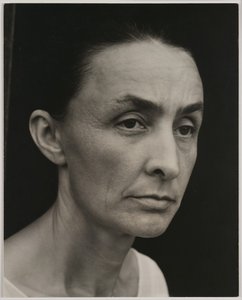
Georgia O'Keeffe

Georgia O'Keeffe

1887 - 1986, Stany Zjednoczone

Quick facts about Georgia O'Keeffe

  • Artistic Movement Or Style: Modernizm, Pradawstwo
  • Artists Or Movements Influenced By This Artist: ['Pradawstwo']
  • Artists Who Influenced This Artist:
    • Arthur Dow
    • Alfred Stieglitz
  • Date Of Birth: 15 listopada 1887
  • Date Of Death: 6 marca 1986
  • Full Name: Georgia Totto O’Keeffe
  • Nationality: Amerykańska
  • Notable Artworks:
    • Czerwona Kanna
    • Koło byka
    • Szerokie Dni
  • Place Of Birth: Sun Prairie, USA

Biografia artysty

Early Life and Artistic Foundations

Georgia Totto O’Keeffe, a name synonymous with American modernism, emerged from the unassuming landscape of Sun Prairie, Wisconsin, in 1887. Born into a family of Irish and Hungarian descent engaged in dairy farming, young Georgia displayed an artistic inclination early on, deciding by age ten that she would dedicate her life to art. This determination was nurtured through lessons with local watercolorist Sara Mann, followed by formal studies at the School of the Art Institute of Chicago from 1905 to 1906 and later at the University of Virginia. However, it was her encounter with Arthur Wesley Dow’s principles – emphasizing personal expression and a harmonious balance of color and line – that truly ignited her artistic path. Dow's teachings steered O’Keeffe away from strict realism toward a more subjective and emotionally resonant approach to art, an approach that would define her career. These formative years weren’t without their challenges; periods of illness and dissatisfaction led her to temporarily abandon painting, but the creative impulse always drew her back, evolving with each new experience and influence.

New York and the Stieglitz Circle

A pivotal moment arrived in 1916 when O’Keeffe’s abstract charcoal drawings were discovered by Alfred Stieglitz, a renowned photographer and art dealer. He exhibited her work without her prior knowledge, sparking a dialogue that would profoundly shape both their lives and the course of American art. Stieglitz recognized an exceptional talent in O'Keeffe, one that resonated with his own modernist sensibilities. He invited her to New York City in 1918, providing not only professional support but also fostering a deep personal connection. Their relationship blossomed into marriage in 1924, creating a dynamic artistic partnership and intellectual exchange. Stieglitz championed O’Keeffe’s work, showcasing it at his gallery “291” and promoting her as a leading figure in the American avant-garde. During this period, she began to develop her signature style – bold, simplified forms and intensely saturated colors – initially expressed through depictions of New York skyscrapers and, most famously, magnified flower paintings. These floral works, often interpreted (though consistently denied by O’Keeffe herself) as veiled representations of female anatomy, challenged conventional notions of beauty and sexuality in art.

The Allure of the Southwest

While New York provided a crucial platform for her early success, it was the landscapes of the American Southwest that truly captured O’Keeffe’s imagination and profoundly influenced her artistic vision. Her first visit to New Mexico in 1929 marked the beginning of a lifelong love affair with the region's stark beauty, vibrant colors, and unique cultural heritage. The vastness of the desert, the dramatic rock formations, and the ancient Pueblo architecture resonated deeply within her, inspiring a new series of paintings that reflected the spirit of the land. Works like *Cow’s Skull: Red, White, and Blue* (1931) and *Summer Days* (1936) are powerful testaments to this influence, transforming seemingly mundane objects into iconic symbols of the American West. She eventually settled permanently in New Mexico in 1949 following Stieglitz’s death, establishing a home and studio in Abiquiu that became integral to her artistic process and identity.

Technique and Style

O'Keeffe’s distinctive style evolved over decades, yet certain elements remained constant throughout her career. She favored bold, simplified forms and intense colors—often employing complementary hues to create striking visual effects. Her use of scale was particularly notable, with many of her paintings featuring oversized flowers or landscapes that dwarfed the viewer, creating a sense of awe and immersion. She often worked directly on large canvases, applying paint in thick layers using a palette knife, resulting in a textured surface that added depth and physicality to her images. While initially influenced by Arthur Wesley Dow’s emphasis on abstraction, O'Keeffe developed a unique approach—one that balanced formal elements with emotional expression. Her work is characterized by an almost meditative quality, inviting viewers to contemplate the beauty and mystery of the natural world.

Legacy and Enduring Influence

Georgia O'Keeffe continued to paint prolifically throughout her life, experimenting with new subjects and pushing the boundaries of abstraction. Her later works included aerial views of clouds and skies, reflecting a fascination with the vastness and ethereal quality of the natural world. She remained fiercely independent and uncompromising in her artistic vision, refusing to be categorized or defined by prevailing art movements. O’Keeffe’s impact on American art is immeasurable. She paved the way for future generations of female artists, challenging societal norms and asserting her own unique voice in a male-dominated field. Her paintings continue to captivate audiences with their bold simplicity, emotional depth, and evocative power. The establishment of the Georgia O'Keeffe Museum in Santa Fe in 1997 further solidified her legacy, preserving her art and providing a space for ongoing scholarship and appreciation. In 2014, *Jimson Weed/White Flower No. 1* sold for $44.4 million, setting a record price for a work by a female artist – a testament to the enduring value and significance of her artistic contribution. O’Keeffe's influence extends beyond painting; she became an icon of American individualism and self-reliance, inspiring countless artists and admirers with her unwavering commitment to her craft and her unique perspective on the world. Her work remains a powerful reminder of the transformative power of art and the enduring beauty of the natural world.

Key Works & Museum Presence

  • Red Canna: Exemplifies her early exploration of floral abstraction.
  • Cow’s Skull: Red, White, and Blue (1931): A powerful symbol of the American Southwest and a meditation on mortality.
  • Summer Days (1936): Captures the essence of the New Mexico landscape with its vibrant colors and simplified forms.
  • Jimson Weed/White Flower No. 1: A monumental floral painting that showcases her mastery of scale and composition.
O’Keeffe's works are prominently featured in numerous museums worldwide, including:
  • Georgia O'Keeffe Museum (Santa Fe)
  • Museum of Modern Art (New York)
  • Art Institute of Chicago
  • National Gallery of Art (Washington, D.C.)

§ 5Comparanda

§ 6Questions

Najważniejsze informacje

  • Medium: Watercolor on paper
  • Influences:
    • Dow
    • Kandinsky
  • Dimensions: 41 x 28 cm
  • Movement: Abstract Expressionism
  • Artistic style: Abstract, Organic
  • Notable elements: Layered blues & whites

Quiz o sztuce

Do każdego pytania dotyczy tylko jedna poprawna odpowiedź.

Pytanie 1:
What is the primary subject matter of Georgia O’Keeffe’s ‘Blue-01’?
Pytanie 2:
The painting ‘Blue-01’ was created in which year?
Pytanie 3:
Which artistic movement is most closely associated with Georgia O’Keeffe’s style as demonstrated in ‘Blue-01’?
Pytanie 4:
What technique is most evident in the creation of ‘Blue-01’?
Pytanie 5:
Based on the image description, what is the lighting like in ‘Blue-01’?

§ 7Cite this entry

AllPaintingsStore.com, “Georgia O'Keeffe, Blue-01 (1916)”, https://allpaintingsstore.com/pl/art/georgia-o-keeffe-blue-01-D3DVRM-en/ArtistReproduction/ (accessed 3 Październik 2026).

§ 8The reproduction

Ręcznie malowana reprodukcja olejowa

Ręcznie malowany obraz olejny na płótnie, wykonany na zamówienie przez naszych artystów w wybranym przez Ciebie wymiarze i oprawie. ( Przełącz na wydania drukowane Przejdź do wersji cyfrowej)

It is specified on the order sheet in the margin; the present state of that sheet reads as follows.

Blue-01

Technika reprodukcji

Wymiary reprodukcji

-

Wybitny mistrz artystyczny

Większa szczegółowość, finezja i dodatkowy czas na realizację

-

Opcje oprawy reprodukcji

-

-

W przypadku dzieł sztuki lub reprodukcji, których którykolwiek z boków przekracza 105 cm (około 41 cali), rama zostanie wysłana w formie zestawu do samodzielnego montażu. Metoda ta zapewnia bezpieczną dostawę i zapobiega uszkodzeniom podczas transportu.

Wymagany profesjonalny montaż – nie jest to produkt typu DIY.
Zestaw musi zostać złożony, a płótno naciągnięte przez doświadczonego profesjonalnego ramiarza, przy użyciu kleju do drewna (brak w zestawie), kleszczy do naciągania płótna oraz ścisków, które utrzymają krosna w równej pozycji podczas schnięcia kleju. Nieprawidłowy montaż lub nierównomierne napięcie płótna może trwale uszkodzić dzieło sztuki i nie podlega naszej gwarancji.

  • W zestawie znajdują się wszystkie listwy z litego drewna, precyzyjnie docięte do wymiarów.

  • Montaż odbywa się przy użyciu dołączonych wkrętów oraz kleju do drewna do łączenia narożników, którego zestaw nie zawiera i który musi zostać dostarczony przez ramiarza.

  • Wymagane są profesjonalne narzędzia, których nie ma w zestawie: kleszcze do naciągania płótna (napinacz) oraz zaciski, które pozwolą utrzymać listwy w równej pozycji podczas schnięcia kleju.

Ważne:
Do połączenia narożników niezbędny jest klej do drewna, listwy należy unieruchomić za pomocą ścisków do momentu całkowitego wyschnięcia kleju, a naciągnięcie płótna na złożoną ramę wymaga użycia kleszczy do naciągania płótna. Żaden z tych elementów nie jest dołączony do zestawu. Przed zamówieniem tego rozmiaru zalecamy konsultację z doświadczonym ramiarzem.

Etykieta obiektu

-

-

Lakier ochronny

Lakier z połyskiem (pogłębia kolory, chroni przed światłem i wilgocią)

-

Personalizacja dzieła

Przykłady możliwości personalizacji: zastąp twarz zdjęciem klienta; dodaj zwierzę domowe (np. zamień kota na psa); umieść ukrytą wiadomość w tle; zmień krajobraz lub elementy tła.

-

Ekspresowa

Dostawa na cały świat () w ciągu 3–4 tygodni zamiast standardowych 5 tygodni. (31 Październik). Bez kompromisów w kwestii jakości.

-

Przesyłka ekspresowa

Dostawa na cały świat () w ciągu 5 tygodni. (7 Listopad).

W cenie

Cena całkowita

zł 1003

Included with every order

  • Bezpłatna ekspresowa wysyłka na cały świat
  • Wysokiej jakości płótno lniane
  • Pełne ubezpieczenie przesyłki
  • Gwarancja zwrotu należności celnych i podatków importowych
  • Gwarancja wiernego odwzorowania kolorów
  • 100-dniowa polityka zwrotów (tylko w przypadku wad)
  • Gwarancja 100% zwrotu pieniędzy
  • Zniżka przy zakupie wielu sztuk
Order sheet