Gwarancja zwrotu pieniędzy · 100 dni Darmowa dostawa na cały świat
449 587dzieła sztuki 30 613artyści 4 660muzea 32język
Catalogue entry

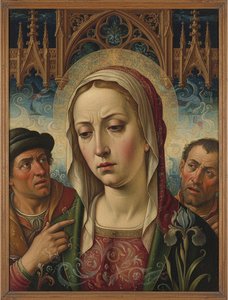
Lamentation

Oil On Panel, 36.0 x 30.0 cm. Muzeum Ermitażu.

Fig. 1. Hugo van der Goes, Lamentation. Shown as the reproduction you are specifying: , .

§ 1Catalogue data

Wymiary
36.0 x 30.0 cm

§ 2Abstract

Opis obiektu

Experience the poignant beauty of Hugo van der Goes' 'Lamentation,' a masterpiece capturing grief and sorrow with masterful realism and emotional depth. Explore its rich symbolism and historical significance.

Biografia artysty

"meta_description": "Hugo van der Goes – flamandzki malarz renesansowy znany z realizmu, emocji i monumentalnych dzieł, takich jak Ołtarz Portinari. Jego twórczość wpłynęła na sztukę włoską i stała się symbolem epoki."

§ 3Commentary

The Heart of Sorrow: Hugo van der Goes’ Lamentation

Hugo van der Goes' "Lamentation," a cornerstone of Early Netherlandish painting, isn’t merely a depiction of grief; it’s a profound exploration of human emotion rendered with an unprecedented level of psychological realism. Completed around 1460-70, this monumental panel—originally part of a larger altarpiece—captures the raw agony of Christ's death and the mourning of his followers with a startling immediacy that continues to resonate centuries later. The painting’s power lies not just in its technical brilliance but also in its ability to evoke a visceral response from the viewer, inviting contemplation on themes of loss, faith, and the human condition.

The scene unfolds within a dimly lit interior, dominated by the stark white linen shroud covering Christ's body. He is positioned centrally, his face serene yet undeniably vulnerable, resting upon a simple cushion—a deliberate choice that elevates him beyond mere suffering to a state of quiet acceptance. Surrounding him are figures draped in rich fabrics – deep blues, reds, and whites – each engaged in distinct gestures of mourning. Mary Magdalene, identifiable by her flowing red robes and sorrowful expression, gently covers his face with a cloth, while John the Evangelist kneels, placing a crown of thorns upon his head—a potent symbol of Christ’s sacrifice and humiliation. Other figures include Nicodemus, holding a vial, and Joseph of Arimathea, carefully carrying the body.

A Masterclass in Realism and Composition

Van der Goes was a revolutionary figure in the artistic landscape of his time, pushing beyond the stylized conventions of previous Flemish painting. He achieved this through an intensely realistic portrayal of human anatomy, meticulously rendered with a deep understanding of musculature and expression. Notice the subtle details: the wrinkles etched on the faces of the mourners, the delicate folds of their garments, the individual textures of the fabrics—all contribute to a sense of palpable presence. The composition itself is carefully orchestrated, employing a pyramidal structure that draws the eye towards Christ’s central figure while distributing the emotional weight across the surrounding figures. The use of chiaroscuro – dramatic contrasts between light and shadow – further intensifies the scene's emotional impact, highlighting key elements and creating a sense of depth and atmosphere.

Symbolism Woven into Sorrow

Beyond its immediate depiction of grief, “Lamentation” is rich in symbolic meaning. The white linen shroud represents purity and Christ’s innocence, while the crown of thorns signifies his suffering and sacrifice. The inclusion of figures like Nicodemus and Joseph of Arimathea—both prominent early Christians—underscores the universality of mourning and the shared experience of loss within the Christian community. Even seemingly minor details, such as the small squirrel perched on a beam in the background, have been interpreted as symbolic representations of mortality and the fleeting nature of earthly existence. The painting’s careful balance between religious iconography and human emotion elevates it beyond a simple devotional image, transforming it into a profound meditation on life, death, and faith.

A Legacy of Emotional Depth

“Lamentation” stands as a testament to Hugo van der Goes' artistic genius and his pioneering approach to painting. His ability to capture the raw intensity of human emotion—to convey grief, sorrow, and acceptance with such remarkable realism—established him as one of the most important artists of the Early Netherlandish period. The work’s influence can be seen in subsequent generations of painters, who continued to draw inspiration from its dramatic composition, psychological depth, and masterful use of color and light. Today, reproductions of “Lamentation” continue to captivate audiences worldwide, offering a poignant reminder of the enduring power of art to evoke empathy and inspire reflection.

Specifications

  • Title: Lamentation
  • Description: A religious scene depicting the mourning over Christ’s death, featuring figures covering his body with cloths, placing a crown of thorns on his head, and expressing sorrowful emotions.
  • Photo Description: The image depicts a religious scene that appears to be the Lamentation of Christ, as suggested by the title "Lamentation" and the presence of figures who seem to be mourning or preparing for burial. The painting is executed in an oil on panel style, which is typical for works from the Northern Renaissance period.
  • Size: 36 x 30 cm
  • Date: Unknown

Artist Information

  • Artist: Hugo van der Goes
  • Birth Year: 1440
  • Death Year: 1482
  • Birth City: Ghent
  • Birth Country: Belgium
  • Biography: A Pioneer of Flemish Realism: The Life and Art of Hugo van der Goes

Additional Research

For further exploration, consider these resources:

Pytania i odpowiedzi

Jaki format i orientacja druku są sugerowane dla „Lamentation” – Hugo van der Goes?

Zalecany rozmiar wydruku dzieła „Lamentation” – Hugo van der Goes to Medium w orientacji Portrait.

Czy kolory dzieła „Lamentation” – Hugo van der Goes są żywe czy stonowane?

Kolorystyka dzieła "Lamentation" charakteryzuje się nasyceniem na poziomie Subtle Color oraz intensywnością wynoszącą Balanced.

Czy istnieją dzieła podobne do „Lamentation”?

Strona Podobne dzieła dzieła „Lamentation” – Hugo van der Goes prezentuje powiązane utwory.

§ 4The artist

Hugo van der Goes

Hugo van der Goes

1440 - 1482, Belgia

Quick facts about Hugo van der Goes

  • Artistic Movement Or Style: Renesans flamandzki
  • Artists Or Movements Influenced By This Artist: ['Domenico Ghirlandaio']
  • Artists Who Influenced This Artist:
    • Jan van Eyck
    • Dierik Bouts
  • Date Of Birth: c. 1440
  • Date Of Death: 1482
  • Full Name: Hugo van der Goes
  • Nationality: Flamandzki
  • Notable Artworks:
    • Portinari
    • Monforte
  • Place Of Birth: Gandawa, Belgia

Biografia artysty

A Pioneer of Flemish Realism: The Life and Art of Hugo van der Goes

Born around 1440 in the vibrant artistic hub of Ghent, Belgium, Hugo van der Goes emerged as a pivotal figure in the Northern Renaissance. Though shrouded in some mystery—details of his early life remain scarce—his impact on the development of painting during the latter half of the 15th century is undeniable. Van der Goes wasn’t merely a painter; he was an innovator who profoundly altered the course of artistic expression, influencing masters both within Flanders and across the burgeoning Italian Renaissance. He entered the Ghent painters' guild in 1467, marking his formal establishment as a master craftsman, yet it was his unique vision—a blend of intense realism, psychological depth, and dramatic composition—that would set him apart. Before Van der Goes, Flemish painting, while technically brilliant, often adhered to established conventions; he dared to break from these traditions, imbuing his work with an unprecedented level of human emotion and tangible reality.

Innovation and Artistic Style

Van der Goes’s artistic signature lies in his ability to infuse religious scenes with a startling sense of immediacy and emotional weight. He moved beyond the stylized conventions of earlier Flemish painting, imbuing his figures with a weighty presence and individualized character. His use of color was deliberate and often somber, creating a sense of gravity and spiritual intensity. This wasn’t simply about replicating appearances; it was about conveying inner states—awe, sorrow, reverence—through subtle gestures, expressive faces, and the careful manipulation of light and shadow. His monumental style, characterized by large-scale compositions and imposing figures, further amplified this emotional impact. He didn't shy away from portraying imperfections; his figures often possess a raw, almost unsettling realism that distinguishes them from the more idealized representations common in earlier art. This commitment to depicting humanity in all its complexity was revolutionary for its time, influencing artists who sought to move beyond mere technical skill and explore the depths of human experience. The influence of Jan van Eyck’s meticulous detail is evident, but Van der Goes transcends imitation, forging a style uniquely his own. He pushed the boundaries of perspective and employed dramatic lighting techniques that created a sense of depth and volume rarely seen in contemporary art.

Masterpieces and Lasting Influence

Perhaps Van der Goes’s most celebrated work is the Portinari Altarpiece, commissioned by Tommaso Portinari, an Italian banker residing in Bruges. Completed around 1475, this magnificent triptych—now housed in the Uffizi Gallery in Florence—is a testament to his mastery of composition, color, and psychological insight. The scene depicting the Adoration of the Shepherds is particularly striking, with its dramatic lighting, realistic portrayal of humble figures, and palpable sense of wonder. The altarpiece’s arrival in Italy had a profound effect on Florentine artists, including Domenico Ghirlandaio, who were captivated by its innovative realism and emotional power. Another significant work is The Adoration of the Magi (Monforte Altarpiece), currently residing in Berlin's Gemäldegalerie. This piece showcases his skill in creating dynamic scenes filled with intricate detail and symbolic meaning. Beyond these iconic works, Van der Goes contributed to numerous civic projects, including heraldic decorations for Charles the Bold’s ceremonial entries into Ghent, demonstrating his versatility as an artist. His influence extended beyond painting; he impacted the development of book illustration through his designs which were disseminated by artists like Alexander Bening.

A Life Transformed: From Workshop to Monastery

In a surprising turn of events, at the height of his artistic success in 1477, Van der Goes abruptly closed his bustling workshop and entered the Roode Klooster monastery near Auderghem. This decision remains something of an enigma, though it’s believed to have been driven by a deep spiritual yearning or perhaps a struggle with mental health. Despite taking religious vows as a lay brother, he continued to accept painting commissions, even undertaking the task of evaluating unfinished works by Dieric Bouts for the city of Leuven. However, his final years were marked by increasing bouts of depression and psychological distress. Accounts suggest that he suffered a severe breakdown in 1482, tragically taking his own life shortly thereafter. This poignant end to a brilliant career adds another layer of complexity to the legacy of Hugo van der Goes—a man whose art explored the depths of human emotion while grappling with inner turmoil. The circumstances surrounding his death have fueled speculation for centuries, adding to the mystique that surrounds this remarkable artist.

A Legacy Enduring Through Time

Hugo van der Goes’s influence extended far beyond his relatively short lifetime. His innovative techniques and profound psychological insights paved the way for future generations of artists, both in Flanders and Italy. His work can be found today in prestigious museums such as the Musées royaux des Beaux-Arts in Brussels, offering a glimpse into the genius of this pioneering Flemish master. He remains a compelling figure—a testament to the power of art to capture the complexities of the human condition and to transcend cultural boundaries. His legacy continues to inspire awe and admiration, solidifying his place as one of the most important artists of the Northern Renaissance.
  • His emphasis on realism influenced subsequent generations.
  • The Portinari Altarpiece remains a landmark achievement in art history.
  • His exploration of psychological depth set a new standard for portraiture and religious painting.

§ 5Comparanda

§ 6Questions

Najważniejsze informacje

  • Influences: Early Netherlandish
  • Artist: Hugo van der Goes
  • Medium: Oil on panel
  • Dimensions: 36 x 30 cm
  • Location: Gemäldegalerie, Berlin

Quiz o sztuce

Do każdego pytania dotyczy tylko jedna poprawna odpowiedź.

Pytanie 1:
What is the primary subject depicted in Hugo van der Goes’ ‘Lamentation of Christ’?
Pytanie 2:
Which artistic period does Hugo van der Goes’ ‘Lamentation of Christ’ primarily belong to?
Pytanie 3:
What is a notable characteristic of Hugo van der Goes' style as seen in this painting?
Pytanie 4:
What is the significance of the figure holding a cloth over Christ’s face in ‘Lamentation of Christ’?
Pytanie 5:
The painting is signed ‘Hugo Van Der Goes’ in which location?

§ 7Cite this entry

AllPaintingsStore.com, “Hugo van der Goes, Lamentation”, https://allpaintingsstore.com/pl/art/hugo-van-der-goes-lamentation-8Y3SCS-en/ArtistReproduction/ (accessed 4 Październik 2026).

§ 8The reproduction

Ręcznie malowana reprodukcja olejowa

Ręcznie malowany obraz olejny na płótnie, wykonany na zamówienie przez naszych artystów w wybranym przez Ciebie wymiarze i oprawie. ( Przełącz na wydania drukowane Przejdź do wersji cyfrowej)

It is specified on the order sheet in the margin; the present state of that sheet reads as follows.

Lamentation

Technika reprodukcji

Wymiary reprodukcji

-

Wybitny mistrz artystyczny

Większa szczegółowość, finezja i dodatkowy czas na realizację

-

Opcje oprawy reprodukcji

-

-

W przypadku dzieł sztuki lub reprodukcji, których którykolwiek z boków przekracza 105 cm (około 41 cali), rama zostanie wysłana w formie zestawu do samodzielnego montażu. Metoda ta zapewnia bezpieczną dostawę i zapobiega uszkodzeniom podczas transportu.

Wymagany profesjonalny montaż – nie jest to produkt typu DIY.
Zestaw musi zostać złożony, a płótno naciągnięte przez doświadczonego profesjonalnego ramiarza, przy użyciu kleju do drewna (brak w zestawie), kleszczy do naciągania płótna oraz ścisków, które utrzymają krosna w równej pozycji podczas schnięcia kleju. Nieprawidłowy montaż lub nierównomierne napięcie płótna może trwale uszkodzić dzieło sztuki i nie podlega naszej gwarancji.

  • W zestawie znajdują się wszystkie listwy z litego drewna, precyzyjnie docięte do wymiarów.

  • Montaż odbywa się przy użyciu dołączonych wkrętów oraz kleju do drewna do łączenia narożników, którego zestaw nie zawiera i który musi zostać dostarczony przez ramiarza.

  • Wymagane są profesjonalne narzędzia, których nie ma w zestawie: kleszcze do naciągania płótna (napinacz) oraz zaciski, które pozwolą utrzymać listwy w równej pozycji podczas schnięcia kleju.

Ważne:
Do połączenia narożników niezbędny jest klej do drewna, listwy należy unieruchomić za pomocą ścisków do momentu całkowitego wyschnięcia kleju, a naciągnięcie płótna na złożoną ramę wymaga użycia kleszczy do naciągania płótna. Żaden z tych elementów nie jest dołączony do zestawu. Przed zamówieniem tego rozmiaru zalecamy konsultację z doświadczonym ramiarzem.

Etykieta obiektu

-

-

Lakier ochronny

Lakier z połyskiem (pogłębia kolory, chroni przed światłem i wilgocią)

-

Personalizacja dzieła

Przykłady możliwości personalizacji: zastąp twarz zdjęciem klienta; dodaj zwierzę domowe (np. zamień kota na psa); umieść ukrytą wiadomość w tle; zmień krajobraz lub elementy tła.

-

Ekspresowa

Dostawa na cały świat () w ciągu 3–4 tygodni zamiast standardowych 5 tygodni. (1 Listopad). Bez kompromisów w kwestii jakości.

-

Przesyłka ekspresowa

Dostawa na cały świat () w ciągu 5 tygodni. (8 Listopad).

W cenie

Cena całkowita

zł 1004

Included with every order

  • Bezpłatna ekspresowa wysyłka na cały świat
  • Wysokiej jakości płótno lniane
  • Pełne ubezpieczenie przesyłki
  • Gwarancja zwrotu należności celnych i podatków importowych
  • Gwarancja wiernego odwzorowania kolorów
  • 100-dniowa polityka zwrotów (tylko w przypadku wad)
  • Gwarancja 100% zwrotu pieniędzy
  • Zniżka przy zakupie wielu sztuk
Order sheet