


 Podgląd w skali 1:1
 Wyślij jako kartkę
 Udostępnij
 Szczegóły dzieła
 Przewodnik

 Pobierz obraz
 Podobne obiekty
 RTG
RTG Pokaz slajdów
 Statystyki
A Mountain Scene


 Rozwiń treść
Giclée / Wydruk artystyczny
Wydruki giclée lub płótna o jakości muzealnej, szybka realizacja i szeroki wybór opcji wykończenia. ( Zamów ręcznie malowaną reprodukcję Przejdź do wersji cyfrowej)




P118B zł10

P118H zł10

P118W zł10

P438Z zł10

P508JH zł12

P508YH zł12

P805H zł10

P805Z zł10

P919BZ zł10

P919G zł10

P919XJ zł10

P959ZH zł10

P968JZ zł12

W106C zł8

W218G zł10

W218JH zł8

W218Y zł10

W307PJ zł10

W316G zł10

W316PJ zł8

W316Y zł10

W398PJ zł8

W4111J zł10

W500HY zł15

W500JH zł15

W692G zł12

W849H zł8

W940BG zł15

W953PJ zł8




Wybierz spośród naszych standardowych rozmiarów, które zachowują oryginalne proporcje dzieła sztuki.

Wpisz wymaganą szerokość i wysokość, aby dopasować grafikę do ramy lub ściany. Wydruk można jedynie przyciąć, nigdy nie powiększając go poza oryginalny obraz, dlatego format o innych proporcjach spowoduje utratę części kompozycji. Przed rozpoczęciem druku prześlemy Ci cyfrowy podgląd do zatwierdzenia. Obraz wyświetlany na tej stronie nie pokazuje rzeczywistego przycięcia — jedynie podgląd oddaje ten efekt.
Dostawa na cały świat () w ciągu 2 tygodni zamiast standardowych 4/5 tygodni. (27 Październik)

Bezpłatna ekspresowa wysyłka na cały świat

Wysokiej jakości płótno lniane

Pełne ubezpieczenie przesyłki

Gwarancja zwrotu należności celnych i podatków importowych

Gwarancja wiernego odwzorowania kolorów

100-dniowa polityka zwrotów (tylko w przypadku wad)

Gwarancja 100% zwrotu pieniędzy

Zniżka przy zakupie wielu sztuk
 Opcja ze szkłem jest dostępna wyłącznie w rozmiarach poniżej 110 cm

A Mountain Scene
Giclée / Wydruk artystyczny
Wymiary reprodukcji
-


Cena całkowita
zł 246
A Mountain Scene by John Crome
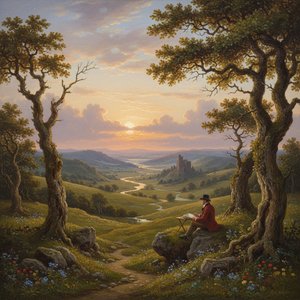
The Norfolk landscape holds a special place in British artistic memory, largely thanks to the unwavering dedication of artists like John Crome who tirelessly sought to capture its sublime beauty. Painted in 1806, “A Mountain Scene” exemplifies the Norwich School’s distinctive approach to landscape painting—a style characterized by understated tonal harmonies and an acute sensitivity to atmospheric conditions. This piece isn't merely a depiction of mountains; it’s an embodiment of Romantic ideals, reflecting a profound connection between humanity and the natural world.Subject Matter & Composition
The artwork presents a panoramic vista of East Anglian hills dominated by a substantial rock outcrop. The artist skillfully employs perspective to convey depth, drawing the viewer's eye upwards towards the cloudy sky—a crucial element in establishing mood and conveying the grandeur of the landscape. Two figures stand prominently positioned near the left side of the canvas, gazing out upon this breathtaking panorama. Their presence serves not only as compositional anchor but also subtly suggests contemplation and admiration for the majesty of nature.Style & Technique: Norwich School Characteristics
Crome’s technique is rooted in the Norwich School's core principles—a deliberate rejection of flamboyant brushwork favored by earlier Romantic painters. Instead, he achieves remarkable tonal gradation through meticulous layering of thin washes of oil paint, creating a velvety surface that captures the subtle nuances of light and shadow. This understated approach prioritizes observation and accuracy, mirroring the Norfolk landscape’s muted palette. The artist's masterful use of color—primarily browns, greys, and blues—creates an atmosphere of quiet contemplation and reinforces the painting’s emotional resonance.Historical Context & Romantic Ideals
“A Mountain Scene” emerged during a period marked by significant intellectual ferment – the burgeoning Romantic movement. Artists like Crome were deeply influenced by thinkers such as Edmund Burke and William Wordsworth, who championed emotion and imagination as pathways to understanding the sublime—that feeling of awe and wonder experienced when confronted with overwhelming natural beauty. The painting reflects this philosophical preoccupation, conveying not just visual information but also a spiritual appreciation for the power and majesty of the mountains.Symbolism & Emotional Impact
The rock formation itself symbolizes resilience and permanence against the forces of time and weather—a recurring motif in Romantic art reflecting anxieties about mortality alongside an affirmation of enduring natural order. The figures observing the landscape represent humanity's yearning for connection with something larger than oneself, inviting viewers to contemplate their place within the vastness of creation. Ultimately, “A Mountain Scene” succeeds in evoking a feeling of tranquility and reverence—a testament to Crome’s ability to translate visual observation into profound emotional experience. It remains an enduring symbol of Norfolk's artistic heritage and a captivating example of Romantic landscape painting at its finest.Pytania i odpowiedzi
Jaki jest dominujący kolor w „A Mountain Scene” – John Crome?
Kolorem, który najbardziej wyróżnia się w "A Mountain Scene", jest Driftwood (#85734f). Dominujący kolor ułatwia dopasowanie dzieła sztuki do wnętrza.
Jaki format i orientacja druku są sugerowane dla „A Mountain Scene” – John Crome?
Zalecany rozmiar wydruku dzieła „A Mountain Scene” – John Crome to Large w orientacji Portrait.
Czy „A Mountain Scene” – John Crome to portret, pejzaż czy kompozycja kwadratowa?
Format dzieła „A Mountain Scene” to Portrait. Jest to pomocna informacja podczas planowania miejsca, w którym zostanie umieszczona reprodukcja.
Podobne dzieła


Biografia artysty
A Norfolk Son: The Life and Art of John Crome
John Crome, affectionately known as “Old Crome” to distinguish him from his artist son, stands as a pivotal figure in British art history—a founder and leading light of the celebrated Norwich School. Born in 1768 in the bustling market town of Norwich, Norfolk, Crome’s journey was one of remarkable self-education and dedication, rising from humble beginnings to become a respected landscape painter who captured the very essence of his beloved East Anglian countryside. His father, a weaver, instilled a strong work ethic, but it was an apprenticeship with house, coach, and sign painter Francis Whisler that first nurtured Crome’s artistic inclinations, providing him with foundational skills in design and color. This practical training proved invaluable as he began to explore his passion for depicting the natural world around him. A formative friendship with Robert Ladbrooke, a fellow aspiring artist, further fueled his development; together they sketched en plein air, honing their observational abilities and sharing a burgeoning enthusiasm for art.Forging a Regional Identity: The Norwich School
Crome’s artistic trajectory was significantly shaped by the generosity of Thomas Harvey of Old Catton, who granted him access to his impressive art collection. This exposure to masterpieces by artists like Gainsborough and Hobbema proved transformative, providing Crome with crucial models for composition, light, and atmosphere. Further guidance came from established figures such as Sir William Beechey and John Opie, cementing his connection to the wider artistic community. However, it was in 1803 that Crome truly left his mark on the art world, co-founding the Norwich Society of Artists with Robert Ladbrooke. This bold initiative marked the formal beginning of the Norwich School—a groundbreaking movement that championed direct observation of nature and sought to capture the unique character of the Norfolk landscape, distinct from the prevailing artistic trends emanating from London. As a frequent president of the society, Crome became its driving force, fostering a community of like-minded painters dedicated to celebrating their regional identity. The Norwich School’s focus wasn't on grand historical scenes or idealized figures; instead, it celebrated the quiet beauty and subtle details of Norfolk’s rural life – the meandering rivers, ancient trees, humble farmhouses, and ever-changing skies.Romantic Sensibility and Artistic Influences
Crome’s style is characterized by a distinctly Romantic sensibility—an expressive brushwork, atmospheric depictions, and an emotional connection to the land. He was deeply rooted in Norfolk scenery, finding inspiration in its broad skies, winding rivers, ancient trees, and humble rural life. While he drew heavily from Dutch 17th-century masters like Hobbema – a lifelong admiration culminating in his famous last words, “Oh Hobbema, my dear Hobbema, how I have loved you!” – he also acknowledged the influence of Richard Wilson’s lyrical landscapes. Crome distinguished himself by being among the first English artists to accurately represent identifiable tree species, moving beyond generalized forms and demonstrating a keen botanical eye. Proficient in both watercolor and oil, he produced over 300 paintings throughout his career, each imbued with a sense of intimacy and authenticity. His works weren’t merely representations of places; they were evocations of mood and feeling, capturing the spirit of Norfolk with remarkable sensitivity. The use of light was particularly important to Crome, often employing subtle gradations to create a sense of depth and atmosphere.Major Works and Techniques
Crome's most celebrated works include "The Lime Kiln," a poignant depiction of a crumbling structure set against a dramatic sky; “Grove Scene,” showcasing the dappled light filtering through ancient trees; and “Mousehold Heath,” capturing the vastness and tranquility of the Norfolk landscape. His etchings, though unpublished during his lifetime, revealed another facet of his talent – a meticulous attention to detail and a masterful command of line. Crome’s technique was characterized by a loose, expressive brushstroke, often employing broken color and atmospheric perspective to create a sense of depth and distance. He favored working *en plein air* (outdoors), directly observing the landscape and capturing its essence in a single sitting. His paintings are notable for their quiet dignity and understated beauty – a testament to his ability to find poetry in the commonplace.Legacy and Lasting Impact
John Crome's contribution extended far beyond his artistic output. The Norwich School he helped establish fostered a distinct regional artistic identity, nurturing generations of painters who followed in his footsteps. Though initially facing some resistance from the London art establishment, Crome gained national recognition through thirteen exhibits at the Royal Academy between 1806 and 1818. His etchings, though unpublished during his lifetime, revealed another facet of his talent. A posthumous exhibition showcasing over 100 of his works underscored the esteem in which he was held by his peers. Even today, Crome’s legacy endures—not only through his paintings but also in the geographical landmarks that bear his name: Crome’s Broad and Crome ward stand as enduring testaments to his lasting impact on Norwich and Norfolk. His life serves as an inspiring example of how artistic vision, combined with a deep connection to one's surroundings, can create a body of work that resonates across generations. His work continues to captivate viewers with its quiet beauty, evocative atmosphere, and enduring connection to the heart of Norfolk.
John Crome
1768 - 1821 , Wielka Brytania
Krótka nota
- Artistic Movement Or Style: Norwich School
- Artists Or Movements Influenced By This Artist: ['The Romantic School']
- Artists Who Influenced This Artist:
- Thomas Gainsborough
- Meindert Hobbema
- Date Of Birth: 1768
- Date Of Death: 1821
- Full Name: John Crome
- Nationality: Angielski
- Notable Artworks:
- Widok z Góry Wysoki
- St. John the Baptist w pustyni
- Place Of Birth: Norwich, UK
Powiązane artykuły
John Varley I: Intimate Observation & the British Romantic Landscape
Explore the serene landscapes of John Varley I, a key figure in British Romanticism. Discover his unique watercolour style, collaboration with William Blake & lasting artistic legacy. Learn about collecting Varley's work.

Romantyczny Krajobraz w Malarstwie: 10 Arcydzieł, Które Zdefiniowały Epokę | AllPaintingsStore.com
Odkryj 10 arcydzieł romantyzmu w malarstwie! Poznaj historie Caspara Davida Friedricha, Turnera i innych mistrzów. Inspiracje wnętrzarskie & reprodukcje obrazów najwyższej jakości na AllPaintingsStore.com. Eksploruj kolekcję online!

Sublime i malowniczość w krajobrazie romantycznym: Emocje, natura i duchowość w sztuce XIX wieku
Odkryj fascynujący świat romantycznego krajobrazu! Poznaj filozofię Sublime, arcydzieła Friedricha i Turnera oraz wpływ tego nurtu na sztukę. Inspiracje i reprodukcje najwyższej jakości – AllPaintingsStore.

John Constable: 25 Najlepszych Obrazów Mistrza Angielskiego Krajobrazu | AllPaintingsStore
Odkryj 25 arcydzieł Johna Constable'a – mistrza angielskiego krajobrazu! Poznaj romantyczne pejzaże, technikę malarską i inspiracje z Dedham Vale. Reprodukcje obrazów najwyższej jakości na AllPaintingsStore.com. Eksploruj pełną kolekcję online!
John Singer Sargent: 25 Arcydzieł Pełnych Elegancji i Światła | AllPaintingsStore.com
Odkryj 25 arcydzieł Johna Singera Sargenta – mistrza portretu i impresjonizmu. Poznaj historie, techniki i inspiracje za jego najsłynniejszymi obrazami. Reprodukcje najwyższej jakości na AllPaintingsStore.com. Eksploruj pełną kolekcję online!


