


 Wyślij
 Udostępnij
 Szczegóły
 Przewodnik

 Pobierz plik obrazu
 Podobne obiekty
 Pokaz slajdów
 Statystyki
Noire et Blanche


 Czytaj więcej
Dzieło sztuki prezentowane na tej stronie podlega ochronie prawem autorskim, co oznacza, że nie mamy prawa do tworzenia ani sprzedaży jego identycznej reprodukcji. Ochrona ta jest egzekwowana na mocy umów międzynarodowych, takich jak Konwencja berneńska oraz przez przepisy prawa krajowego, w tym te określone w Prawo autorskie USA – Tytuł 17.
Metoda ta jest w pełni zgodna z przepisami prawa autorskiego, ponieważ nie polega na kopiowaniu ani powielaniu chronionego dzieła. Stanowi ona kreatywną reinterpretację – nowy obraz, który czerpie inspirację z oryginału, ale nie jest z nim tożsamy.
Giclée / Wydruk artystyczny
Wydruki giclée lub płótna o jakości muzealnej, szybka realizacja i szeroki wybór opcji wykończenia. ( Kup ręcznie malowany obraz Przełącz na wersję cyfrową)




































Wybierz spośród naszych standardowych rozmiarów, które zachowują oryginalne proporcje dzieła sztuki.

Wpisz wymaganą szerokość i wysokość, aby dopasować grafikę do ramy lub ściany. Wydruk można jedynie przyciąć, nigdy nie powiększając go poza oryginalny obraz, dlatego format o innym proporcji spowoduje utratę części kompozycji. Przed rozpoczęciem druku prześlemy Ci cyfrowy podgląd do zatwierdzenia. Obraz wyświetlany na tej stronie nie pokazuje rzeczywistego przycięcia — jedynie podgląd oddaje ten efekt.
Dostawa na cały świat () w ciągu 2 tygodni zamiast standardowych 4/5 tygodni. (24 Październik)

Bezpłatna ekspresowa wysyłka na cały świat

Wysokiej jakości płótno lniane

Pełne ubezpieczenie transportowe

Gwarancja zwrotu należności celnych i podatków importowych

Gwarancja idealnego odwzorowania barw

100-dniowy okres na zwrot dzieła w przypadku wykrycia wad produkcyjnych

Gwarancja 100% zwrotu pieniędzy

Oferta przy zakupie wielu sztuk
 Opcja ze szkłem jest dostępna wyłącznie w rozmiarach poniżej 110 cm

Noire et Blanche
Giclée / Wydruk artystyczny
Rozmiar reprodukcji
-


Suma do zapłaty
zł 246
The Enigma of Shadow and Form
Man Ray’s evocative photograph, Noire et Blanche, immediately draws the viewer into a realm where identity blurs and cultural narratives collide. This piece is more than a mere depiction; it is an intellectual puzzle rendered in stark, beautiful monochrome. The composition centers on a striking tableau: a woman whose head rests intimately against a mask of profound mystery. This mask itself, appearing to be a masterful amalgamation of metal and aged wood, suggests artifacts from distant, powerful traditions. Man Ray, ever the provocateur, uses this juxtaposition—the pale, seemingly modern subject against the weight of an ancient, stylized object—to challenge our very understanding of selfhood and representation.
Dadaist Play and Photographic Mastery
To understand Noire et Blanche is to appreciate the spirit of Dadaism itself. The photographer was not content merely to record; he sought to play with the image, with language, and with expectation. The title, referencing "Black and White," points directly to the duality embodied by the two masks—one dark, evocative of African artistry, and the other represented by the luminous pallor of Kiki de Montparnasse’s face. This interplay is a sophisticated visual pun, inviting contemplation on what constitutes 'black' and what defines 'white.' Technically, Man Ray employs the sharp contrasts inherent in black and white photography to heighten the drama. The resulting image possesses a haunting graphic quality, where shadow becomes as significant an element as light.
Symbolism of the Masked Self
The mask has always been a potent symbol throughout art history—a veil, a transformation, a temporary shedding of the everyday self. Here, it functions on multiple symbolic levels. It speaks to cultural appropriation, yes, but more deeply, it whispers about the performance of identity in modern life. Are we all wearing masks? The presence of other partially obscured figures in the background only deepens this sense of collective anonymity and observation. The woman’s posture—her head surrendered to the mask—suggests a moment of profound contemplation or perhaps even surrender to an unknown, powerful narrative force.
A Touch for the Modern Collector
For those who appreciate art that demands conversation, Noire et Blanche offers endless depth. Whether displayed in a gallery setting or reproduced as a striking piece for a sophisticated interior space, its power lies in its ambiguity. It resonates with collectors drawn to Surrealism, Dada, and the rich tradition of photographic portraiture that questions reality. Owning this reproduction is acquiring not just an image, but a dialogue—a conversation starter steeped in modernist genius, inviting every passerby to question who is looking, and more importantly, what they are seeing.
Pytania i odpowiedzi
Czy „Noire et Blanche” autorstwa Man Ray to jasne czy ciemne dzieło?
Ogólnie rzecz biorąc, "Noire et Blanche" charakteryzuje się poziomem brilliant. Postrzegana jasność opisuje, jak jasne lub ciemne wydaje się dzieło.
Jak kolory w dziele "Noire et Blanche" współgrają ze sobą?
Kolory dzieła „Noire et Blanche” autorstwa Man Ray wykazują Strong Color Unity harmonię. Harmonia opisuje wzajemne relacje między kolorami.
Jakie emocje przekazuje dzieło "Noire et Blanche" należące do nurtu Dada?
"Noire et Blanche" niesie ze sobą Reflective wydźwięk emocjonalny w obrębie nurtu Dada.


Biografia artysty
A Life Illuminated by Shadows
Emmanuel Radnitzky, known to the world as Man Ray, was a restless spirit who defied easy categorization. Born in 1890 in Philadelphia to Russian Jewish immigrant parents, his journey from aspiring painter to pioneering photographer and filmmaker embodies the radical artistic ferment of the early 20th century. The shift from “Manny” Radnitzky to the enigmatic “Man Ray” itself speaks volumes about an artist determined to forge a new identity, one unbound by convention. His family’s move to New York City proved pivotal, exposing him to the burgeoning modernist scene and instilling in him a lifelong fascination with experimentation. Early influences included the European avant-garde showcased at Alfred Stieglitz's 291 gallery, and the gritty realism of the Ashcan School – a blend that would subtly inform his later work. Though initially dedicated to painting, it was photography that ultimately became Ray’s most potent medium for exploring the boundaries of perception and reality. He wasn't merely capturing images; he was inventing new ways of *seeing*. His early artistic endeavors were marked by a desire to break from traditional styles, influenced by his exposure to both European modernism and the raw energy of New York City life. The Ferrer Centre, with its anarchist leanings and emphasis on free expression, proved particularly formative during this period, fostering an environment where experimentation was not just encouraged but expected.Dada, Surrealism, and the Pursuit of the Impossible
Man Ray's artistic trajectory took a dramatic turn with his encounter with Marcel Duchamp in New York around 1915. This meeting sparked a shared fascination with challenging traditional notions of art, leading to explorations of “ready-mades” – ordinary manufactured objects elevated to the status of artwork. This rebellious spirit propelled Ray into the heart of the Dada movement, an anti-art protest born from the disillusionment of World War I. In 1921, he made the momentous decision to relocate to Paris, becoming a central figure in both the Dada and Surrealist circles that flourished there. While never fully aligning himself with any rigid artistic dogma, Ray embraced the Surrealists’ exploration of the unconscious mind, dreams, and the irrational. His work during this period is characterized by a dreamlike quality, often unsettling yet undeniably captivating. He wasn't interested in depicting reality as it *is*, but rather as it *feels* – fragmented, distorted, and imbued with hidden meanings. This embrace of the subconscious allowed him to move beyond mere representation towards an exploration of psychological states and emotional resonance within his art. His collaborations with other Surrealist artists, like Salvador Dalí, further solidified his position within the movement, though he always maintained a degree of independence in his artistic vision.Rayographs and the Alchemy of Light
Perhaps Man Ray is most celebrated for his invention of the “rayograph,” a cameraless photographic technique he stumbled upon almost by accident. These images—created by placing objects directly onto light-sensitive paper and exposing them to light—resulted in ethereal, ghostly compositions that defied conventional photographic representation. The rayograph wasn't simply an alternative method; it was a philosophical statement about the nature of photography itself. By eliminating the camera lens, Ray stripped away the illusion of objectivity, revealing the inherent subjectivity of the medium. These weren’t representations *of* things, but rather direct imprints *from* them, imbued with a sense of mystery and otherworldliness. Beyond rayographs, his photographic portraits – particularly those of artists like Lee Miller (who would become both his muse and collaborator) – are renowned for their striking compositions and psychological depth. He experimented relentlessly with solarization, multiple exposures, and darkroom manipulation, pushing the boundaries of what photography could achieve. Solarization, in particular, became a signature technique, creating dramatic reversals of tone that added an element of the uncanny to his portraits.Beyond Stillness: Film and a Lasting Legacy
Man Ray’s artistic curiosity extended beyond still images into the realm of filmmaking. His experimental films, such as *Le Retour à la Raison* (1923) and *L'Étoile de Mer* (1928), were characterized by their surreal imagery, unconventional editing techniques, and rejection of narrative conventions. These weren’t stories told in a traditional sense; they were visual poems, explorations of form, rhythm, and the subconscious. He often employed innovative techniques like stop-motion animation and superimposition to create disorienting and dreamlike effects. Though his film work remained relatively small in volume, it was profoundly influential on subsequent generations of avant-garde filmmakers. Throughout his long career, Man Ray continued to challenge artistic norms, refusing to be confined by labels or expectations. He died in Paris in 1976, leaving behind a body of work that continues to inspire and provoke. His legacy lies not only in his technical innovations but also in his unwavering commitment to artistic freedom and his relentless pursuit of the impossible—a true pioneer who forever altered our perception of art and reality.A Continuing Influence
- Photography: Man Ray’s techniques, particularly rayography and solarization, continue to be explored by contemporary photographers.
- Surrealism: His contributions solidified the movement's visual language and inspired countless artists across disciplines.
- Experimental Film: His pioneering work in film laid the groundwork for future generations of avant-garde filmmakers.
- Fashion Photography: Ray’s innovative approach to portraiture and composition influenced the development of modern fashion photography.

Man Ray
1890 - 1976 , Stany Zjednoczone
Najważniejsze informacje
- Artistic Movement Or Style: Dada, Surrealizm
- Artists Or Movements Influenced By This Artist: ['Surrealizm']
- Artists Who Influenced This Artist: ['Marcel Duchamp']
- Date Of Birth: 27 sierpnia 1890
- Date Of Death: 18 listopada 1976
- Full Name: Emmanuel Radnitzky
- Nationality: Amerykański
- Notable Artworks:
- Rayographs
- Le Retour à la Raison
- L'Étoile de Mer
- Place Of Birth: Philadelphia, USA
Zobacz także powiązane artykuły

Piktorializm w Polsce: Poszukiwanie Duszy Fotografii i Estetyki Malarskiej
Poznaj historię piktorializmu w Polsce – nurtu fotografii artystycznej dążącego do estetyki malarskiej. Odkryj kluczowe postacie, techniki i wpływ na polską sztukę. Ekspercka analiza i fascynujące fakty!

Beyond the Lens: Photography's Enduring Influence on Modern & Contemporary Art
Explore photography's pivotal role in shaping modern & contemporary art. Discover key movements, influential artists like Stieglitz, and expert collecting advice from AllPaintingsStore.

Timeless Shadows: The Artistry, History, and Emotional Resonance of Black and White Photography
Explore the profound artistry of black and white photography. From historical mastery to the interplay of light and shadow, discover how monochrome captures timeless emotion and form through a sophisticated lens of art history.

Beyond Color: The Timeless Power and Artistry of Black and White Photography
Explore the profound artistry of black and white photography. From the chemistry of gelatin silver to the chiaroscuro of the Old Masters, discover how monochrome captures the eternal essence of light, form, and emotion for the discerning art collector.
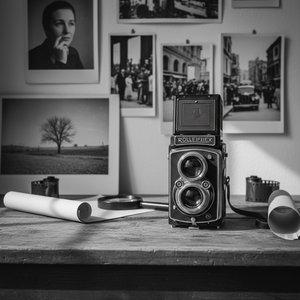
Monochromatyczne Wizje: Estetyka i Historyczne Znaczenie Fotografii Czarno-Białej
Odkryj fascynujący świat fotografii czarno-białej! Poznaj historię, techniki i arcydzieła monochromatycznej sztuki. Inspiracje, porady i analiza wpływu na współczesną estetykę. AllPaintingsStore.com.


