Gwarancja zwrotu pieniędzy · 100 dni Darmowa dostawa na cały świat
449 587dzieła sztuki 30 613artyści 4 660muzea 32język
Waluta
    Język
      Atelier · Est. 2015 · Paryż, Francja
      AllPaintingsStore
      allpaintingsstore.com
      Catalogue entry

      Moses and Aaron

      1931. Gouache, 64.0 x 51.0 cm.

      Fig. 1. Marc Chagall, Moses and Aaron, 1931. Shown as the reproduction you are specifying: , .

      § 1Catalogue data

      § 2Abstract

      Opis obiektu

      Chagall’s fascination with Vitebsk—its cultural blend—influenced his aesthetic sensibility, appearing repeatedly in his paintings. He pursued formal training initially with a local sign painter before embarking on an independent artistic path.

      Biografia artysty

      Poznaj fascynujący świat Marc Chagalla (1887-1985), rosyjskiego i francuskiego mistrza sztuki, znanego z obrazów pełnych snu i folklorystycznych motywów oraz pięknych witraży. Odkryj jego dziedzictwo!

      § 3Commentary

      A Symphony of Color and Dreamlike Narrative

      In the vast, evocative landscape of twentieth-century modernism, few works capture the intersection of spiritual fervor and surrealist whimsy as poignantly as Marc Chagall’s “Moses and Aaron.” Completed in 1931, this mesmerizing gouache on canvas serves as a profound window into the artist's soul, blending his deeply personal recollections of Vitebsk, Belarus, with the timeless weight of biblical tradition. To gaze upon this piece is to step into a realm where the boundaries between reality and memory dissolve, replaced by a dreamlike atmosphere that feels both ancient and startlingly immediate. Chagall does not merely depict two figures; he orchestrates a visual poem that speaks to the enduring power of faith and the boundless reaches of human imagination.

      The painting presents Moses and Aaron standing side by side, their presence commanding yet ethereal. Their mouths are captured agape, as if caught in the middle of a profound, sacred dialogue or perhaps a shared moment of divine revelation. Chagall’s mastery lies in his ability to use distortion not as a technical flaw, but as a spiritual tool. The elongated proportions and stylized features of the figures evoke a sense of transcendence, lifting them out of the mundane world and into a celestial plane. This deliberate departure from realism allows the viewer to bypass rational thought and connect directly with the raw, emotional essence of the narrative.

      The Soul of Naive Art and Surrealist Vision

      At its core, “Moses and Aaron” is a masterclass in what is often termed pseudo-naïve art. Chagall intentionally rejected the rigid, academic conventions of his era, opting instead for a style that mirrors the uninhibited spontaneity of folk art. By embracing vibrant, saturated hues—predominantly deep reds, luminous yellows, and soulful blues—he creates a palette that pulses with life. This technique, rooted in the traditions of his Hasidic Jewish upbringing, allows him to tap into primal instincts and ancestral memories. The colors do not merely decorate the canvas; they vibrate with the intensity of the emotions they represent, turning a simple biblical scene into a kaleidoscopic experience.

      While the roots of the work are grounded in the simplicity of folk traditions, there is an undeniable layer of Surrealism woven through the composition. The way forms drift and colors bleed into one another suggests a world governed by the logic of dreams rather than the laws of physics. For collectors and enthusiasts of fine art, this duality makes the piece particularly captivating. It offers the comfort of recognizable cultural heritage alongside the intellectual intrigue of the avant-garde. It is a work that invites endless contemplation, as each layer of color reveals a new nuance of Chagall’s complex psychological landscape.

      A Timeless Addition to the Discerning Collection

      For the interior designer or the dedicated art collector, a high-quality reproduction of “Moses and Aaron” offers more than just aesthetic beauty; it provides a focal point of profound narrative depth. The painting’s ability to command attention through its bold color palette makes it an extraordinary addition to spaces that seek to inspire thought and evoke emotion. Whether placed in a quiet study, a grand gallery, or a contemporary living space, the work acts as a portal, bringing a sense of history, spirituality, and whimsical wonder into the modern home.

      Owning a piece that echoes Chagall’s vision is an opportunity to surround oneself with the "poetry of color." This artwork stands as a testament to a period when art was used to bridge the gap between the earthly and the divine. It remains a cornerstone of modernist history, reminding us that even in our most fragmented eras, there is beauty to be found in the reclamation of memory, the celebration of heritage, and the courage to dream in full color.

      Pytania i odpowiedzi

      Czy „Moses and Aaron” – Marc Chagall to dzieło o jasnej czy ciemnej kolorystyce?

      „Moses and Aaron” charakteryzuje się ogólną jasnością na poziomie balanced, a jej luminancja wynosi Gentle Luminance.

      Kto stworzył "Moses and Aaron" i w jakim stylu jest to dzieło?

      "Moses and Aaron" powstało autorstwa Marc Chagall w stylu Naive Art / Primitivism. Artysta oraz nurt definiują tradycję tego dzieła.

      Jaka jest technika i wymiary dzieła „Moses and Aaron” – Marc Chagall?

      Technika wykonania dzieła „Moses and Aaron” – Marc Chagall to Gouache, a jego wymiary to 64 x 51 cm.
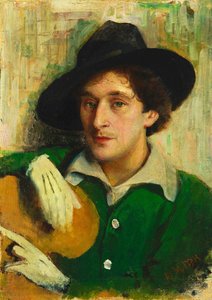
      § 4The artist

      Marc Chagall

      Marc Chagall

      1887 - 1985, Білорусь

      Quick facts about Marc Chagall

      • Artistic Movement Or Style: Modernizm, Kubizm
      • Artists Or Movements Influenced By This Artist:
        • Surrealizm
        • Artyści nowoczesni
      • Artists Who Influenced This Artist:
        • Bakst
        • Delaunay
        • Borowikowy
      • Date Of Birth: 7 lipca 1887
      • Date Of Death: 28 marca 1985
      • Full Name: Marc Chagall
      • Nationality: Rosjanin-Francuz
      • Notable Artworks:
        • I i Wieś
        • Nad Vitebskiem
        • Białe Ukrzyżowanie
      • Place Of Birth: Liozna, Białoruś

      Biografia artysty

      A Life Painted in Dreams: The World of Marc Chagall

      Marc Chagall, born Moishe Shagal in 1887 in the small Belarussian town of Liozna near Vitebsk, wasn’t merely a painter; he was a poet of color, a weaver of dreams, and a chronicler of memory. His life, spanning nearly a century, mirrored the tumultuous currents of the 20th century, yet his art remained steadfastly rooted in a deeply personal vision—one infused with the folklore of his Hasidic Jewish upbringing and an unwavering belief in the power of imagination. Vitebsk itself was more than just a birthplace; it became the emotional core of his artistic universe, a recurring motif populated by flying figures, whimsical animals, and the vibrant hues of remembered landscapes. The town’s unique blend of cultures—Russian Orthodox churches alongside bustling Jewish marketplaces—forged an aesthetic sensibility that would defy easy categorization throughout his long career. Though he sought formal training first with a local sign painter and later in St. Petersburg under Léon Bakst, and then in Paris at the Académie de la Grande Chaumière, Chagall never fully embraced any single artistic movement. He absorbed elements of Cubism, Symbolism, and Fauvism, but always filtered them through his own intensely personal lens, creating a style that was uniquely, unmistakably Chagall.

      Early Years and Artistic Beginnings

      Chagall’s formative years were marked by hardship and displacement. Born into a family of impoverished Jewish artisans, he experienced the trauma of pogroms—violent attacks against Jews—which instilled in him a profound awareness of persecution and loss. Despite these challenges, he pursued his artistic ambitions with unwavering determination, initially studying sign painting before enrolling at St. Petersburg’s Imperial Art Academy under Léon Bakst, where he honed his skills in theatrical design. However, Bakst's insistence on adhering to academic conventions clashed with Chagall’s innate inclination toward expressive abstraction, prompting him to forge his own path—a path that would ultimately lead him away from formal training and towards a radically original artistic vision. His early paintings, such as I and the Village (1911), already demonstrated his distinctive approach: he eschewed realistic representation in favor of fragmented imagery imbued with symbolic meaning. The village wasn’t rendered realistically but as a collection of recollections, bathed in luminous colors—a technique that would become central to his oeuvre. This ability to transmute personal experience into universal themes became a hallmark of his art and foreshadowed the stylistic innovations that would characterize his subsequent work.

      The Symbolist Influence and Vitebsk’s Vision

      Chagall's artistic development was profoundly shaped by Symbolism, particularly by artists like Gustave Moreau and Edvard Munch. He embraced the Symbolists’ preoccupation with emotion and psychological depth, rejecting the objective depiction of reality in favor of subjective expression. The influence of folklore—particularly Jewish folklore—was equally significant. Chagall drew inspiration from biblical stories, folktales, and Jewish traditions, incorporating fantastical elements into his paintings that evoked a sense of wonder and enchantment. Vitebsk remained an enduring presence in Chagall’s artistic imagination. He depicted the town repeatedly throughout his career, capturing its distinctive atmosphere—the juxtaposition of Orthodox churches and Jewish marketplaces—with vibrant colors and dreamlike distortions. These images weren't merely topographical representations; they were expressions of nostalgia for a lost homeland and reflections on themes of identity and belonging.

      Cubism and Beyond: Experimentation and Innovation

      While Chagall absorbed elements of Cubism, pioneered by Pablo Picasso and Georges Braque, he never fully embraced its geometric rigor. Instead, he adapted Cubist principles—such as fragmentation and multiple perspectives—to his own expressive style, creating canvases that defied conventional spatial conventions. He experimented with collage techniques, incorporating newspaper clippings and other found objects into his paintings—a practice that reflected his engagement with the cultural landscape of his time. His palette became increasingly bold and chromatic, employing colors that seemed to defy natural laws—colors that pulsed with emotion and conveyed a sense of otherworldly beauty. This willingness to push boundaries—to challenge artistic conventions—was driven by an unwavering belief in the transformative power of art.

      Mature Works and Legacy

      Chagall’s mature oeuvre encompasses a vast range of subjects—biblical narratives, portraits, landscapes, still lifes—each rendered with unparalleled sensitivity and imagination. Paintings like White Crucifixion (1937) are emotionally charged meditations on suffering and redemption, reflecting the anxieties of the era while simultaneously reaffirming Chagall’s humanist values. His stained glass windows for the Hadassah Hebrew University Medical Center synagogue in Jerusalem—a monumental undertaking that cemented his reputation as a visionary artist—represent a culmination of his artistic explorations. These works stand as testament to his enduring influence on subsequent generations of artists, who continue to draw inspiration from his lyrical style and his profound engagement with universal themes. Marc Chagall’s legacy extends beyond his paintings; it resides in the indelible mark he left on the history of art—a mark characterized by beauty, imagination, and an unwavering commitment to expressing the deepest recesses of human experience. He died March 28, 1985, leaving behind a body of work that continues to captivate audiences worldwide.

      § 5Comparanda

      § 6Questions

      Najważniejsze informacje

      • Artist: Marc Chagall
      • Artistic style: Dreamlike quality
      • Movement: Naive Art / Primitivism
      • Influences:
        • Folklore
        • Imagination
      • Dimensions: 64 x 51 cm
      • Subject or theme: Biblical Narrative

      Quiz o sztuce

      Do każdego pytania dotyczy tylko jedna poprawna odpowiedź.

      Pytanie 1:
      In what year was the painting 'Moses and Aaron' completed?
      Pytanie 2:
      What medium did Marc Chagall use for this artwork?
      Pytanie 3:
      Which artistic style is associated with this piece?
      Pytanie 4:
      What are the primary colors mentioned in the description of the painting's palette?
      Pytanie 5:
      Where was Marc Chagall born?

      § 7Cite this entry

      AllPaintingsStore.com, “Marc Chagall, Moses and Aaron (1931)”, https://allpaintingsstore.com/pl/art/marc-chagall-moses-and-aaron-8XYGZ9-en/ArtistReproduction/ (accessed 2 Październik 2026).

      § 8The reproduction

      Ręcznie malowana reprodukcja olejowa

      Ręcznie malowany obraz olejny na płótnie, wykonany na zamówienie przez naszych artystów w wybranym przez Ciebie wymiarze i oprawie. ( Przełącz na wydania drukowane Przejdź do wersji cyfrowej)

      It is specified on the order sheet in the margin; the present state of that sheet reads as follows.

      Moses and Aaron

      Technika reprodukcji

      Wymiary reprodukcji

      -

      Wybitny mistrz artystyczny

      Większa szczegółowość, finezja i dodatkowy czas na realizację

      -

      Opcje oprawy reprodukcji

      -

      -

      W przypadku dzieł sztuki lub reprodukcji, których którykolwiek z boków przekracza 105 cm (około 41 cali), rama zostanie wysłana w formie zestawu do samodzielnego montażu. Metoda ta zapewnia bezpieczną dostawę i zapobiega uszkodzeniom podczas transportu.

      Wymagany profesjonalny montaż – nie jest to produkt typu DIY.
      Zestaw musi zostać złożony, a płótno naciągnięte przez doświadczonego profesjonalnego ramiarza, przy użyciu kleju do drewna (brak w zestawie), kleszczy do naciągania płótna oraz ścisków, które utrzymają krosna w równej pozycji podczas schnięcia kleju. Nieprawidłowy montaż lub nierównomierne napięcie płótna może trwale uszkodzić dzieło sztuki i nie podlega naszej gwarancji.

      • W zestawie znajdują się wszystkie listwy z litego drewna, precyzyjnie docięte do wymiarów.

      • Montaż odbywa się przy użyciu dołączonych wkrętów oraz kleju do drewna do łączenia narożników, którego zestaw nie zawiera i który musi zostać dostarczony przez ramiarza.

      • Wymagane są profesjonalne narzędzia, których nie ma w zestawie: kleszcze do naciągania płótna (napinacz) oraz zaciski, które pozwolą utrzymać listwy w równej pozycji podczas schnięcia kleju.

      Ważne:
      Do połączenia narożników niezbędny jest klej do drewna, listwy należy unieruchomić za pomocą ścisków do momentu całkowitego wyschnięcia kleju, a naciągnięcie płótna na złożoną ramę wymaga użycia kleszczy do naciągania płótna. Żaden z tych elementów nie jest dołączony do zestawu. Przed zamówieniem tego rozmiaru zalecamy konsultację z doświadczonym ramiarzem.

      Etykieta obiektu

      -

      -

      Lakier ochronny

      Lakier z połyskiem (pogłębia kolory, chroni przed światłem i wilgocią)

      -

      Personalizacja dzieła

      Przykłady możliwości personalizacji: zastąp twarz zdjęciem klienta; dodaj zwierzę domowe (np. zamień kota na psa); umieść ukrytą wiadomość w tle; zmień krajobraz lub elementy tła.

      -

      Ekspresowa

      Dostawa na cały świat () w ciągu 3–4 tygodni zamiast standardowych 5 tygodni. (30 Październik). Bez kompromisów w kwestii jakości.

      -

      Przesyłka ekspresowa

      Dostawa na cały świat () w ciągu 5 tygodni. (6 Listopad).

      W cenie

      Cena całkowita

      zł 1002

      Included with every order

      • Bezpłatna ekspresowa wysyłka na cały świat
      • Wysokiej jakości płótno lniane
      • Pełne ubezpieczenie przesyłki
      • Gwarancja zwrotu należności celnych i podatków importowych
      • Gwarancja wiernego odwzorowania kolorów
      • 100-dniowa polityka zwrotów (tylko w przypadku wad)
      • Gwarancja 100% zwrotu pieniędzy
      • Zniżka przy zakupie wielu sztuk
      Order sheet