Gwarancja zwrotu pieniędzy · 100 dni Darmowa dostawa na cały świat
449 564dzieła sztuki 30 613artyści 4 660muzea 32język
Wpis do katalogu

The green branch

1984. Lithograph, 83.0 x 60.0 cm.

Ryc. 1. Marc Chagall, The green branch, 1984. Przedstawiono jako wybraną przez Ciebie reprodukcję: , .

§ 1Dane katalogowe

Wymiary
83.0 x 60.0 cm

§ 2Abstrakcja

Opis obiektu

Marc Chagall’s ‘The Green Branch’ (1984) – a dreamlike lithograph featuring vibrant foliage & figures. Explore Expressionism, symbolism & Chagall's unique style.

Biografia artysty

Poznaj fascynujący świat Marc Chagalla (1887-1985), rosyjskiego i francuskiego mistrza sztuki, znanego z obrazów pełnych snu i folklorystycznych motywów oraz pięknych witraży. Odkryj jego dziedzictwo!

§ 3Komentarz

A Dreamscape of Fertility and Aspiration: Exploring Chagall’s ‘The Green Branch’

  • Subject & Composition: ‘The Green Branch’ transports viewers to a whimsical realm populated by figures entwined with lush foliage. Two women take center stage – one nude, her gaze lifted heavenward, and the other partially clothed, seemingly observing or engaged in conversation. A male figure appears to float amongst the leaves, adding to the dreamlike quality. The composition is vertically oriented, emphasizing upward movement, yet deliberately imbalanced; a dense cluster of greenery on the right contrasts with the more centralized figures, creating dynamic tension.
  • Style & Technique: Executed as a lithograph in 1984, this work exemplifies Marc Chagall’s signature Expressionistic style. He masterfully employs loose brushwork and distorted forms to prioritize emotional impact over realistic representation. The lithographic technique itself is crucial – allowing for textured surfaces with varying ink densities that contribute to the artwork's vibrancy and depth. Colors are applied spontaneously, enhancing the sense of movement and energy.

Symbolism Rooted in Chagall’s Life & Legacy

  • Fertility & Nature’s Power: The abundance of vegetation is a recurring motif in Chagall's work, deeply rooted in his childhood memories of Vitebsk, Belarus. It symbolizes fertility, growth, and the potent force of nature – themes frequently linked to Jewish folklore and personal experiences.
  • Aspiration & Spiritual Connection: The upward gaze of the central female figure is particularly poignant. It suggests a yearning for something beyond the earthly realm, perhaps representing spiritual aspiration or a connection to the divine. This motif echoes themes found in Chagall’s earlier works like “Adam and Eve,” exploring humanity's relationship with paradise and faith.
  • Chagall’s Late Style: Created late in his life, ‘The Green Branch’ demonstrates Chagall’s continued exploration of these core themes. While retaining the fantastical elements that define his style, there is a sense of reflection and perhaps even acceptance present in the work.

Emotional Resonance & Interior Design Considerations

  • A Mood of Tranquil Wonder: ‘The Green Branch’ evokes a feeling of tranquil wonder, inviting contemplation and offering an escape from reality. The soft colors and flowing lines create a soothing atmosphere, while the symbolic elements add layers of meaning.
  • Interior Design Applications: This artwork would be particularly well-suited for spaces intended for relaxation or creative inspiration – bedrooms, living rooms, or home offices. Its predominantly green and blue palette complements natural materials like wood and linen, creating a harmonious environment. The verticality of the composition makes it ideal for hallways or areas with high ceilings.
  • A Lasting Legacy: Marc Chagall remains one of the most beloved artists of the 20th century. Owning a reproduction of ‘The Green Branch’ is not merely acquiring a beautiful image; it's embracing a legacy of imagination, emotion, and artistic innovation.

Pytania i odpowiedzi

Czy mogę zobaczyć obraz „The green branch” – Marc Chagall w widoku rentgenowskim?

Widok rentgenowski dzieła „The green branch” – Marc Chagall jest dostępny na stronie Analiza rentgenowska: to interaktywna analiza obrazu obejmująca jedenaście warstw optycznych.

Czy dostępny jest plik do pobrania w wysokiej rozdzielczości dla "The green branch"?

Aby otrzymać plik cyfrowy dzieła „The green branch” – Marc Chagall, zamów wysokiej rozdzielczości cyfrowe zdjęcie do pobrania na stronie Cyfrowy obraz.

Gdzie mogę znaleźć przewodnik do "The green branch"?

Strona Karta informacyjna dla uczniów dzieła „The green branch” – Marc Chagall oferuje dwustronicową kartę informacyjną w formacie do druku: samo dzieło wraz z tabelą identyfikacyjną, oś czasu umieszczającą je w latach życia artysty, inne prace tego twórcy, zmierzoną paletę kolorystyczną oraz gotowe do skopiowania cytaty w czterech stylach.
§ 4Artysta

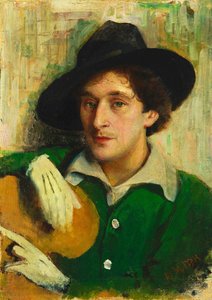
Marc Chagall

Marc Chagall

1887 - 1985, Білорусь

Krótkie informacje o Marc Chagall

  • Artistic Movement Or Style: Modernizm, Kubizm
  • Artists Or Movements Influenced By This Artist:
    • Surrealizm
    • Artyści nowoczesni
  • Artists Who Influenced This Artist:
    • Bakst
    • Delaunay
    • Borowikowy
  • Date Of Birth: 7 lipca 1887
  • Date Of Death: 28 marca 1985
  • Full Name: Marc Chagall
  • Nationality: Rosjanin-Francuz
  • Notable Artworks:
    • I i Wieś
    • Nad Vitebskiem
    • Białe Ukrzyżowanie
  • Place Of Birth: Liozna, Białoruś

Biografia artysty

A Life Painted in Dreams: The World of Marc Chagall

Marc Chagall, born Moishe Shagal in 1887 in the small Belarussian town of Liozna near Vitebsk, wasn’t merely a painter; he was a poet of color, a weaver of dreams, and a chronicler of memory. His life, spanning nearly a century, mirrored the tumultuous currents of the 20th century, yet his art remained steadfastly rooted in a deeply personal vision—one infused with the folklore of his Hasidic Jewish upbringing and an unwavering belief in the power of imagination. Vitebsk itself was more than just a birthplace; it became the emotional core of his artistic universe, a recurring motif populated by flying figures, whimsical animals, and the vibrant hues of remembered landscapes. The town’s unique blend of cultures—Russian Orthodox churches alongside bustling Jewish marketplaces—forged an aesthetic sensibility that would defy easy categorization throughout his long career. Though he sought formal training first with a local sign painter and later in St. Petersburg under Léon Bakst, and then in Paris at the Académie de la Grande Chaumière, Chagall never fully embraced any single artistic movement. He absorbed elements of Cubism, Symbolism, and Fauvism, but always filtered them through his own intensely personal lens, creating a style that was uniquely, unmistakably Chagall.

Early Years and Artistic Beginnings

Chagall’s formative years were marked by hardship and displacement. Born into a family of impoverished Jewish artisans, he experienced the trauma of pogroms—violent attacks against Jews—which instilled in him a profound awareness of persecution and loss. Despite these challenges, he pursued his artistic ambitions with unwavering determination, initially studying sign painting before enrolling at St. Petersburg’s Imperial Art Academy under Léon Bakst, where he honed his skills in theatrical design. However, Bakst's insistence on adhering to academic conventions clashed with Chagall’s innate inclination toward expressive abstraction, prompting him to forge his own path—a path that would ultimately lead him away from formal training and towards a radically original artistic vision. His early paintings, such as I and the Village (1911), already demonstrated his distinctive approach: he eschewed realistic representation in favor of fragmented imagery imbued with symbolic meaning. The village wasn’t rendered realistically but as a collection of recollections, bathed in luminous colors—a technique that would become central to his oeuvre. This ability to transmute personal experience into universal themes became a hallmark of his art and foreshadowed the stylistic innovations that would characterize his subsequent work.

The Symbolist Influence and Vitebsk’s Vision

Chagall's artistic development was profoundly shaped by Symbolism, particularly by artists like Gustave Moreau and Edvard Munch. He embraced the Symbolists’ preoccupation with emotion and psychological depth, rejecting the objective depiction of reality in favor of subjective expression. The influence of folklore—particularly Jewish folklore—was equally significant. Chagall drew inspiration from biblical stories, folktales, and Jewish traditions, incorporating fantastical elements into his paintings that evoked a sense of wonder and enchantment. Vitebsk remained an enduring presence in Chagall’s artistic imagination. He depicted the town repeatedly throughout his career, capturing its distinctive atmosphere—the juxtaposition of Orthodox churches and Jewish marketplaces—with vibrant colors and dreamlike distortions. These images weren't merely topographical representations; they were expressions of nostalgia for a lost homeland and reflections on themes of identity and belonging.

Cubism and Beyond: Experimentation and Innovation

While Chagall absorbed elements of Cubism, pioneered by Pablo Picasso and Georges Braque, he never fully embraced its geometric rigor. Instead, he adapted Cubist principles—such as fragmentation and multiple perspectives—to his own expressive style, creating canvases that defied conventional spatial conventions. He experimented with collage techniques, incorporating newspaper clippings and other found objects into his paintings—a practice that reflected his engagement with the cultural landscape of his time. His palette became increasingly bold and chromatic, employing colors that seemed to defy natural laws—colors that pulsed with emotion and conveyed a sense of otherworldly beauty. This willingness to push boundaries—to challenge artistic conventions—was driven by an unwavering belief in the transformative power of art.

Mature Works and Legacy

Chagall’s mature oeuvre encompasses a vast range of subjects—biblical narratives, portraits, landscapes, still lifes—each rendered with unparalleled sensitivity and imagination. Paintings like White Crucifixion (1937) are emotionally charged meditations on suffering and redemption, reflecting the anxieties of the era while simultaneously reaffirming Chagall’s humanist values. His stained glass windows for the Hadassah Hebrew University Medical Center synagogue in Jerusalem—a monumental undertaking that cemented his reputation as a visionary artist—represent a culmination of his artistic explorations. These works stand as testament to his enduring influence on subsequent generations of artists, who continue to draw inspiration from his lyrical style and his profound engagement with universal themes. Marc Chagall’s legacy extends beyond his paintings; it resides in the indelible mark he left on the history of art—a mark characterized by beauty, imagination, and an unwavering commitment to expressing the deepest recesses of human experience. He died March 28, 1985, leaving behind a body of work that continues to captivate audiences worldwide.

§ 5Podobne dzieła

§ 6Pytania

Najważniejsze informacje

  • artist: Marc Chagall
  • year: 1984
  • style: Expressionistic
  • title: The green branch
  • subject: Figures amidst lush foliage and swirling clouds

Quiz o sztuce

Do każdego pytania dotyczy tylko jedna poprawna odpowiedź.

Pytanie 1:
What artistic movement is most closely associated with Marc Chagall's style, as exemplified in 'The Green Branch'?
Pytanie 2:
The abundance of foliage in 'The Green Branch' can be interpreted symbolically as representing what?
Pytanie 3:
What printmaking technique was used to create 'The Green Branch'?
Pytanie 4:
Which of the following best describes the perspective employed in 'The Green Branch'?
Pytanie 5:
What is a recurring motif in Chagall's work, stemming from his childhood?

§ 7Cytuj ten wpis

AllPaintingsStore.com, “Marc Chagall, The green branch (1984)”, https://allpaintingsstore.com/pl/art/marc-chagall-the-green-branch-8XYHCL-en/ArtistReproduction/ (dostęp dnia 8 Październik 2026).

§ 8Reprodukcja dzieła

Ręcznie malowana reprodukcja olejowa

Ręcznie malowany obraz olejny na płótnie, wykonany na zamówienie przez naszych artystów w wybranym przez Ciebie wymiarze i oprawie. ( Przełącz na wydania drukowane Przejdź do wersji cyfrowej)

Informacja ta widnieje na marginesie arkusza zamówienia; obecny stan tego arkusza przedstawia się następująco.

The green branch

Technika reprodukcji

Wymiary reprodukcji

-

Wybitny mistrz artystyczny

Większa szczegółowość, finezja i dodatkowy czas na realizację

-

Opcje oprawy reprodukcji

-

-

W przypadku dzieł sztuki lub reprodukcji, których którykolwiek z boków przekracza 105 cm (około 41 cali), rama zostanie wysłana w formie zestawu do samodzielnego montażu. Metoda ta zapewnia bezpieczną dostawę i zapobiega uszkodzeniom podczas transportu.

Wymagany profesjonalny montaż – nie jest to produkt typu DIY.
Zestaw musi zostać złożony, a płótno naciągnięte przez doświadczonego profesjonalnego ramiarza, przy użyciu kleju do drewna (brak w zestawie), kleszczy do naciągania płótna oraz ścisków, które utrzymają krosna w równej pozycji podczas schnięcia kleju. Nieprawidłowy montaż lub nierównomierne napięcie płótna może trwale uszkodzić dzieło sztuki i nie podlega naszej gwarancji.

  • W zestawie znajdują się wszystkie listwy z litego drewna, precyzyjnie docięte do wymiarów.

  • Montaż odbywa się przy użyciu dołączonych wkrętów oraz kleju do drewna do łączenia narożników, którego zestaw nie zawiera i który musi zostać dostarczony przez ramiarza.

  • Wymagane są profesjonalne narzędzia, których nie ma w zestawie: kleszcze do naciągania płótna (napinacz) oraz zaciski, które pozwolą utrzymać listwy w równej pozycji podczas schnięcia kleju.

Ważne:
Do połączenia narożników niezbędny jest klej do drewna, listwy należy unieruchomić za pomocą ścisków do momentu całkowitego wyschnięcia kleju, a naciągnięcie płótna na złożoną ramę wymaga użycia kleszczy do naciągania płótna. Żaden z tych elementów nie jest dołączony do zestawu. Przed zamówieniem tego rozmiaru zalecamy konsultację z doświadczonym ramiarzem.

Etykieta obiektu

-

-

Lakier ochronny

Lakier z połyskiem (pogłębia kolory, chroni przed światłem i wilgocią)

-

Personalizacja dzieła

Przykłady możliwości personalizacji: zastąp twarz zdjęciem klienta; dodaj zwierzę domowe (np. zamień kota na psa); umieść ukrytą wiadomość w tle; zmień krajobraz lub elementy tła.

-

Ekspresowa

Dostawa na cały świat () w ciągu 3–4 tygodni zamiast standardowych 5 tygodni. (5 Listopad). Bez kompromisów w kwestii jakości.

-

Przesyłka ekspresowa

Dostawa na cały świat () w ciągu 5 tygodni. (12 Listopad).

W cenie

Cena całkowita

zł 1196

W każdym zamówieniu

  • Bezpłatna ekspresowa wysyłka na cały świat
  • Wysokiej jakości płótno lniane
  • Pełne ubezpieczenie przesyłki
  • Gwarancja zwrotu należności celnych i podatków importowych
  • Gwarancja wiernego odwzorowania kolorów
  • 100-dniowa polityka zwrotów (tylko w przypadku wad)
  • Gwarancja 100% zwrotu pieniędzy
  • Zniżka przy zakupie wielu sztuk
Arkusz zamówień