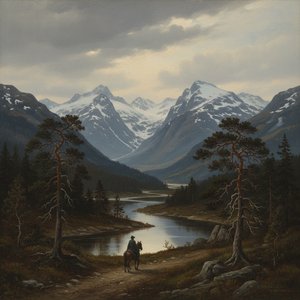
Peder Balke: A Visionary of the Nordic Sublime
Peder Andersen Balke, born in 1804 on the remote island of Helgøya in Hedmark, Norway, stands as a uniquely powerful voice within the landscape tradition of the 19th century. His life was one profoundly shaped by both artistic ambition and the harsh realities of rural existence – a duality that deeply informed his evocative paintings. From humble beginnings, marked by poverty and familial struggles, Balke’s innate talent for capturing the essence of nature ultimately propelled him to become a celebrated artist, recognized today as a pivotal figure in Norwegian art history.
Early Life and Artistic Foundations
Balke's childhood was far from idyllic. His family, simple farmers on the island of Helgøya, struggled with poverty, compounded by the devastating famine of 1812 following a blockade of Norwegian ports during the Napoleonic Wars. His father abandoned the family when Peder was young, leaving his mother to raise him and his brother amidst hardship. Despite these challenges, Balke’s maternal grandfather, an artisan and painter, instilled in him a love for art and provided early encouragement. Recognizing his son's potential, he secured him an apprenticeship with Heinrich August Grosch, a renowned engraver and artist in Christiania (now Oslo). Later, Balke studied under Jacob Munch, further honing his skills before embarking on formal training at the Royal Swedish Academy of Fine Arts in Stockholm, where he was influenced by the dramatic landscapes of Johan Christian Dahl. This diverse artistic education laid the foundation for Balke’s distinctive style – a synthesis of Romanticism and a deeply personal connection to the Norwegian wilderness.
The Shaping of a Unique Style: Light, Atmosphere, and Emotion
Balke's artistic development was characterized by an intense exploration of technique and expression. He wasn’t merely interested in replicating what he saw; instead, he sought to capture the *feeling* of nature – its power, its mystery, and its sublime beauty. His paintings are immediately recognizable for their dramatic use of light, often depicting scenes bathed in ethereal moonlight or shrouded in atmospheric darkness. This fascination with fleeting effects—particularly the interplay of light and shadow during twilight hours—became a defining feature of his work. His brushwork is notably textured and unconventional, creating a dreamlike quality that sets him apart from more conventional Romantic landscape painters. As he himself expressed, “I don’t paint what I see, but what I feel.” This emphasis on emotional resonance elevated his landscapes beyond mere depictions of scenery; they became windows into the soul of Norway.
Landscapes of Norway: A National Identity
Balke is most celebrated for his evocative portrayals of the Norwegian landscape – a subject he revisited repeatedly throughout his career. Works such as Vue de Christiania (1872) offer glimpses into the urban life of Oslo, yet even here, the natural world remains dominant, framing the cityscape and reminding viewers of its inextricable connection to the surrounding wilderness. The painting *The Harbor at Skjervøy* (1846) showcases his meticulous attention to detail alongside an ability to capture the bustling energy of a coastal port. Perhaps most powerfully, paintings like Old Trees (1840) and *Seascape* (1845), and especially *The North Cape by Moonlight* (1848), exemplify his mastery of mood and atmosphere – conveying the rugged beauty and untamed spirit of Norway’s coastline and northern reaches. These weren't simply picturesque views; they were statements about national identity, a passionate celebration of Norway’s unique natural heritage.
Beyond the Canvas: Social Activism and Legacy
Peder Balke was more than just an artist; he was a committed social reformer deeply invested in improving the lives of his fellow Norwegians. He recognized the vital role that art could play in society, advocating for financial support for artists – both men and women – arguing that creativity should be accessible to all. His most significant social initiative was the Balkeby project – a new suburb of Oslo designed to provide decent living conditions for workers. Balke personally oversaw the construction, enforcing strict building regulations and providing loans, demonstrating a practical commitment to social justice. Despite his considerable contributions, Balke’s work remained largely overlooked after his death in 1887. However, in recent decades, a renewed appreciation for his unique vision has emerged, culminating in major exhibitions at institutions like the National Gallery in London and the Metropolitan Museum of Art in New York. Today, Peder Balke is recognized as a pivotal figure in Norwegian art history – an artist whose dramatic landscapes and profound emotional depth continue to resonate with audiences worldwide.


 Rozwiń treść


 Przełącz na wydania drukowane


 W przypadku dzieł sztuki lub reprodukcji, których którykolwiek z boków przekracza 105 cm (około 41 cali), rama zostanie wysłana w formie zestawu do samodzielnego montażu. Metoda ta zapewnia bezpieczną dostawę i zapobiega uszkodzeniom podczas transportu.