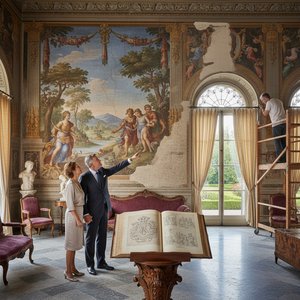
1315. Akryl na płótnie. Pałac Publiczny w Siennie.

§ 1Catalogue data


§ 2Abstract
Opis obiektu
Detaliczny fresk Simone Martini przedstawiający Marię Bogorodziczkową z Dzieciątkiem Jezus. Klasyka włoskiego gotyku siennego, emanująca elegancją i ciepłem kolorystyki. Zamów reprodukcję obrazu Maestà!
 Rozwiń treść
Biografia artysty
Simone Martini – włoski malarz gotycki, mistrz elegancji i wyrafinowania. Jego arcydzieła, takie jak "Maestà", łączą religijne tematy z dworskim szykiem i niezwykłą precyzją.
§ 3Commentary
Maestà – A Symphony of Grace and Divine Femininity
Simone Martini’s Maestà, completed around 1315 in Siena, transcends mere depiction; it embodies the very essence of Sienese Gothic art and stands as a testament to artistic brilliance. Painted on alabaster, this monumental fresco captures an exquisitely serene Madonna and Child scene—a composition that immediately draws the viewer into its contemplative atmosphere. The delicate lines of Martini’s brushstrokes convey an unparalleled sense of elegance and refinement, distinguishing him from his contemporaries and establishing him as a cornerstone of Sienese artistic heritage.Style and Technique: Gothic Elegance Refined
Martini's Maestà exemplifies the stylistic hallmarks of Siena during its golden age – a fusion of Byzantine influence with Northern European sensibilities. The artist skillfully employs tempera paint on alabaster, achieving remarkable luminosity and depth. This technique, favored by Martini and his collaborators like Lippo Memmi, allowed for meticulous detail work, particularly evident in the drapery folds and facial expressions. Unlike Giotto’s more monumental frescoes, Maestà prioritizes subtlety and grace, reflecting a shift towards a more refined aesthetic that anticipates the burgeoning Renaissance spirit. The careful layering of colors—primarily blues, reds, and golds—creates a visual richness that enhances the spiritual significance of the image.Historical Context: Siena's Religious Heartbeat
The fresco’s creation coincided with Siena’s fervent devotion to Saint Dominic, founder of the Dominican Order and champion of papal reform. The Madonna and Child iconography served as a powerful symbol of piety and maternal compassion—values deeply ingrained in Sienese society at the time. Maestà wasn't merely commissioned for liturgical decoration; it represented an ambitious undertaking aimed at glorifying God and reaffirming Siena’s spiritual identity. Its placement within the Duomo di Siena underscores its importance as a focal point of religious pilgrimage and artistic patronage.Symbolism: Layers of Meaning Beyond Beauty
Beyond its visual splendor, Maestà is laden with symbolic significance. The Virgin Mary's posture—seated on a throne adorned with lilies—represents purity and royalty, mirroring the divine majesty of God. The Child Jesus cradled in her arms symbolizes innocence and divine grace – emblems universally recognized within Christian iconography. Furthermore, the surrounding figures—angels flanking the throne—emphasize God’s protection and benevolence. Even the bird perched atop the throne serves as a subtle allusion to the Holy Spirit, signifying divine inspiration and spiritual illumination.Emotional Impact: A Moment of Transcendental Calm
Looking upon Maestà is akin to entering a realm of serene contemplation. Martini's masterful rendering captures not only the physical beauty of the Madonna and Child but also their profound emotional depth. The gaze of Mary conveys tenderness and compassion, inviting viewers into an intimate communion with divine grace. This enduring image continues to resonate across centuries, reminding us of the timeless power of faith and artistic expression—a testament to Simone Martini’s unparalleled ability to transform pigment and plaster into a masterpiece that transcends time itself.Pytania i odpowiedzi
Jaki rozmiar wydruku jest zalecany dla „Maestà” – Simone Martini?
Zalecany rozmiar wydruku dla „Maestà” – Simone Martini to Duży format.
Gdzie mogę pobrać „Maestà” – Simone Martini?
Możliwość pobrania dzieła „Maestà”: strona Pobierz plik cyfrowy oferuje wysokiej rozdzielczości cyfrowe zdjęcie do pobrania.
Jakie emocje przekazuje „Maestà” – Simone Martini?
„Maestà” budzi Spokój emocje. Ton emocjonalny opisuje wrażenie, jakie wywołuje to dzieło.


 Przełącz na wydania drukowane


 W przypadku dzieł sztuki lub reprodukcji, których którykolwiek z boków przekracza 105 cm (około 41 cali), rama zostanie wysłana w formie zestawu do samodzielnego montażu. Metoda ta zapewnia bezpieczną dostawę i zapobiega uszkodzeniom podczas transportu.