Gwarancja zwrotu pieniędzy · 100 dni Darmowa dostawa na cały świat
449 564dzieła sztuki 30 613artyści 4 660muzea 32język
Wpis do katalogu

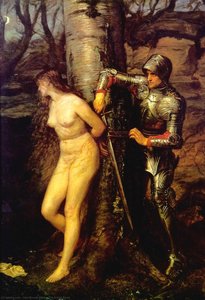
Mariana

1851. Oil On Canvas, 49.0 x 59.0 cm. Tate Britain.

Ryc. 1. John Everett Millais, Mariana, 1851. Przedstawiono jako wybraną przez Ciebie reprodukcję: , .

§ 1Dane katalogowe

Wymiary
49.0 x 59.0 cm

§ 2Abstrakcja

Opis obiektu

Sir John Everett Millais' 'Mariana' (1851) captures a woman’s poignant solitude & longing, rendered with Pre-Raphaelite detail. Explore Victorian melancholy and artistic innovation in this iconic painting.

Biografia artysty

John Everett Millais (1829-1896) – wybitny malarz Prerafaelita, znany z realizmu i obrazów takich jak "Ophelia". Jego twórczość odzwierciedlałaby ducha epoki wiktoriańskiej.

§ 3Komentarz

The Enigmatic Figure of Mariana

John Everett Millais’s “Mariana,” painted in 1851, isn't merely a portrait; it’s an exquisitely rendered distillation of Victorian melancholy and the quiet desperation of a woman caught between longing and resignation. The painting immediately draws the viewer into a small, intimate chamber, dominated by a figure draped in a luminous blue gown – a color that simultaneously suggests both serenity and profound sadness. This isn't a scene of dramatic action or vibrant celebration; instead, Millais masterfully captures a moment of suspended animation, a pregnant pause within a life seemingly defined by waiting.

The subject, identified as Mariana from Shakespeare’s “Measure for Measure,” is positioned near a window adorned with stained glass panels depicting the Annunciation. This subtle detail introduces a layer of religious symbolism – the promise of divine grace juxtaposed against the woman's earthly sorrow. Her posture, with one hand resting on her hip and the other supporting a table laden with wine glasses and a vase, speaks volumes about her state of mind: poised between activity and inertia, engagement and detachment. The carefully arranged objects around her—the embroidery hoop, the fallen leaves, the scattered fruit – contribute to a sense of domesticity tinged with decay and loss.

Pre-Raphaelite Detail and Atmospheric Rendering

Millais’s technical skill is breathtakingly evident in every brushstroke. He employed the Pre-Raphaelite style—a movement characterized by an obsessive attention to detail, a reverence for nature, and a rejection of academic conventions—to create an image that feels both hyperrealistic and intensely emotional. The embroidery itself is rendered with astonishing precision, each stitch painstakingly depicted, inviting the viewer to contemplate the labor and perhaps the loneliness associated with such meticulous work. The use of light is particularly noteworthy; it’s diffused and soft, bathing the scene in a melancholic glow that enhances the painting's overall mood.

  • Color Palette: Dominated by blues, greens, and browns, creating a sense of muted elegance.
  • Brushwork: Loose and expressive, particularly evident in the rendering of the foliage and the texture of the fabrics.
  • Composition: Carefully balanced, with the figure occupying a central position within the confined space.

Symbolism and Victorian Longing

“Mariana” is rich in symbolic meaning, reflecting the anxieties and sensibilities of Victorian society. The woman’s posture—stretching her back, seemingly burdened by an unseen weight—represents the constraints placed upon women during that era. Her gaze towards the window, a space offering both beauty and distance, symbolizes her yearning for something beyond her immediate circumstances. The fallen leaves suggest the passage of time and the inevitability of loss, while the stained-glass windows hint at a spiritual longing that remains unfulfilled.

Furthermore, the reference to Tennyson’s poem adds another layer of interpretation. Mariana's story is one of abandonment and despair, yet Millais transforms this tragic narrative into a poignant meditation on beauty, solitude, and the enduring power of human emotion. The painting isn’t simply about a woman in distress; it’s about the universal experience of longing—a feeling that transcends time and circumstance.

A Timeless Portrait of Human Emotion

“Mariana” remains one of Millais's most celebrated works, captivating viewers with its haunting beauty and profound emotional resonance. It stands as a testament to the Pre-Raphaelite movement’s commitment to capturing the complexities of human experience—a poignant reminder that even in moments of quiet solitude, the heart can still ache with longing and unfulfilled desires. Reproductions of this masterpiece offer an opportunity to bring its evocative atmosphere into any space, serving as both a work of art and a window into the soul.

Pytania i odpowiedzi

Kto jest autorem i jaki styl reprezentuje "Mariana"?

Za dziełem "Mariana" stoi John Everett Millais oraz nurt Pre-Raphaelite Brotherhood.

W którym roku powstało dzieło "Mariana"?

„Mariana” – John Everett Millais powstało w 1851.

Jaki nastrój wprowadzi Mariana do wnętrza?

Calm atmosfera dzieła „Mariana” – John Everett Millais idealnie współgra z polecaną przestrzenią: jest nią Living Room.

§ 4Artysta

John Everett Millais

John Everett Millais

1829 - 1896, Wielka Brytania

Krótkie informacje o John Everett Millais

  • Artistic Movement Or Style: Prerafaelizm, Realizm
  • Artists Or Movements Influenced By This Artist: Prerafaelska szkoła
  • Artists Who Influenced This Artist: Prerafaeliści
  • Date Of Birth: 8 czerwca 1829
  • Date Of Death: 13 sierpnia 1896
  • Full Name: Sir John Everett Millais
  • Nationality: Brytyjski
  • Notable Artworks:
    • Christ w domu...
    • Ophelia
    • Hugenot
    • Mariana
  • Place Of Birth: Southampton, Wielka Brytania

Biografia artysty

A Prodigy of the Pre-Raphaelites: The Life and Art of Sir John Everett Millais

Born in Southampton in 1829, John Everett Millais entered the Royal Academy Schools at the astonishing age of eleven—the youngest student ever admitted. This early demonstration of prodigious talent foreshadowed a career that would not only define an artistic movement but also capture the Victorian imagination with its breathtaking realism and emotional depth. From his earliest days, Millais possessed a remarkable gift for observation, a quality that would become the cornerstone of his artistic style. He wasn’t merely painting what he saw; he was meticulously recreating it, imbuing each brushstroke with an almost photographic fidelity. This dedication to truth in representation set him apart and ultimately led him to challenge the established conventions of British art.

The Birth of a Brotherhood and Artistic Rebellion

Millais’s artistic trajectory took a pivotal turn in 1848 when, alongside Dante Gabriel Rossetti and William Holman Hunt, he founded the Pre-Raphaelite Brotherhood. This wasn't simply an aesthetic choice; it was a deliberate rebellion against what they perceived as the artificiality of academic art—art that had strayed too far from the natural world and the sincerity of early Renaissance masters, those working *before* Raphael. The Pre-Raphaelites sought to revive the clarity, detail, and vibrant color palettes of artists like Jan van Eyck and Fra Angelico. Their manifesto was one of truth to nature, a rejection of idealized forms, and an embrace of subjects drawn from literature, mythology, and everyday life. Millais’s early works, such as *Isabella*, immediately showcased this new approach—a meticulous attention to detail combined with a narrative intensity that captivated and often provoked audiences. His most controversial work during this period, Christ in the House of His Parents (1849-50), depicted the Holy Family not as ethereal beings but as ordinary working-class people, sparking outrage among critics who found its realism unsettling and even blasphemous. The painting’s depiction of a mother washing her child's clothes in a muddy stream was considered shockingly unidealized for religious art at the time.

Evolving Styles and Victorian Sensibilities

The mid-1850s marked a period of significant change for Millais, both personally and artistically. His marriage to Effie Gray, following the annulment of her marriage to John Ruskin, profoundly influenced his work. He moved away from the intensely detailed, symbolic style of his early Pre-Raphaelite paintings towards a broader, more atmospheric realism. This shift wasn’t simply a matter of stylistic preference; it reflected a growing engagement with contemporary life and a desire to capture the fleeting beauty of the natural world. Paintings like *Autumn Leaves* exemplify this new direction—a serene depiction of a group of young women drifting leaves on a river, imbued with a sense of melancholy and nostalgia. The painting’s luminous quality and subtle color variations were groundbreaking for their time. He also found considerable success as a portraitist, capturing the likenesses of prominent Victorian figures, including John Gladstone and Benjamin Disraeli. This period saw Millais achieve widespread popularity and financial security, but it also drew criticism from some who felt he had compromised his artistic principles.

Major Works & Collections

  • Christ in the House of His Parents (1849-1850): Tate Britain, London – A controversial masterpiece that exemplifies early Pre-Raphaelite realism.
  • Ophelia (1851-1852): Tate Britain, London – Perhaps his most famous work, renowned for its haunting beauty and symbolic depth.
  • A Huguenot (1851-1852): Private Collection – A dramatic depiction of religious conflict and forbidden love.
  • Mariana (1850-1851): Manchester Art Gallery – Inspired by Shakespeare and Tennyson, showcasing Millais’s skill in capturing mood and atmosphere.
  • Autumn Leaves (1855-1856): City of Manchester Art Galleries – A serene and evocative painting that reflects his evolving style.

Legacy and Lasting Influence

Despite these criticisms, Sir John Everett Millais remains one of the most important figures in 19th-century British art. His influence extends far beyond the Pre-Raphaelite Brotherhood; he helped to redefine the standards of realism and narrative painting, inspiring generations of artists. His iconic images—Ophelia, with its haunting beauty and symbolic richness, A Huguenot, depicting a moment of poignant drama, and countless others—continue to resonate with audiences today. Millais’s ability to blend meticulous observation with emotional depth, his mastery of color and composition, and his willingness to challenge artistic conventions cemented his place as a true innovator. In 1896, he was elected President of the Royal Academy, a testament to his enduring legacy—though sadly, he passed away only months later. His work continues to be celebrated in museums and collections worldwide, ensuring that the beauty and power of his art will endure for generations to come.

§ 5Podobne dzieła

§ 6Pytania

Najważniejsze informacje

  • Medium: Oil on wood
  • Movement: Pre-Raphaelite
  • Artistic style: Realism, Symbolism
  • Year: 1851
  • Dimensions: 597 x 762 mm
  • Title: Mariana

§ 7Cytuj ten wpis

AllPaintingsStore.com, “John Everett Millais, Mariana (1851)”, https://allpaintingsstore.com/pl/art/sir-john-everett-millais-mariana-D3UAS8-en/ (dostęp dnia 7 Październik 2026).

§ 8Reprodukcja dzieła

Ręcznie malowana reprodukcja olejowa

Ręcznie malowany obraz olejny na płótnie, wykonany na zamówienie przez naszych artystów w wybranym przez Ciebie wymiarze i oprawie. ( Przełącz na wydania drukowane Przejdź do wersji cyfrowej)

Informacja ta widnieje na marginesie arkusza zamówienia; obecny stan tego arkusza przedstawia się następująco.

Mariana

Technika reprodukcji

Wymiary reprodukcji

-

Wybitny mistrz artystyczny

Większa szczegółowość, finezja i dodatkowy czas na realizację

-

Opcje oprawy reprodukcji

-

-

W przypadku dzieł sztuki lub reprodukcji, których którykolwiek z boków przekracza 105 cm (około 41 cali), rama zostanie wysłana w formie zestawu do samodzielnego montażu. Metoda ta zapewnia bezpieczną dostawę i zapobiega uszkodzeniom podczas transportu.

Wymagany profesjonalny montaż – nie jest to produkt typu DIY.
Zestaw musi zostać złożony, a płótno naciągnięte przez doświadczonego profesjonalnego ramiarza, przy użyciu kleju do drewna (brak w zestawie), kleszczy do naciągania płótna oraz ścisków, które utrzymają krosna w równej pozycji podczas schnięcia kleju. Nieprawidłowy montaż lub nierównomierne napięcie płótna może trwale uszkodzić dzieło sztuki i nie podlega naszej gwarancji.

  • W zestawie znajdują się wszystkie listwy z litego drewna, precyzyjnie docięte do wymiarów.

  • Montaż odbywa się przy użyciu dołączonych wkrętów oraz kleju do drewna do łączenia narożników, którego zestaw nie zawiera i który musi zostać dostarczony przez ramiarza.

  • Wymagane są profesjonalne narzędzia, których nie ma w zestawie: kleszcze do naciągania płótna (napinacz) oraz zaciski, które pozwolą utrzymać listwy w równej pozycji podczas schnięcia kleju.

Ważne:
Do połączenia narożników niezbędny jest klej do drewna, listwy należy unieruchomić za pomocą ścisków do momentu całkowitego wyschnięcia kleju, a naciągnięcie płótna na złożoną ramę wymaga użycia kleszczy do naciągania płótna. Żaden z tych elementów nie jest dołączony do zestawu. Przed zamówieniem tego rozmiaru zalecamy konsultację z doświadczonym ramiarzem.

Etykieta obiektu

-

-

Lakier ochronny

Lakier z połyskiem (pogłębia kolory, chroni przed światłem i wilgocią)

-

Personalizacja dzieła

Przykłady możliwości personalizacji: zastąp twarz zdjęciem klienta; dodaj zwierzę domowe (np. zamień kota na psa); umieść ukrytą wiadomość w tle; zmień krajobraz lub elementy tła.

-

Ekspresowa

Dostawa na cały świat () w ciągu 3–4 tygodni zamiast standardowych 5 tygodni. (4 Listopad). Bez kompromisów w kwestii jakości.

-

Przesyłka ekspresowa

Dostawa na cały świat () w ciągu 5 tygodni. (11 Listopad).

W cenie

Cena całkowita

zł 1009

W każdym zamówieniu

  • Bezpłatna ekspresowa wysyłka na cały świat
  • Wysokiej jakości płótno lniane
  • Pełne ubezpieczenie przesyłki
  • Gwarancja zwrotu należności celnych i podatków importowych
  • Gwarancja wiernego odwzorowania kolorów
  • 100-dniowa polityka zwrotów (tylko w przypadku wad)
  • Gwarancja 100% zwrotu pieniędzy
  • Zniżka przy zakupie wielu sztuk
Odkryj dzieła sztuki uporządkowane według tematów, stylów i cech charakterystycznych.
Arkusz zamówień