

.

§ 1Catalogue data
§ 2Abstract
Biografia artysty
Explore the evocative landscapes of William Bradley Lamond’s Forest Tracks – a British artist known for his detailed depictions of nature & rural life.
.
Explore the evocative landscapes of William Bradley Lamond’s Forest Tracks – a British artist known for his detailed depictions of nature & rural life.

1857 - 1924, United Kingdom
Born in Newtyle, Angus, Scotland, in 1857, William Bradley Lamond’s life and artistic journey were inextricably linked to the rugged beauty of his native land. He wasn't a man sculpted by formal art academies; instead, he emerged from the practical world of the Caledonian Railway, where he spent decades as an employee – a circumstance that profoundly shaped his perspective and ultimately fueled his distinctive style. This grounding in the rhythms of industry and the realities of rural life provided a unique foundation for his artistic vision, allowing him to capture not just landscapes but also the very spirit of Scotland’s Highland communities.
Lamond's early career began modestly, with exhibitions at local venues like Dunfermline and Dundee. However, it was his election to the Royal Society of British Artists in 1906 that marked a significant turning point, elevating him within the established art world. This recognition opened doors to larger institutions, including the Royal Academy and Glasgow Institute of the Fine Arts, where he showcased his increasingly celebrated landscapes. His work quickly gained attention for its vibrant colors, dynamic compositions, and an uncanny ability to evoke the atmosphere of the Scottish Highlands – a region he knew intimately through years spent traversing its hills and valleys.
Lamond’s artistic language is immediately recognizable: it's a celebration of light and color, deeply rooted in the Impressionistic movement yet infused with a distinctly personal vision. He wasn’t interested in photographic realism; rather, he sought to translate the *feeling* of a place onto canvas – the way sunlight filters through mist-laden peaks, the warmth radiating from a peat fire, the drama of a storm brewing over Loch Ness. His palette is bold and expressive, utilizing rich blues, greens, and yellows to capture the intensity of Highland light. He frequently employed loose brushstrokes and a sense of spontaneity, creating an impressionistic effect that prioritized atmosphere and emotion over meticulous detail.
Crucially, Lamond’s work isn't simply about depicting scenery; it’s about portraying people – their lives, their labors, and their connection to the land. His paintings often feature scenes of rural life: shepherds tending flocks, farmers working the fields, fishermen casting nets into icy waters. These figures are not idealized or romanticized; they are presented with a quiet dignity and an honest portrayal of their daily routines. This focus on the human element, combined with his masterful rendering of light and color, elevates his work beyond mere landscape painting.
Perhaps Lamond’s most famous series is “Forest Tracks,” a collection of paintings that became synonymous with his style. These works capture the essence of the Scottish Highlands in all their dramatic beauty – towering mountains, dense forests, and shimmering lochs. The titles themselves—"Glen Affric," "Loch Morlich," "Ben Nevis"—suggest a deep connection to specific locations, reflecting Lamond’s intimate knowledge of the region. These paintings are not simply representations of landscapes; they are imbued with a sense of mystery and timelessness, inviting viewers to lose themselves in their evocative beauty.
Beyond “Forest Tracks,” Lamond continued to produce a prolific body of work throughout his career. He explored various subjects – coastal scenes, portraits, and even interiors – always maintaining his distinctive style and unwavering commitment to capturing the spirit of Scotland. His later works demonstrate a subtle shift in focus, with an increased emphasis on atmospheric effects and a more subdued palette, reflecting perhaps a growing sense of melancholy or nostalgia.
William Bradley Lamond’s legacy extends beyond his individual paintings; he played a significant role in shaping the perception of the Scottish Highlands as a subject for art. His work helped to popularize the region's dramatic landscapes, inspiring generations of artists and travelers alike. While often categorized within the broader tradition of British landscape painting, Lamond’s unique style—his bold use of color, his emphasis on atmosphere, and his portrayal of rural life—sets him apart as a distinctly Scottish artist.
His work continues to be exhibited and appreciated today, serving as a powerful reminder of the beauty and resilience of Scotland's Highland communities. Lamond’s paintings are not just images; they are windows into a bygone era, offering glimpses of a world where life was intimately connected to the rhythms of nature and the traditions of the land.

AllPaintingsStore.com, “William Bradley Lamond, Horses At Water Trough”, https://allpaintingsstore.com/pl/art/william-bradley-lamond-horses-at-water-trough-9CWC7X-en/ (accessed 1 Październik 2026).
Ręcznie malowany obraz olejny na płótnie, wykonany na zamówienie przez naszych artystów w wybranym przez Ciebie wymiarze i oprawie. ( Przełącz na wydania drukowane Przejdź do wersji cyfrowej)
It is specified on the order sheet in the margin; the present state of that sheet reads as follows.
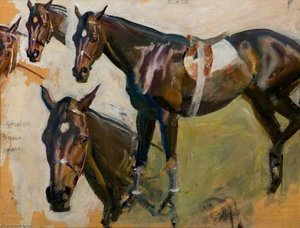
Horses At Water Trough
Wymiary reprodukcji
Większa szczegółowość, finezja i dodatkowy czas na realizację
-
W przypadku dzieł sztuki lub reprodukcji, których którykolwiek z boków przekracza 105 cm (około 41 cali), rama zostanie wysłana w formie zestawu do samodzielnego montażu. Metoda ta zapewnia bezpieczną dostawę i zapobiega uszkodzeniom podczas transportu.
Wymagany profesjonalny montaż – nie jest to produkt typu DIY.
Zestaw musi zostać złożony, a płótno naciągnięte przez doświadczonego profesjonalnego ramiarza, przy użyciu kleju do drewna (brak w zestawie), kleszczy do naciągania płótna oraz ścisków, które utrzymają krosna w równej pozycji podczas schnięcia kleju. Nieprawidłowy montaż lub nierównomierne napięcie płótna może trwale uszkodzić dzieło sztuki i nie podlega naszej gwarancji.
W zestawie znajdują się wszystkie listwy z litego drewna, precyzyjnie docięte do wymiarów.
Montaż odbywa się przy użyciu dołączonych wkrętów oraz kleju do drewna do łączenia narożników, którego zestaw nie zawiera i który musi zostać dostarczony przez ramiarza.
Wymagane są profesjonalne narzędzia, których nie ma w zestawie: kleszcze do naciągania płótna (napinacz) oraz zaciski, które pozwolą utrzymać listwy w równej pozycji podczas schnięcia kleju.
Ważne:
Do połączenia narożników niezbędny jest klej do drewna, listwy należy unieruchomić za pomocą ścisków do momentu całkowitego wyschnięcia kleju, a naciągnięcie płótna na złożoną ramę wymaga użycia kleszczy do naciągania płótna. Żaden z tych elementów nie jest dołączony do zestawu. Przed zamówieniem tego rozmiaru zalecamy konsultację z doświadczonym ramiarzem.
-
Lakier z połyskiem (pogłębia kolory, chroni przed światłem i wilgocią)
Przykłady możliwości personalizacji: zastąp twarz zdjęciem klienta; dodaj zwierzę domowe (np. zamień kota na psa); umieść ukrytą wiadomość w tle; zmień krajobraz lub elementy tła.
Dostawa na cały świat () w ciągu 3–4 tygodni zamiast standardowych 5 tygodni. (29 Październik). Bez kompromisów w kwestii jakości.
Dostawa na cały świat () w ciągu 5 tygodni. (5 Listopad).
Included with every order


 Rozwiń treść




 W przypadku dzieł sztuki lub reprodukcji, których którykolwiek z boków przekracza 105 cm (około 41 cali), rama zostanie wysłana w formie zestawu do samodzielnego montażu. Metoda ta zapewnia bezpieczną dostawę i zapobiega uszkodzeniom podczas transportu.


