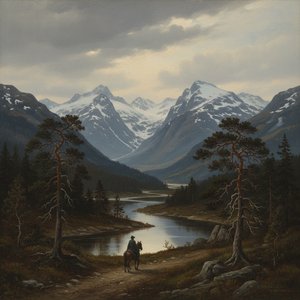
Frithjof Smith Hald: A Master of Norwegian Landscapes and the ‘Fiskerkone’
Frithjof Smith Hald, a name perhaps less familiar than some of his contemporaries, nevertheless stands as a significant figure in late 19th-century Scandinavian art. Born in Norway and later establishing himself as a prominent international artist, Hald's work is characterized by a profound connection to the land – particularly the rugged fjords, dramatic coastlines, and traditional rural life of his homeland. His paintings aren’t merely depictions of scenery; they are imbued with a deep sense of atmosphere, light, and the quiet dignity of everyday existence, earning him recognition as a master of realism and a keen observer of human experience.
Hald's early artistic development was shaped by formal training in Kristiania (now Oslo), initially at the Royal Drawing School and later under Johan Fredrik Eckersberg’s guidance. This foundation instilled within him a rigorous approach to observation and technique, prioritizing accuracy and detail. However, his ambition extended beyond Norway’s borders, leading him to study at the Karlsruhe Academy of Art in Germany and subsequently at the Düsseldorf Kunstakademie – institutions renowned for their emphasis on realism and historical painting. It was during his time in Paris, beginning in 1878, that Hald truly blossomed, absorbing the influences of Impressionism and developing a distinctive style that blended these diverse elements with his inherent Norwegian sensibility.
The ‘Fiskerkone’ and Rural Life
Hald's most enduring legacy lies in his series of paintings depicting the “fiskerkone” – the traditional Norwegian female fishmonger. These captivating scenes, often set against the backdrop of a bustling harbor or a windswept coastline, offer a poignant glimpse into the lives of women who played a vital role in the region’s economy and culture. More than just portraits, these works are imbued with a sense of melancholy and resilience, capturing the strength and dignity of these figures as they navigate their demanding profession. Hald masterfully rendered the textures of their clothing, the weathered faces etched by years of labor, and the dramatic interplay of light and shadow, creating images that resonate deeply with viewers.
Beyond the ‘fiskerkone,’ Hald’s oeuvre encompasses a wide range of subjects – mountain landscapes, fjord scenes, rural farms, and coastal villages. He possessed an extraordinary ability to capture the essence of Norwegian nature, conveying its raw beauty and elemental power. His use of color is particularly noteworthy; he favored muted tones—grays, blues, and browns—to evoke the atmospheric conditions prevalent in his native land, creating a sense of depth and realism that draws the viewer into the scene.
Technique and Influences
Hald’s artistic style evolved considerably throughout his career. Initially influenced by the academic traditions he encountered during his formal training, his work gradually embraced elements of Impressionism and plein air painting. He was a meticulous observer, spending countless hours studying nature directly from life – a practice that informed his ability to accurately depict light, color, and texture. His brushwork is generally smooth and controlled, yet capable of conveying a sense of movement and atmosphere.
While he benefited greatly from the artistic currents of Paris, Hald remained firmly rooted in Norwegian tradition. His work reflects a deep respect for his cultural heritage, as well as a willingness to experiment with new techniques and approaches. The influence of artists like Johan Christian Dahl, another prominent Norwegian landscape painter, is evident in Hald’s compositions and color palettes. However, Hald developed a unique voice—one that combined the realism of Dahl with a more nuanced understanding of light and atmosphere.
A Life Shaped by Art and Travel
Born in 1846 in Christiania (now Oslo), Frithjof Smith-Hald’s early life was marked by a strong connection to his family's heritage. His father, Christian Frederick Smith, held a prominent position as Registrar, while his mother, Karen Christine Hald, brought a deep appreciation for the arts into their home. This upbringing instilled in him a sense of responsibility and a love for both tradition and innovation. His artistic journey began with formal training at the Royal Drawing School and later under Johan Fredrik Eckersberg’s guidance, laying the foundation for his future success.
Seeking further artistic development, Hald traveled to Karlsruhe in Germany, where he studied alongside Hans Gude, a fellow Norwegian painter who had established himself there. This period exposed him to new techniques and perspectives, broadening his artistic horizons. His time in Düsseldorf, under the tutelage of renowned German artists, honed his skills in realism and composition. However, it was his move to Paris in 1878 that proved transformative, immersing him in the vibrant Impressionist scene and allowing him to develop a distinctly personal style.
Throughout his career, Hald traveled extensively, capturing the diverse landscapes of Norway and beyond. He spent time in Belgium, particularly Antwerp, and even ventured to Minnesota in 1902, exhibiting his work and gaining recognition from American audiences. His travels enriched his artistic vision, providing him with a broader understanding of human culture and natural beauty.
Legacy and Recognition
Frithjof Smith Hald achieved considerable recognition during his lifetime, exhibiting his work both in Norway and abroad. He was awarded numerous medals and accolades for his artistic achievements, solidifying his reputation as one of Scandinavia’s leading painters. His paintings are now held in public and private collections around the world, testament to their enduring appeal.
Today, Frithjof Smith Hald is increasingly recognized as a significant figure in Norwegian art history. His evocative landscapes and poignant depictions of rural life offer a valuable window into the cultural heritage of Norway—a nation deeply connected to its land and traditions. His work continues to captivate viewers with its beauty, realism, and profound sense of place.
Pytania i odpowiedzi
Ile dzieł Frithjof Smith-Hald można przejrzeć w katalogu?
Możesz przeglądać 10 dzieł sztuki dzieł autorstwa Frithjof Smith-Hald na stronie Wszystkie dzieła.
W jakim mieście i kraju urodził(a) się Frithjof Smith-Hald?
Frithjof Smith-Hald urodził się w Kristiansand w Norwegia.
Jak znaleźć dzieła Frithjof Smith-Hald o konkretnej tematyce?
Aby znaleźć dzieła artysty Frithjof Smith-Hald o konkretnej tematyce, skorzystaj ze strony Według słów kluczowych, która grupuje prace według słów kluczowych.