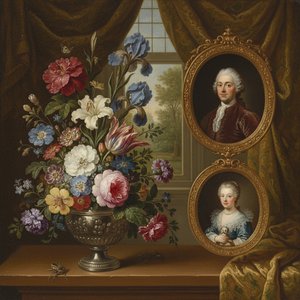
A Bloom in the Shadow of Tradition: The Life and Art of Gerard Chowne
Gerard Chowne, a name perhaps less celebrated than his Flemish contemporaries, nevertheless occupies a significant niche within the tradition of 19th-century floral painting. Born in 1875, Chowne’s life remains shrouded in relative obscurity; biographical details are scarce, allowing his artwork to speak most eloquently for him. What *is* known suggests a dedicated artist deeply immersed in the techniques and aesthetics of the Dutch Masters, particularly those specializing in still life – artists like Jan van Huysum and Rachel Ruysch served as clear inspirations. He passed away in 1917, leaving behind a body of work that testifies to his skill and sensitivity towards the natural world. While not extensively documented during his lifetime, Chowne’s paintings have steadily gained recognition for their meticulous detail, luminous quality, and quiet beauty, offering a compelling glimpse into a bygone era of artistic refinement. He was part of a generation continuing the legacy of Flemish still life painting, adapting it to suit the tastes and sensibilities of the late 19th and early 20th centuries.The Echoes of the Old Masters: Influences and Development
Chowne’s artistic development was profoundly shaped by the rich heritage of Flemish painting. The influence of the Dutch Golden Age is palpable in his work, particularly in his masterful rendering of light and texture. He wasn't simply copying; rather, he absorbed the principles that underpinned these earlier masterpieces – the careful observation of nature, the subtle gradations of tone, and the ability to imbue inanimate objects with a sense of life.- Jan van Huysum: Chowne’s compositions often echo Van Huysum's elaborate arrangements of flowers in glass vases, showcasing similar levels of detail and complexity.
- Rachel Ruysch: The delicate precision with which Chowne depicts individual petals and leaves recalls the botanical accuracy found in Ruysch’s work.
- Flemish Baroque Tradition: A general adherence to the principles of chiaroscuro, creating dramatic contrasts between light and shadow, is evident throughout his oeuvre.
A Symphony of Petals: Characteristics of Chowne’s Art
Chowne's paintings are characterized by an extraordinary attention to detail. He possessed a remarkable ability to capture the delicate textures of petals, the sheen of leaves, and the subtle variations in color that distinguish each individual flower. His compositions typically feature arrangements of flowers placed in elegant vases or bowls, often set against dark, neutral backgrounds which serve to accentuate their vibrant hues.- Meticulous Detail: Each petal, leaf, and stem is rendered with painstaking accuracy, creating a sense of hyperrealism.
- Luminous Quality: Chowne’s skillful use of light creates a soft, glowing effect that enhances the beauty of his subjects.
- Harmonious Compositions: His arrangements are carefully balanced and visually appealing, demonstrating a strong understanding of color theory and composition.
- Quiet Intimacy: Chowne’s paintings evoke a sense of tranquility and contemplation, inviting the viewer to appreciate the beauty of nature in its most delicate form.
The Legacy of a Quiet Master: Historical Significance
While Chowne may not have achieved widespread fame during his lifetime, his work holds an important place within the history of 19th-century painting. He represents a continuation of the Flemish still life tradition, demonstrating a commitment to technical excellence and artistic refinement in an era increasingly dominated by new movements like Impressionism and Post-Impressionism. His paintings offer a valuable insight into the tastes and sensibilities of the late Victorian and Edwardian periods, revealing a continued appreciation for classical aesthetics and meticulous craftsmanship.- Preservation of Tradition: Chowne’s work helped to keep alive the techniques and principles of Flemish painting at a time when they were falling out of favor.
- A Counterpoint to Modernism: His paintings provide a fascinating contrast to the more experimental styles that emerged during his lifetime, highlighting the diversity of artistic expression in the late 19th and early 20th centuries.
- Rediscovery and Appreciation: In recent years, Chowne’s work has been increasingly recognized for its quality and beauty, attracting the attention of collectors and art historians alike.
Pytania i odpowiedzi
Czy mogę sortować dzieła Gerard Chowne według koloru?
Strona Indeks kolorystyczny pozwala przeglądać dzieła Gerard Chowne z podziałem na kolory.
Jak zmieniała się twórczość Gerard Chowne na przestrzeni lat?
Kariera Gerard Chowne rozwija się etap po etapie na stronie Osiągnięcia artystyczne: jako pozioma oś czasu dzieł, pogrupowanych w rozdziały odpowiadające poszczególnym okresom twórczości.
Gdzie można zobaczyć wszystkie dzieła Gerard Chowne?
Wszystkie dzieła Gerard Chowne dostępne w niniejsza strona można przeglądać na stronie Wszystkie dzieła artysty.