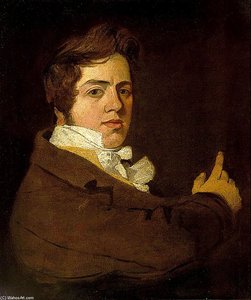
A Norfolk Son: The Life and Art of John Sell Cotman
John Sell Cotman, a name inextricably linked to the serene beauty and evocative atmosphere of early 19th-century England, emerged from the vibrant artistic community of Norwich to become a pivotal figure in British Romanticism. Born on May 16, 1782, into a family deeply rooted in the prosperous trades of silk merchantry and lace dealing, Cotman’s path wasn't immediately destined for the world of art. Yet, an innate sensitivity to the natural world—a profound connection to light, color, and texture—and a burgeoning talent quickly steered him away from commerce and toward a life dedicated to capturing its essence on canvas and paper. His early education at Norwich Grammar School provided a foundational understanding of classical studies, but it was his relocation to London in 1798 that truly ignited the flame within him, setting him upon a transformative artistic journey.
The Norwich School: A Celebration of Local Landscapes
Cotman’s artistic identity became inextricably linked to the Norwich School, a distinctive movement of painters who distinguished themselves by their unwavering focus on depicting the unique character and charm of the Norfolk countryside. Unlike many of his contemporaries, preoccupied with grand historical narratives or idealized classical forms, the Norwich School artists cultivated a deep appreciation for the subtle nuances of their local landscape—the rolling fields, the meandering rivers, the quaint villages, and the ever-changing light. Cotman quickly rose to prominence within this group, developing a style characterized by masterful watercolor technique, meticulous attention to detail, and a uniquely Romantic sensibility. He possessed an exceptional ability to translate fleeting impressions into enduring works of art, capturing the atmosphere and mood of a scene with remarkable sensitivity. His paintings weren’t merely representations of landscapes; they were imbued with emotion—a sense of tranquility, melancholy, or quiet contemplation.
Technique and Style: Watercolor Mastery
Cotman's artistic style was defined by his exceptional command of watercolor, a medium he elevated to new heights. He wasn’t simply applying color to paper; he was sculpting with washes—building up layers of translucent pigment to create atmospheric depth and luminous effects. His technique involved a delicate balance between controlled precision and spontaneous expression, allowing for both meticulous detail and a sense of fluidity and movement. He frequently employed dry brushstrokes to suggest texture and form, while utilizing broad washes of color to evoke the vastness of the sky or the shimmering surface of water. His etchings, often preparatory studies for his paintings, further demonstrated his versatility and technical skill, showcasing his ability to capture subtle tonal variations and intricate details with remarkable precision. He was a master of light and shadow, skillfully manipulating color to create a sense of depth and atmosphere that drew viewers into the heart of his landscapes.
Key Works and Influences
Among Cotman’s most celebrated works are “Jesus Chapel, Norwich Cathedral with the tomb of Sir Thomas Windham,” a quintessential example of the Norwich School's style—a meticulously rendered depiction of a local landmark imbued with a sense of quiet reverence. “View From Yarmouth Bridge, Norfolk, Looking Towards Breydon, Just After Sunset” is another iconic image, capturing the beauty of the coastal landscape at twilight. His work was influenced by the Romantic movement’s emphasis on emotion and imagination, as well as by his encounters with other artists in London, particularly J.M.W. Turner and Thomas Girtin. These experiences broadened his artistic horizons and helped him to develop a more expressive and dynamic style. He also drew inspiration from the works of earlier landscape painters, such as Constable and Gainsborough, adapting their techniques to suit his own unique vision.
Legacy and Enduring Significance
John Sell Cotman’s influence extended far beyond his prolific output. He played a crucial role in shaping the development of British art, particularly within the context of the Norwich School movement. His emphasis on direct observation, atmospheric effects, and emotional resonance resonated with subsequent generations of artists. Furthermore, his dedication to teaching ensured that his artistic principles were passed down to a new cohort of painters. Both of his sons, Miles Edmund Cotman and John Joseph Cotman, followed in their father’s footsteps, contributing to the family's enduring legacy within the art world. Today, Cotman’s works are held in prestigious collections worldwide—the Tate Gallery, the British Museum, the Victoria and Albert Museum, and the Yale Center for British Art—and continue to captivate viewers with their beauty, sensitivity, and profound connection to the natural world. He remains a celebrated figure, not only as a master of watercolor and etching but also as a key representative of the Romantic spirit in English art. His dedication to capturing the essence of place and emotion ensures his enduring relevance for generations to come.
Pytania i odpowiedzi
Czy mogę przeanalizować sposób użycia koloru przez Jan Siel Cotman we wszystkich jego/jej dziełach?
Profil kolorystyczny twórczości Jan Siel Cotman można zobaczyć na stronie Genom Palety artysty.
Gdzie można znaleźć dzieła Jan Siel Cotman pogrupowane według słów kluczowych?
Strona Według słów kluczowych artysty Jan Siel Cotman grupuje jego dzieła według słów kluczowych.
Do jakiej epoki należał/a Jan Siel Cotman?
Jan Siel Cotman tworzył w okresie – Wiek XIX. Epoka ta osadza twórczość artysty w kontekście historycznym.