Garanție de rambursare în 100 de zile Livrare gratuită în toată lumea
449.587opere de artă 30.613artişti 4.660muzee 32limbi
Catalogue entry

Birds

1914. Oil On Canvas, 109.0 x 99.0 cm.

Fig. 1. Franz Marc, Birds, 1914. Shown as the reproduction you are specifying: , .

§ 1Catalogue data

Dimensiuni
109.0 x 99.0 cm

§ 2Abstract

Descriere obiect de colecție

Franz Marc's 'Birds,' painted in 1914, embodies the spirit of Der Blaue Reiter movement—a fusion of Cubism and Expressionism. This artwork showcases a bird motif symbolizing liberation against a dynamic backdrop of orange, yellow, blue, and green hues. Influenced by Van Gogh and exploring themes of animal spirituality, Marc’s piece remains a cornerstone of modern art history.

Biografie artist

Franz Marc (1880-1916): pictor german expresionist, renumit pentru operele sale cu animale simbolice și culori vibrante. Descoperă spiritualitatea dincolo de realitate prin arta sa!

§ 3Commentary

A Symphony of Color and Spiritual Resonance

In the pantheon of early 20th-century German Expressionism, few works capture the ethereal dance between nature and the soul as poignantly as Franz Marc’s “Birds.” Created in 1914, this masterpiece serves as a breathtaking window into the artist's profound spiritual quest. At first glance, the viewer is met with a vibrant explosion of color, but beneath the surface lies a deliberate, rhythmic composition that transcends mere visual representation. The painting features a central bird in flight, its wings outstretched in a gesture of pure liberation, set against a kaleidoscopic backdrop of fiery oranges, sun-drenched yellows, and tranquil, deep blues. It is not merely an observation of avian life; it is a symphony of light and motion designed to evoke the very essence of joy and transcendence.

The technique employed by Marc in “Birds” represents a masterful intersection of Cubism and Expressionism. One can observe the subtle influence of Cubist fragmentation in the way the forms are structured; the birds and their environment are composed of geometric, interlocking planes that reject traditional perspective in favor of a more dynamic, multidimensional reality. Yet, this structural rigor is softened by the emotive intensity of Expressionism. Marc’s brushwork does not seek to replicate the texture of feathers or the transparency of air, but rather to translate the feeling of flight. For collectors and designers alike, this duality offers a unique aesthetic appeal—a piece that possesses both a modern, structured elegance and a raw, emotional heartbeat.

Symbolism and the Language of Color

To understand “Birds,” one must understand Franz Marc’s personal philosophy regarding color. As a leading figure of Der Blaue Reiter (The Blue Rider) movement, Marc believed that colors possessed inherent spiritual properties capable of communicating truths that words could not. In this work, his palette acts as a direct conduit for emotion: the blues evoke a sense of masculine spirituality and calm, while the yellows radiate a feminine, gentle energy. The interplay of these hues creates a visual tapestry that feels alive, pulsing with the rhythm of the natural world. The birds themselves are far more than subjects; they are symbols of purity and an uncorrupted connection to the divine—a theme Marc pursued relentlessly throughout his brief but luminous career.

For those looking to integrate such a profound work into a curated interior, “Birds” offers unparalleled versatility. Its vibrant energy can serve as a commanding focal point in a contemporary gallery-style room, or its rhythmic patterns can provide a sophisticated layer of depth to a more minimalist setting. Owning a high-quality reproduction of this piece is an invitation to surround oneself with the spirit of 1914—a moment in art history where the boundaries between the physical world and the spiritual realm were beautifully blurred. It remains a timeless testament to the power of art to capture the fleeting beauty of life and the enduring strength of the spirit.

Întrebări și răspunsuri

Ce nuanță dominantă străbate întregul "Birds" de Franz Marc?

"Birds" tinde spre o nuanță de Amber to Saffron.

Ce paletă și ce culoare dominantă definesc "Birds"?

Identitatea cromatică a operei "Birds" de Franz Marc: o paletă Dark, dominată de Driftwood (#91715b).

Ce armonie de culori prezintă "Birds" de Franz Marc?

Culorile din "Birds" de Franz Marc prezintă o armonie Softly Mixed Palette. Armonia descrie modul în care culorile interacționează între ele.
§ 4The artist

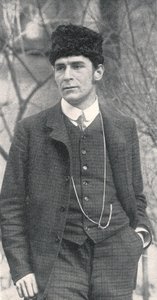
Franz Marc

Franz Marc

1880 - 1916, Germania

Quick facts about Franz Marc

  • Artistic Movement Or Style: Expresionism German
  • Artists Or Movements Influenced By This Artist:
    • Expresionism
    • Der Blaue Reiter
  • Artists Who Influenced This Artist:
    • Van Gogh
    • Delaunay
  • Date Of Birth: 8 Feb 1880
  • Date Of Death: 4 Mar 1916
  • Full Name: Franz Moritz Wilhelm Marc
  • Nationality: German
  • Notable Artworks:
    • Calărețul albastru
    • Caii roșii
    • Coiul roșu
  • Place Of Birth: Munich, Germania

Biografie artist

A Life Immersed in Color and Spirit

Franz Moritz Wilhelm Marc, born in Munich in 1880, was a painter whose brief but intensely focused career irrevocably altered the course of German Expressionism. His story is one of profound spiritual seeking translated into a vibrant visual language, a quest to understand the essence of life through the purity he found in the natural world—particularly within the animal kingdom. Initially influenced by his father, Wilhelm Marc, a landscape painter, young Franz’s artistic path wasn't immediately certain. He briefly considered theology, grappling with questions of faith and existence before ultimately dedicating himself to art at the Academy of Fine Arts in Munich. These early explorations into religious thought would remain deeply embedded within his work, shaping his belief that art could be a conduit for spiritual experience. His academic training provided him with technical foundations, but it was encounters with the works of Vincent van Gogh during visits to Paris that truly ignited his artistic vision. Van Gogh’s emotive use of color and raw expression resonated profoundly with Marc, liberating him from conventional techniques and setting him on a path toward a more subjective and emotionally charged style.

The Blue Rider and a New Artistic Vision

Marc's artistic development wasn’t solitary; it flourished within the dynamic context of early 20th-century Munich. He experimented with various artist groups, including the Neue Künstlervereinigung München, before co-founding *Der Blaue Reiter* (The Blue Rider) in 1911 alongside Wassily Kandinsky. This wasn’t merely a group or an exhibition series; it was a philosophical and artistic revolution. *Der Blaue Reiter* sought to move beyond mere representation, aiming instead to express inner spiritual truths through abstraction and symbolic color. The journal of the same name became a platform for disseminating these ideas, showcasing not only their own work but also that of other forward-thinking artists and exploring diverse cultural influences from folk art to primitive sculpture. Marc’s contributions during this period were pivotal. He moved away from depicting landscapes as static scenes, instead focusing on animals—horses, deer, foxes—as vessels of spiritual energy. These weren't simply animal portraits; they were symbolic representations of innocence, harmony, and a connection to the natural world that he believed humanity had lost. The influence of Robert Delaunay’s exploration of abstract forms and vibrant colors further propelled Marc toward simplification and heightened emotional expression in his work. Paintings like *The Tiger* (1912) and *Red Deer* (1912) exemplify this shift, showcasing bold color choices and a growing focus on the inherent qualities of his subjects rather than realistic depiction.

Symbolism, Color, and the Essence of Being

Marc’s artistic style is immediately recognizable for its distinctive use of color and form. He didn't employ color descriptively; instead, he imbued it with symbolic meaning. Blue represented spirituality and masculinity, yellow signified joy and femininity, and red embodied violence and materiality. These weren’t arbitrary choices but a carefully constructed system designed to convey specific emotional and philosophical ideas. His animals aren’t merely subjects; they are embodiments of these concepts. The simplification of forms—reducing figures to their essential shapes—further emphasized the underlying spiritual essence he sought to capture. *The Tower of Blue Horses* (1913), sadly lost during World War II, is perhaps the most iconic example of this approach, a powerful and evocative composition that encapsulates his artistic vision. He believed animals possessed an inherent purity and connection to nature that humans had forfeited through societal constraints and intellectualization. By portraying them with such reverence and symbolic weight, Marc sought to remind viewers of this lost harmony and inspire a deeper appreciation for the natural world. His work wasn’t about depicting *what* he saw but rather *how* he felt—a deeply personal and spiritual response to his surroundings.

Key Works and Influences

Marc's oeuvre is characterized by a remarkable consistency in subject matter and stylistic approach, despite evolving techniques. Early works like *The Yellow Cow* (1909) demonstrate his initial exploration of simplified forms and vibrant colors, heavily influenced by Van Gogh’s expressive brushwork. His later paintings, such as *The Tower of Blue Horses*, showcase a more complex use of symbolism and abstraction, reflecting his engagement with Kandinsky's theories on spirituality in art. The influence of Paul Gauguin is also evident in Marc’s interest in primitive cultures and the depiction of non-Western subjects. He was deeply moved by the art of indigenous peoples, particularly their symbolic representations of animals and spirits. Furthermore, Marc’s time in Paris exposed him to the innovations of Cubism, which he incorporated into his work through fragmented forms and multiple perspectives. The impact of these diverse influences is evident throughout his career, creating a unique artistic language that continues to fascinate viewers today.

A Tragic End and Lasting Legacy

The outbreak of World War I in 1914 dramatically altered Marc's life and artistic trajectory. Despite seeking exemption due to his status as an artist, he was drafted into the German army, serving as a cavalryman. The horrors of war deeply affected him, yet even amidst the chaos, he continued to paint, finding solace and meaning in his art. Tragically, Franz Marc died on March 4, 1916, at the Battle of Verdun, a devastating loss for the art world. His untimely death cut short a career brimming with potential, but it also cemented his place as a pivotal figure in modern art history. His work continues to resonate today, influencing generations of artists and captivating audiences with its emotional depth and spiritual resonance. Marc’s paintings are exhibited in major museums worldwide, including the Lenbachhaus in Munich, which holds an extensive collection of his work. He is remembered not only as a pioneer of German Expressionism but also as a visionary artist who dared to explore the profound connection between art, spirituality, and the natural world—a legacy that continues to inspire awe and contemplation. His artistic vision remains a testament to the power of art to transcend the material realm and touch upon something deeper within the human spirit.

§ 5Comparanda

§ 6Questions

Informații rapide

  • Subject or theme: Animal Symbolism
  • Location: Private Collection
  • Movement: Cubism
  • Artist: Franz Marc
  • Notable elements or techniques: Geometric forms, Vibrant colors
  • Medium: Oil on canvas

§ 7Cite this entry

AllPaintingsStore.com, “Franz Marc, Birds (1914)”, https://allpaintingsstore.com/ro/art/franz-marc-birds-8BWPST-en/ (accessed 4 Octombrie 2026).

§ 8The reproduction

Reproducere pictată manual în ulei

Pictură în ulei pe pânză, pictată manual de artiștii noștri la dimensiunea și ramele dorite de dumneavoastră, pe comandă. ( Comută pe versiunea Print Comută pe Imagine Digitală)

It is specified on the order sheet in the margin; the present state of that sheet reads as follows.

Birds

Tehnică de reproducere

Dimensiune reproducere

-

Selecție de artiști de elită

Mai multe detalii, rafinament și timp suplimentar de execuție

-

Ramă pentru reproducere artistică

-

-

Pentru opere de artă sau reproduceri care depășesc 105 cm (aproximativ 41 de inch) pe oricare dintre laturi, cadrul va fi livrat demontat, sub formă de kit. Această metodă asigură o livrare sigură și previne deteriorarea în timpul transportului.

Este necesară asamblarea profesională – acest produs nu este de tip DIY (de făcut singur).
Kitul trebuie asamblat, iar pânza întinsă, de către un legător de cadre experimentat, utilizând adeziv pentru lemn (neinclus în colet), o cheie pentru întinderea pânzei și cleme pentru a menține barele la unghi drept în timp ce adezivul se usucă. Asamblarea incorectă sau tensiunea neuniformă a pânzei pot deteriora permanent opera de artă și nu sunt acoperite de garanția noastră.

  • Toate barele din lemn masiv sunt incluse, tăiate cu precizie la dimensiunea necesară.

  • Asamblat cu șuruburile incluse, plus adeziv pentru lemn pentru îmbinările de colț, care nu este furnizat și trebuie achiziționat de către tâmplarul dumneavoastră.

  • Sunt necesare unelte profesionale care nu sunt incluse: o șipte de întindere a pânzei (tensionator) și cleme pentru a menține barele la unghi drept în timp ce adezivul se usucă.

Important:
Îmbinările de colț necesită adeziv pentru lemn, barele trebuie fixate cu clești de strângere până când adezivul este complet uscat, iar întinderea pânzei pe cadrul asamblat necesită un clește pentru întins pânza. Niciunul dintre aceste elemente nu este inclus în kit. Vă rugăm să consultați un încadrator profesionist cu experiență înainte de a comanda această dimensiune.

Etichetă de prezentare

-

-

Lac de protecție

Lac lucios (intensifică nuanțele și oferă protecție împotriva luminii și a umidității)

-

Personalizează opera mea de artă

Exemple de elemente ce pot fi personalizate: Înlocuirea feței cu fotografia clientului; Adăugarea unui animal de companie (de exemplu, înlocuirea unei pisici cu un câine); Includerea unui mesaj ascuns în fundal; Modificarea peisajului sau a elementelor din fundal.

-

Livrare rapidă

Livrare la nivel mondial () în 3-4 săptămâni, în loc de cele 5 săptămâni standard. (2 Noiembrie). Fără compromisuri când vine vorba de calitate.

-

Livrare rapidă

Livrare la nivel mondial () în 5 săptămâni. (9 Noiembrie).

Inclus

Preț total calculat

lei 1224

Included with every order

  • Livrare expres gratuită la nivel mondial
  • Pânză de in de înaltă calitate
  • Asigurare completă pentru transport
  • Garanție de rambursare a taxelor vamale
  • Garanția fidelității culorilor
  • Politica de retur în 100 de zile (doar pentru defecte de fabricație)
  • Garanție de rambursare 100%
  • Ofertă pentru comenzi multiple
Order sheet