

6th Lord Byron (Thomas Phillips)
Oil On Canvas.

Printuri pe canvas și artă fină de la lei213 pentru 36 x 28 cm
Reproducere pictată manual în ulei de la lei904
- Livrare gratuită în toată lumea, în 3-4 săptămâni
- Printuri rulate, livrate în 3-4 săptămâni
- Retur în 100 de zile, banii înapoi
- Evaluat 4.9/5 de către 241 clienți pe ArtShopReviews.com
§ 1Date catalog


§ 2Abstract
6th Lord Byron de Thomas Phillips, descrierea picturii
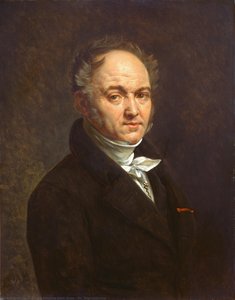
A somber oil portrait of a man in a dark coat and white cravat, rendered with soft blending and dramatic chiaroscuro lighting.
 Citește descrierea completă a lucrării 6th Lord Byron de Thomas Phillips
Thomas Phillips: biografie
Thomas Phillips (1770-1845): pictor britanic renumit pentru portrete detaliate și captarea personalității unor figuri istorice importante, precum Lord Byron. #ArtăBritanică #PicturăDePortret
§ 3Comentariu
The Portrait of the 6th Lord Byron
In this portrait, titled 6th Lord Byron, the English painter Thomas Phillips captures the likeness of George Gordon Byron, 6th Baron Byron. The work presents a formal study of the man, focusing on his upper body and his steady, serious gaze. Phillips, who was born in Dudley, United Kingdom, in 1770, brings a meticulous attention to the subject's features and the textures of his attire. The sitter is positioned slightly off-center, looking toward his left, which lends a sense of quiet introspection to the composition.
The artist, who passed away in London on 20 April 1845, utilizes a dark, receding background to ensure the viewer's attention remains fixed upon the subject. This choice of lighting creates a chiaroscuro effect, highlighting the contours of the face and the white of the shirt against the darker tones of the coat. There is a palpable sense of dignity in the subject's expression, a quality Phillips often sought when portraying the prominent figures of his era. The painting remains a significant example of the artist's ability to render both physical presence and character through oil on canvas.
Composition and Visual Elements
The composition focuses on the subject's upper body, with the figure cropped just below the waist. He is positioned slightly off-center, gazing toward his left with a serious expression that suggests a sense of dignity and status. This deliberate placement avoids a static, frontal view, lending a quiet gravity to his presence. The dark background recedes into obscurity, which serves to emphasize the figure and create a palpable sense of depth within the frame.
Lighting is used with precision, concentrated primarily on the man's face and upper body. This creates a chiaroscuro effect, where strong contrasts between light and shadow define his features and the folds of his attire. The interplay of light and dark provides a sculptural quality to the portrait, pulling the viewer's attention toward the sitter's contemplative gaze and the subtle textures of his clothing.
Technique and Artistic Style
Executed in oil on canvas, this portrait adheres closely to the formal traditions of the late 18th and early 19th centuries. The artist employs a meticulous realism, focusing on the precise rendering of the subject's features and the specific textures of his attire. Through a disciplined application of paint, the work achieves a smooth finish where brushstrokes remain largely invisible to the eye. This controlled approach allows the viewer to focus entirely on the character and presence of the sitter rather than the hand of the painter.
The technical proficiency is most evident in the handling of light and material. There is a sophisticated contrast between the surfaces depicted; the artist has successfully captured the subtle sheen of the white shirt against the matte quality of the dark coat. This interplay of light and shadow, achieved through careful blending and the layering of paint, provides the figure with a tangible, three-dimensional presence. The result is a portrait that prioritizes a quiet, dignified accuracy over dramatic flourish.
Related Works by Thomas Phillips
The artist's engagement with the Romantic era is perhaps most visible through his various depictions of the poet. In 1813, he produced Lord Byron in Albanian Dress, a work that captures the subject in traditional costume. This particular theme was revisited in a 1835 version of Lord Byron in Albanian Dress, which is currently held in the National Portrait Gallery, London. He also completed a Portrait of Lord Byron in 1814, offering a different perspective on the same figure.
Beyond his portraits of literary figures, Phillips demonstrated a keen ability to render the likenesses of significant intellectuals and professionals. His 1807 portrait of William Blake remains a notable example of his skill. He continued this practice into the following decades, producing a portrait of Sir Francis Chantrey in 1818 and a work featuring George Crabbe in 1819.
Întrebări și răspunsuri
Această reproducere a lucrării 6th Lord Byron este pictată manual sau este tipărită?
Tipărit: 6th Lord Byron este reprodus sub formă de print giclée pe pânză de bumbac sau pe hârtie de pânză arhivistică Epson.
Ce dimensiune ar trebui să aleg pentru 6th Lord Byron?
Dimensiunile variază de la 35.9 x 27.9 cm (lei213) la 245.4 x 190.7 cm (lei2122); tabelul de pe această pagină prezintă principalele variante de dimensiuni și prețurile acestora.
Cât durează livrarea?
Printurile rulate în tub sunt trimise gratuit prin poșta obișnuită și ajung în 3-4 săptămâni; printurile întinse pe șasiu sau înramate necesită 4-5 săptămâni. Livrarea prin curier rapid este disponibilă doar prin opțiunea de Livrare Express, contra cost, oferită pe această pagină. Puteți returna produsul în termen de 100 de zile pentru rambursarea integrală, fără nicio condiție.
Ce tehnică a folosit Thomas Phillips pentru 6th Lord Byron?
Oil On Canvas




 Pictură în ulei


 Pentru opere de artă sau reproduceri care depășesc 105 cm (aproximativ 41 de inch) pe oricare dintre laturi, cadrul va fi livrat demontat, sub formă de kit. Această metodă asigură o livrare sigură și previne deteriorarea în timpul transportului.


