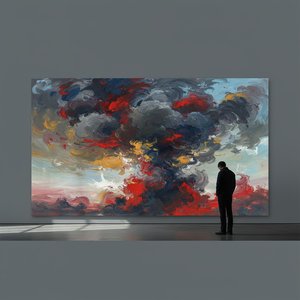
1992. Acrylic On Canvas. Inter-American Development Bank.

§ 1Данные каталога


Данное произведение защищено авторским правом
Произведение искусства, представленное на этой странице, защищено законом об авторском праве, что исключает возможность законного создания или продажи его точной репродукции. Данная защита обеспечивается международными соглашениями, такими как Бернская конвенция и национальным законодательством, включая положения, изложенные в Закон США об авторском праве — Раздел 17.
В качестве достойной и законной альтернативы мы предлагаем авторские картины ручной работы, вдохновленные оригиналом. Наши опытные профессиональные художники тщательно изучают стиль, настроение и художественную суть оригинала, чтобы создать новое, уникальное произведение, которое вызывает те же чувства, оставаясь при этом самостоятельным оригинальным творением.
Этот метод полностью соответствует нормам авторского права, так как он не предполагает копирования или дублирования защищенного произведения. Напротив, это творческая реинтерпретация — создание новой картины, которая вдохновлена оригиналом, но не является его точной копией.
 Узнать больше
§ 2Абстракция
Описание предмета коллекционирования
Биография художника
Fernando de Szyszlo (1925-2017) was a pivotal Peruvian abstract artist who fused European modernism with pre-Columbian themes & Incan motifs. Explore his paintings, sculptures, and legacy as a key figure in Latin American art.
§ 3Комментарий
Fernando de Szyszlo: Bridging Ancient Echoes and Modern Expression
Fernando de Szyszlo (1925-2017) stands as a monumental figure in Peruvian art history, recognized for his pioneering role in establishing abstract expressionism within Latin America while simultaneously honoring the profound legacy of Andean culture. Born in Lima to a Peruvian mother of Spanish-Indian descent and a Polish father, Szyszlo’s formative years instilled in him an appreciation for both European intellectual traditions and indigenous heritage—a duality that would profoundly shape his artistic vision. This confluence of influences is palpable throughout his oeuvre, resulting in canvases that resonate with a unique blend of formal innovation and symbolic depth. Szyszlo's journey into art began at the National University of Engineering but was swiftly redirected by an irresistible passion for architecture before he decisively embraced the School of Plastic Arts of Pontifical Catholic University of Peru. Graduating in 1948, he embarked on a transformative voyage across Europe, immersing himself in the groundbreaking works of masters like Rembrandt and Titian—artists who championed dramatic chiaroscuro and psychological realism. These encounters ignited Szyszlo’s imagination and fueled his determination to forge a path distinct from established artistic conventions. His stylistic evolution culminated in the embrace of abstract expressionism during the mid-1950s, marking a pivotal moment in Peruvian art. Rejecting representational accuracy, Szyszlo sought to convey emotion and experience directly onto the canvas through spontaneous gestures and bold color palettes—a technique championed by artists like Jackson Pollock and Willem de Kooning. However, unlike his contemporaries who often prioritized purely formal experimentation, Szyszlo consistently incorporated elements of Andean iconography and symbolism into his paintings. Recurring motifs such as llamas, condors, and geometric patterns hark back to the rich artistic traditions of Peru’s pre-Columbian past, grounding his abstract explorations in a tangible connection to Peruvian cultural heritage. The painting "Duino-Nueve (Orrantia/92)" exemplifies Szyszlo's distinctive approach. The image depicts a solitary figure wielding a knife—a potent symbol representing both vulnerability and decisive action—against a dark backdrop punctuated by flashes of intense color. The artist’s meticulous attention to detail, particularly in capturing the texture and contours of the hand holding the blade, underscores his commitment to conveying palpable physicality alongside conceptual ideas. Furthermore, Szyszlo's masterful use of pigment creates an atmosphere of dramatic tension, mirroring the psychological complexities inherent in the subject matter. Szyszlo’s artistic legacy extends beyond stylistic innovation; he served as a crucial catalyst for fostering dialogue between Peruvian art and Andean culture—a contribution that continues to inspire artists and scholars alike. His unwavering dedication to exploring the expressive potential of abstraction combined with his reverence for indigenous traditions solidified his position as one of Peru's most influential visual artists, ensuring that his work remains relevant and captivating for generations to come.- Artist: Fernando de Szyszlo
- Born Year: 1925
- Death Year: 2017
- Birth City: Lima
- Birth Country: Peru
Historical Context
Szyszlo’s artistic endeavors unfolded during the formative years of Peruvian art history—a period marked by burgeoning interest in European modernism alongside an increasing awareness of Andean cultural identity. The influence of Surrealist artists like René Magritte and Salvador Dalí can be discerned in Szyszlo's exploration of dreamlike imagery and subconscious symbolism, reflecting a broader artistic preoccupation with psychological depth and imaginative vision.Style & Technique
Szyszlo’s signature style—abstract expressionism infused with Andean motifs—characterized by spontaneous brushstrokes, bold color combinations, and textural layering—represents a radical departure from traditional Peruvian painting practices. He skillfully manipulated pigment to create luminous surfaces that capture the essence of emotion and experience, mirroring the expressive dynamism found in the works of European masters like Willem de Kooning and Franz Kline.Symbolism
Recurring motifs such as llamas, condors, and geometric patterns—elements drawn from Andean iconography—serve as powerful symbols representing resilience, spiritual aspiration, and connection to ancestral traditions. Szyszlo’s deliberate incorporation of these visual cues underscores his commitment to honoring Peruvian cultural heritage while simultaneously elevating abstract expressionism beyond purely formal considerations.Emotional Impact
“Duino-Nueve (Orrantia/92)” evokes a profound sense of contemplation and unease—a reflection of Szyszlo’s masterful ability to convey psychological complexity through visual language. The painting's dramatic chiaroscuro contrasts heighten the tension between vulnerability and determination, prompting viewers to confront existential questions about human experience and artistic expression.Вопросы и ответы
Насколько выражен контраст в работе «Duino-Nueve (Orrantia/92)», Fernando de Szyszlo?
Уровень контрастности «Duino-Nueve (Orrantia/92)», Fernando de Szyszlo составляет Serene.
Можно ли увидеть «Duino-Nueve (Orrantia/92)», Fernando de Szyszlo при другом освещении?
Страница Рентгеновское исследование произведения «Duino-Nueve (Orrantia/92)», Fernando de Szyszlo представляет собой интерактивный просмотрщик, позволяющий изучать одиннадцать оптических слоев изображения, включая рентгеновский вид.
Как работа «Duino-Nueve (Orrantia/92)» соотносится с общим творчеством Fernando de Szyszlo?
«Duino-Nueve (Orrantia/92)» разделяет с другими работами Fernando de Szyszlo характерный стиль Abstract Expressionism и повторяющиеся темы: european modernism, andean heritage, symbolic imagery, exploring identity, central role.


 Перейти к печатным копиям


 Для произведений искусства или репродукций, размер которых превышает 105 см (приблизительно 41 дюйм) по любой из сторон, рама будет доставлена в разобранном виде (в виде комплекта). Этот метод обеспечивает безопасную доставку и предотвращает повреждения при транспортировке.