- Hem

- Reproduktion av oljemålning
- Hans Holbein den yngre
- The Ambassadors

 Köp tryck Köp högupplöst digital bild
 Skicka
 Dela
Dela
 Visa detaljer
 Lägg till i favoriter

 Ladda ner
 Liknande objekt
 Röntgen
 Bildspel
The Ambassadors
 Akryl på duk
- Väggkonst
- Renaissance Northern Style
 1533
1533- Renässansen
 207.0 x 209.0 cm
 National Gallery
 Visa mer
Handgjord oljereproduktion
Handmålad olja på duk i din valda storlek och ram, tillverkad efter beställning av våra konstnärer.




P118B $10

P118H $10

P118W $10

P438Z $10

P508JH $12

P508YH $12

P805H $10

P805Z $10

P919BZ $10

P919G $10

P919XJ $10

P959ZH $10

P968JZ $12

W106C $8

W218G $10

W218JH $8

W218Y $10

W307PJ $10

W316G $10

W316PJ $8

W316Y $10

W398PJ $8

W4111J $10

W500HY $15

W500JH $15

W692G $12

W849H $8

W940BG $15

W953PJ $8




Välj bland våra förinställda storlekar som motsvarar konstverkets ursprungliga proportioner.

Du kan ange egna mått för att passa en specifik ram eller yta. Om den valda storleken inte matchar originalbildens proportioner kommer vi antingen att beskära konstverket eller utöka målningen med ytterligare handmålade element. En digital skiss skickas till dig för godkännande innan produktionen påbörjas.
Observera att förhandsvisningen på skärmen inte återspeglar den faktiska beskärningen eller utökningen. Endast skissen visar den slutgiltiga kompositionen korrekt.
Även om anpassade storlekar är möjliga, rekommenderar vi att du väljer en dimension från den fördefinierade listan för att bevara originalproportionerna.
Efter beställning kommer AllPaintingsStore.com team att mejla kunden för instruktioner och tillhandahålla en skissförhandsvisning
Leverans över hela världen () på 3–4 veckor istället för standard 5 veckor. (16 juli). Inga kompromisser med kvaliteten.

Fri expressfrakt över hela världen

Högkvalitativ linnecanvas

Fullständig fraktförsäkring

Garantier för återbetalning av tullavgifter

Garantier för exakt färgåtergivning

60 dagars returrätt (endast vid fabrikationsfel)

100% pengarna tillbaka-garanti

Mängdrabatt erbjuds
 Glasalternativet är endast tillgängligt i storlekar under 110 cm.

The Ambassadors
Teknik för reproduktion
Storlek på reproduktion
-


Slutgiltigt pris
-
Beskrivning av konstverket
A Window into Renaissance Ambition and Mortality: Examining Hans Holbein’s “The Ambassadors”
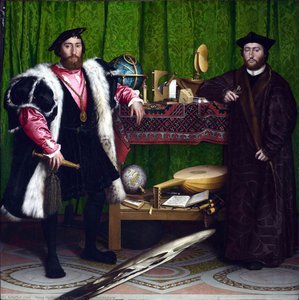
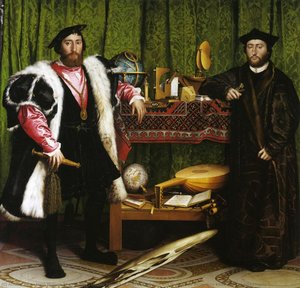
“The Ambassadors,” completed in 1533 by Hans Holbein the Younger, stands as a monumental achievement of Northern Renaissance art—a portrait that transcends mere likeness to delve into profound philosophical questions about human existence. Housed prominently at the National Gallery in London, this painting continues to captivate viewers with its meticulous detail and layered symbolism, offering an unparalleled glimpse into the intellectual climate of Tudor England.The Portrait’s Subjects: Diplomats Embodied
At first glance, the artwork depicts two distinguished men—Jean de Dinteville, French ambassador to England, and Georges de Selve, bishop of Lavaur—seated before a draped curtain adorned with opulent gold leaf patterns. Holbein's masterful rendering captures not just their physical appearance but also conveys an aura of erudition and power. Dinteville, dressed in black robes trimmed with white fur, exudes confidence as he holds a book open in his right hand – a deliberate gesture signifying his scholarly pursuits and diplomatic responsibilities. Opposite him stands Selve, adorned in brown robes embellished with intricate patterns, equally poised and contemplative, clutching a lute—a musical instrument symbolizing harmony and artistic expression.A Symphony of Instruments: Decoding Renaissance Symbolism
Beyond the figures themselves lies a carefully orchestrated tableau of objects designed to communicate complex ideas. The upper shelf showcases instruments of celestial observation: a globe representing the cosmos, an astronomical clock displaying the precise time (10:35), and various scientific instruments reflecting the burgeoning spirit of inquiry during Holbein’s era. Below rests another collection of symbols – a lute, a case of flutes, a hymn book, a book of arithmetic, and a terrestrial globe—each contributing to the painting's overarching narrative about knowledge, faith, and earthly dominion. The inclusion of a Lutheran hymn book subtly hints at tensions between religious factions prevalent in Europe during this period.The Fractured Skull: Mortality’s Silent Witness
Dominating the foreground is a skull positioned on its side—a recurring motif in Renaissance art symbolizing death and reminding viewers of the inevitability of mortality. However, Holbein employs an ingenious anamorphic illusion – correcting the distortion when viewed from a specific angle—creating a paradoxical juxtaposition between beauty and decay. This technique underscores the painting’s central theme: confronting the transient nature of human life amidst aspirations for lasting achievement.Technique and Style: Holbein's Legacy
Holbein’s unparalleled skill in capturing realistic textures and subtle expressions is evident throughout “The Ambassadors.” He utilized oil paint on oak panel, applying thin glazes to achieve luminous colors and remarkable depth—a hallmark of his distinctive style. The meticulous attention to detail extends beyond the figures themselves; every surface – from the drapery folds to the polished gold leaf – is rendered with painstaking accuracy, reflecting Holbein’s dedication to portraying the world as he perceived it. This artwork remains a testament to Holbein's artistic genius and continues to inspire admiration for its beauty and intellectual richness.Liknande konstverk


Konstnärsbiografi
A Life Etched in Detail: The World of Hans Holbein the Younger
Hans Holbein the Younger (1497/8 – 1543) was a German-Swiss painter and printmaker who worked in the Northern Renaissance—a master portraitist whose work continues to resonate with breathtaking realism and psychological depth. His upbringing within an artistically gifted family laid the foundation for his exceptional talent; his father, Hans Holbein the Elder, was a respected painter and printmaker who instilled in young Hans a meticulous approach to observation and technique. This early training wasn’t merely about mastering brushstrokes or mixing pigments—it was about learning to *see*, to capture not just likeness but the very essence of a subject. Holbein's initial artistic explorations occurred within his father’s workshop, where he honed his skills before embarking on a journey that would lead him through Switzerland and ultimately to the heart of the English court.From Basel to the Tudor Court: A Rising Star
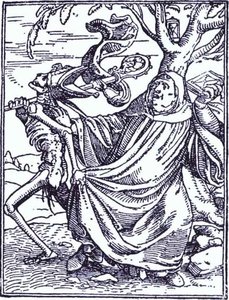
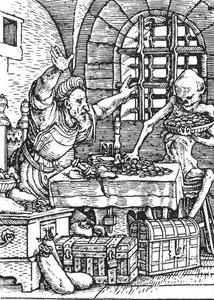
Holbein’s formative years were spent in Basel, Switzerland, where he established himself as an independent artist with a burgeoning reputation. He excelled not only in portraiture but also in religious art—creating monumental murals and stained glass windows that showcased his mastery of color and composition. Perhaps most strikingly, Holbein designed the *Dance of Death* series, a macabre depiction of mortality featuring exquisitely detailed figures representing every stratum of society. These early works reveal a profound fascination with capturing human emotion and exploring themes of life and death—qualities that would permeate his entire artistic career. The influence of Italian Renaissance humanist ideals is palpable in Basel’s artistic milieu during this period, shaping Holbein's stylistic choices and broadening his intellectual horizons.The Art of Perception: Style and Masterpieces
Holbein’s distinctive style is characterized by an unparalleled commitment to realism—a pursuit achieved through painstaking attention to detail in rendering textures, fabrics, and the subtle nuances of facial expressions. He didn’t simply *paint* portraits; he meticulously constructed them, layering upon layer, capturing not just physical appearances but also the personality and inner life of his sitters. His innovative compositions further enhanced the impact of his work—often employing symbolic objects or backgrounds to convey deeper meaning. The Ambassadors (1533), arguably Holbein’s most celebrated masterpiece, exemplifies this approach—a complex and symbolically rich double portrait showcasing both Holbein’s technical brilliance and intellectual depth. The anamorphic skull subtly embedded within the painting serves as a stark *memento mori*, reminding viewers of the inevitability of death. This masterful use of perspective and detail elevates the image beyond mere representation, inviting contemplation on themes of mortality and human ambition. His portraits of Henry VIII—particularly his depiction of the king’s coronation robes—became iconic representations of royal power and solidified Holbein's reputation as one of the foremost portraitists of his time.Historical Significance: A Legacy Enduring Through Time
Holbein’s artistic journey coincided with a period of profound intellectual and religious upheaval—the Reformation—and he skillfully utilized his art to convey messages of faith and authority. His depictions of Erasmus of Rotterdam capture the humanist scholar's erudition and moral integrity, reflecting the values of the Renaissance humanism movement. Furthermore, Holbein’s meticulous documentation of historical events—such as Henry VIII’s reign—provides invaluable insights into the political landscape and cultural sensibilities of Tudor England. He remains one of the most admired and studied painters of the Renaissance—a master whose legacy continues to inspire artists today. His work transcends mere technical skill; it embodies intellectual curiosity, artistic innovation, and a profound understanding of the human condition—qualities that cemented his place as a cornerstone of Northern Renaissance art history. He didn't merely record appearances—he captured moments in time, preserving them for posterity.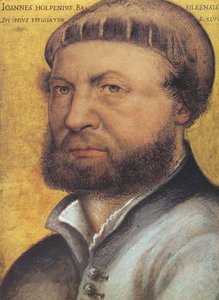
Hans Holbein den yngre
1497 - 1543 , Tyskland
Kortfattad information
- Artistic Movement Or Style: Nordländska renässansen
- Artists Or Movements Influenced By This Artist: ['Later portrait artists']
- Artists Who Influenced This Artist: ['Albrecht Dürer']
- Date Of Birth: c. 1497
- Full Name: Hans Holbein den Yngre
- Nationality: Tysk
- Notable Artworks:
- Ambrosius Holbein
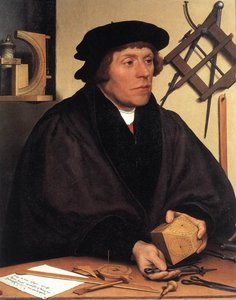
- Nikolaus Kratzer
- The Ambassadors
- Place Of Birth: Augsburg, Germany
Relaterade artiklar

Hans Holbein the Younger: A Renaissance Portraitist's Mastery of Realism & Psychological Insight
Explore the life & art of Hans Holbein the Younger, a Renaissance master renowned for his strikingly realistic portraits and psychological insight. Discover iconic works like 'The Ambassadors' and delve into his lasting legacy.

Porträttkonstens Mästare: Topp 10 Verk som Fångar Själens Essens – AllPaintingsStore.se
Utforska porträttkonstens historia med 10 ikoniska verk! Från Mona Lisa till Frida Kahlo – lär känna berättelserna bakom mästerverken och deras unika stil. Köp museumkvalitativa konsttryck på AllPaintingsStore.com och förvandla ditt hem med tidlös skönhet. Upptäck hela samlingen online!

Illuminating Belief: Faith & Symbolism Across Art History's Canvas
Explore the rich history of faith through art! Discover religious symbolism, Renaissance masterpieces & iconic artists. Expert analysis for collectors & enthusiasts. Learn more at AllPaintingsStore.

Från Selfie till Studio Porträtt: En Modern Förvandling i Olja – Konstnärlig Återskapelse av Personliga Fotografier med Klassisk Teknik
Förvandla dina älskade fotografier till tidlösa oljemålningar! Handmålade porträtt av professionella konstnärer med klassisk teknik. Unik kvalitet & personlig service. Beställ din tavla idag!
Personliga mytologier i olja: Att förvandla livsberättelser till symboliska mästerverk genom konstnärlig tolkning
Förvandla dina livsberättelser till unika oljemålningar! Vi hjälper dig att skapa symboliska mästerverk med professionella konstnärer. Expertkonsultation & högsta kvalitet.