


 Переглянути в інтер'єрі
 Надіслати
 Поділитися
 Деталі
 Посібник

 Завантажити
 Схожі предмети колекціонування
 Рентгенівське дослідження
 Слайд-шоу
 Статистика переглядів
Procession
 Олія на полотні
- Настінне мистецтво
- Expressionist Painting
 1911
1911- — Модерн
 100.0 x 100.0 cm
 Читати далі
Придбайте цифрову копію високої роздільної здатності з покращеною якістю, що значно перевершує онлайн-перегляд.
Кожен файл ретельно підготовлений нашими фахівцями за допомогою сучасних інструментів та професійної ручної ретуші. Ми гарантуємо виняткову чіткість, точну передачу кольору та високу деталізацію кожного зображення.
Фінальний файл надсилається електронною поштою протягом 72 годин і оптимізований для негайного використання у професійних виданнях та друкованих матеріалах. Таку якість обирають провідні дизайнерські студії, видавництва та галереї.
Цифрове зображення
Завантажте файл високої роздільної здатності для особистого використання, друку та творчих проєктів. ( Перейти до друку Купити картину ручної роботи)
Що входить у кожне замовлення цифрових зображень
Експертна цифрова доставка з гарантією якості
Обираючи AllPaintingsStore.com, ви отримуєте не просто зображення — ви отримуєте професійно вдосконалений цифровий витвір мистецтва, створений з надзвичайною точністю та підкріплений гарантією задоволення. Ось усе, що автоматично додається до вашого замовлення:

Швидка доставка на email
Ваш цифровий файл із зображенням високої роздільної здатності буде надісланий вам електронною поштою протягом 72 годин після оформлення замовлення — він буде готовий до негайного використання.

Цифровий файл із покращенням ШІ
Ваш витвір мистецтва професійно оптимізовано за допомогою передових інструментів штучного інтелекту та ручної корекції, що забезпечує максимальну деталізацію, чіткість і точність передачі кольорів.

Безкоштовне повторне завантаження назавжди
Випадково видалили або втратили файл? Не хвилюйтеся — ми надішлемо його вам повторно в будь-який час безкоштовно.

Без митних зборів — завжди
Насолоджуйтесь вашим витвором мистецтва миттєво без жодних мит, зборів або плати за доставку — цифрові завантаження завжди не оподатковуються.

Гарантія точності кольорів
Ми гарантуємо максимально точне відтворення оригінальних кольорів на вашому цифровому зображенні завдяки використанню професійних інструментів та систем управління кольором.

100-денна гарантія задоволення клієнта
Якщо ви не задоволені придбаним цифровим зображенням, ми внесемо правки або повернемо 100% вартості протягом 100 днів — без зайвих запитань.

Гарантія повернення 100% коштів
Незадоволені покупкою? Отримайте повне повернення коштів протягом 100 днів після отримання цифрового файлу — без зайвих запитань.

Знижки на оптові замовлення
Купуйте 3 зображення — заощаджуйте 10% — Купуйте 5 — заощаджуйте 15% — Купуйте 10+ — заощаджуйте 20%. Чудово підходить для творчих проєктів, галерей та агентств.
An Unsettling Dance of Life and Mortality
In the hauntingly beautiful masterpiece "Procession," created in 1911, Egon Schiele invites us into a psychological landscape where the boundaries between reality and inner turmoil dissolve. This seminal work of Expressionism serves as much more than a mere depiction of a group of figures; it is an immersive descent into the anxieties of the early twentieth century. As we gaze upon the canvas, we are immediately struck by the tension held within the composition. Schiele masterfully positions two women in the foreground, their presence anchoring an otherwise fragmented and surreal environment. One woman cradles a sleeping infant, a tender moment of maternal instinct that feels strangely fragile against the backdrop of unsettling, skeletal forms and heavy, somber tones. The painting captures a profound sense of human interaction, yet it is an interaction steeped in a quiet, existential dread.
The emotional weight of the piece is amplified by Schiele’s revolutionary use of line and form. Eschewing the polished perfection of traditional realism, he employs bold, angular, and often jagged lines that seem to vibrate with nervous energy. The figures are characterized by elongated limbs and distorted proportions, a hallmark of the Expressionist style designed to communicate raw, unadulterated feeling rather than anatomical accuracy. Through these deliberate distortions, Schiele creates a sense of instability, mirroring the psychological fragmentation of his subjects. The color palette, dominated by muted ochres, deep browns, and earthy tones, wraps the scene in a melancholic shroud, ensuring that every brushstroke contributes to the overarching atmosphere of somber reflection.
Symbolism and the Cycle of Existence
Beyond its striking visual impact, "Procession" is a profound meditation on the stages of human life and the inevitability of fate. Scholars often interpret the figures within the work as symbolic representations of existence itself. The presence of the infant suggests the beginning of life, while the more emaciated, weathered faces of the older figures hint at the progression toward decay. Some even see a deeply personal narrative woven into the paint—a reflection of Schiele’s own family history, where the figures might represent his father and mother, caught in an eternal, ghostly parade. This layer of symbolism transforms the painting from a historical snapshot into a timeless allegory of mortality, making it a piece that resonates deeply with anyone who has contemplated the fleeting nature of time.
For the discerning collector or interior designer, "Procession" offers a unique opportunity to introduce a conversation piece of immense intellectual and aesthetic depth into a space. A high-quality reproduction of this work does not merely decorate a wall; it commands attention, providing a focal point that invites contemplation and evokes a sense of historical gravity. Whether placed in a contemporary gallery setting or a classic study, the painting’s ability to balance raw emotion with sophisticated technique makes it an enduring choice for those who appreciate art that challenges the soul and enriches the environment with its complex, haunting beauty.
Запитання та відповіді
Чи можу я побачити рентгенівський знімок «Procession» Еґон Шілельє?
Сторінка Рентгенівське дослідження для твору «Procession» Еґон Шілельє — це інтерактивний візуалізатор, який дозволяє переглядати одинадцять оптичних шарів зображення, включаючи рентгенівський зріз.
Яке національне походження стоїть за Expressionist Painting твору "Procession"?
«Procession» була створена Еґон Шілельє, народилася в Австрія і належить до течії Expressionist Painting. Походження митця пов'язує цей твір із напрямом Expressionist Painting, як його представляли художники з Австрія.
Чи можу я замовити олійну репродукцію «Procession»?
Ви можете замовити написану вручну репродукцію твору «Procession» Еґон Шілельє безпосередньо на його сторінці Репродукція ручного письма: репродукція олією ручного розпису на лляному полотні, під замовлення.
Схожі твори мистецтва


Біографія митця
A Life Forged in Expression
Egon Schiele’s life, a turbulent and intensely personal journey, unfolded from his birth in Tulln an der Donau in 1890, a small Austrian town nestled along the Danube. His early years were shadowed by profound loss – first the death of his father, Adolf Schiele, a railway station master consumed by syphilis when Egon was just fourteen, and later the untimely passing of his sister Elvira. This early exposure to mortality and grief became deeply ingrained within his artistic vision, fueling an enduring fascination with the fragility of existence and the inevitability of death. Raised initially by his mother and then under the somewhat controlling guardianship of his uncle Leopold Czihaczek, Schiele’s childhood lacked the stability often associated with conventional upbringing, yet it fostered a remarkable sense of independence and self-reliance—qualities that would profoundly shape his artistic approach. Even as a young boy, he exhibited an intense curiosity about trains – a motif that subtly reappeared throughout his career, symbolizing both movement and the passage of time. Simultaneously, he displayed a burgeoning talent for drawing, though this pursuit was initially met with disapproval from his father, who viewed it as a distraction from more “practical” endeavors. The early loss of his sister Elvira cast a long shadow over the young artist’s psyche, contributing to a pervasive sense of melancholy and vulnerability that permeated much of his work. These formative experiences—illness, loss, and a lack of stability—instilled within him an unparalleled sensitivity and emotional rawness, qualities that would become defining characteristics of his artistic expression, constantly grappling with the fundamental questions of life, death, and the human condition.The Crucible of Vienna: Artistic Development
Schiele’s formal artistic training began at the Kunstgewerbeschule (School of Arts and Crafts) in Vienna, but he quickly found himself stifled by its conservative and rigidly academic approach. Seeking a more liberating environment, he transferred to the Akademie der bildenden Künste (Academy of Fine Arts), only to discover that even this institution failed to satisfy his artistic aspirations. The rigid traditions and emphasis on historical precedent clashed sharply with Schiele’s desire for innovation and personal expression. Dissatisfied with these constraints, he ultimately abandoned formal training altogether, choosing instead to forge his own path—a bold decision that underscored his unwavering commitment to his artistic vision. Crucially, during these formative years, Schiele was profoundly influenced by the work of Gustav Klimt, a leading figure in Viennese Secessionism. He admired Klimt’s distinctive decorative style and his exploration of symbolism, even receiving mentorship from the established artist. However, Schiele soon diverged significantly from Klimt's aesthetic, developing a uniquely personal style characterized by its stark honesty, psychological intensity, and unflinching portrayal of human vulnerability. This divergence was further fueled by his encounters with other progressive artists within Vienna’s avant-garde circles, leading to the formation of the Neues Wiener Kunstgruppe (New Viennese Art Group) in 1909—a collective dedicated to challenging conventional artistic norms and pushing the boundaries of modern art. The group included figures like Anton Faistauer, Rudolf Kalvach, and Hans Ehrlich, all seeking to redefine the role of art in a rapidly changing world.Raw Emotion and Unflinching Truth
Egon Schiele’s art is immediately recognizable for its raw honesty and psychological depth. He fearlessly confronted themes often considered taboo – sexuality, death, anxiety, isolation – with an unflinching gaze. His distinctive style features elongated figures, contorted poses, and expressive lines that convey a sense of unease and emotional intensity. The human form, particularly the nude, became his primary subject, not as an object of idealized beauty but as a vehicle for exploring the complexities of human experience. Self-portraits constitute a significant portion of his oeuvre, offering intimate glimpses into his inner world—a world often marked by loneliness and self-doubt. He didn’t shy away from depicting himself in unflattering or vulnerable poses, revealing a profound level of self-awareness and introspection. Beyond self-portraiture, Schiele created numerous portraits of others, capturing their likenesses with an unsettling realism that seemed to penetrate beneath the surface. His landscapes, while less central to his work than his figurative paintings, demonstrate his mastery of form and color, often reflecting the same emotional intensity as his portraits. Recurring motifs like the *Physalis* plant – symbolizing death and transience with its delicate, papery husk – further underscore this preoccupation with mortality. The use of line is particularly striking in Schiele’s work; it's not merely a tool for defining shape but an expressive force that conveys emotion and psychological tension.A Legacy Cut Short: Achievements & Significance
Despite facing censorship and legal challenges—including a brief imprisonment for allegedly corrupting minors with his art—Schiele gained recognition within Vienna’s avant-garde circles. His work challenged the conventions of the time, provoking both admiration and outrage. By the time of his untimely death during the Spanish flu pandemic in 1918 at the age of twenty-eight, he had established himself as a leading figure in Austrian Expressionism. Significant works such as *Self-Portrait with Physalis*, *Couple Embracing*, and *Field Landscape (Kreuzberg near Krumau)* stand as testaments to his artistic genius. His influence on subsequent generations of artists is undeniable, particularly those interested in exploring psychological themes and challenging conventional artistic norms. Schiele’s bold approach to form and subject matter continues to resonate with audiences today, making him one of the most important and influential figures in early 20th-century art. His paintings are now held in major museum collections worldwide, including the Leopold Museum in Vienna and the Egon Schiele Art Centrum in Český Krumlov, ensuring his artistic legacy endures. He left behind a body of work that is not merely aesthetically compelling but profoundly human—a testament to the power of art to confront the complexities of existence with honesty, courage, and unwavering vision.- Key Themes: Mortality, sexuality, isolation, psychological turmoil.
- Influences: Gustav Klimt, Viennese Secession, personal trauma.
- Style Characteristics: Elongated figures, contorted poses, expressive lines, raw emotion.
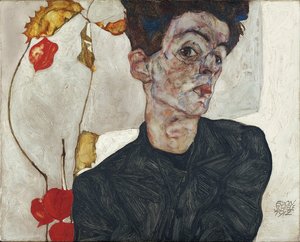
Еґон Шілельє
1890 - 1918 , Австрія
Коротко про автора
- Artistic Movement Or Style: Експресіонізм
- Artists Or Movements Influenced By This Artist: ['Експресіонізм']
- Artists Who Influenced This Artist: ['Густав Клімт']
- Date Of Birth: 1890
- Full Name: Еґон Шілельє
- Nationality: Австрієць
- Notable Artworks:
- Автопортрет з фізалісом
- Пара обіймається
- Поле краєвид (Креуберг)
- Place Of Birth: Тюльн, Австрія

