

Acrylic On Canvas.

§ 1Catalogue data

§ 2Abstract
Collectible Description
Discover 'Portrait de Amand Ono L'homme à la pipe,' a poignant realism painting by Jean-François Millet. Explore the life and work of this Barbizon School master, capturing rural French life with remarkable detail.
 Read More
Artist Biography
Jean-François Millet (1814-1875): French Realist painter of the Barbizon School, celebrated for poignant depictions of peasant life like 'The Gleaners' & 'The Angelus'. Explore his legacy.
§ 3Commentary
Portrait de Amand Ono L'homme à la pipe (autre titre): A Window into Rural Life
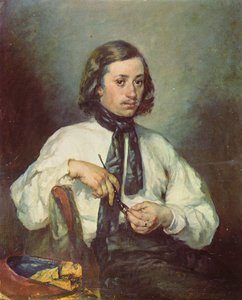
Jean-François Millet’s “Portrait de Amand Ono L’homme à la pipe” offers more than just a likeness; it’s a poignant glimpse into the heart of 19th-century rural France and the burgeoning Realist movement. Painted around 1850, this intimate portrait captures a moment of quiet contemplation within the familiar setting of a humble farmhouse. The subject, identified as Amand Ono, is a weathered farmer, his face etched with the stories of sun, soil, and labor. He’s seated comfortably, enveloped in a simple black tie, white shirt, and vest – attire that speaks to practicality and a life deeply connected to the land. The inclusion of a pipe, held casually between his lips, immediately invites us into his world, suggesting moments of respite amidst demanding work.
Millet’s masterful technique is evident in the subtle modeling of Amand's features and the way he renders the textures of fabric and skin. He employs a muted palette – predominantly browns, grays, and ochres – characteristic of the Barbizon school, which sought to depict nature as it truly appeared, eschewing idealized representations for a more honest portrayal of everyday life. The background, featuring two unassuming chairs and a simple bowl, further anchors the scene in domesticity, reinforcing the idea that this is not a grand portrait but a genuine observation of a working man.
The Barbizon School and Millet’s Vision
Jean-François Millet's work is inextricably linked to the Barbizon school, a revolutionary movement within French painting. Rejecting the academic traditions of the Salon, artists like Millet chose to paint *en plein air* – outdoors – directly from nature. This commitment to direct observation profoundly shaped their artistic approach. Unlike earlier painters who idealized rural life, Millet focused on the dignity and hardship of peasant farmers, portraying them with a remarkable degree of empathy and respect. His subjects weren’t romanticized heroes but ordinary individuals grappling with the realities of their existence.
The Barbizon school's emphasis on capturing light and atmosphere was equally significant. Millet skillfully utilizes diffused sunlight to create a sense of depth and realism, imbuing the scene with a quiet serenity. This deliberate choice reflects his deep connection to the natural world, honed by his upbringing in Gruchy, Normandy – a region he meticulously depicted throughout his career. His early life as a farmer profoundly influenced his artistic vision, providing him with an unparalleled understanding of rural rhythms and the lives of those who worked the land.
Symbolism and Emotional Resonance
Beyond its realistic depiction, “Portrait de Amand Ono L’homme à la pipe” is rich in symbolic meaning. The pipe itself represents a moment of pause, a brief respite from labor – a quiet contemplation within the demands of daily life. It suggests a connection to tradition, a link to generations past who have also found solace and companionship in this simple pleasure. Amand's weathered face speaks volumes about resilience, hard work, and the enduring spirit of those rooted in the soil.
The painting’s emotional impact is one of quiet dignity and understated beauty. It avoids sentimentality, instead offering a genuine portrait of an individual and his world. Millet doesn’t judge or romanticize; he simply presents Amand Ono as he is – a man of the land, marked by time and toil, yet possessing a profound sense of peace.
AllPaintingsStore's Hand-Painted Reproduction
At AllPaintingsStore, we are dedicated to preserving the legacy of master artists like Jean-François Millet. Our hand-painted reproductions of “Portrait de Amand Ono L’homme à la pipe” capture every nuance of detail and atmospheric quality of the original painting. Each reproduction is meticulously crafted by skilled artisans using traditional techniques and archival-quality materials, ensuring that it will endure for generations to come.
Whether you're an art collector, interior designer seeking a touch of rustic elegance, or simply someone captivated by Millet’s evocative vision, our hand-painted reproduction offers the perfect way to experience this iconic work of art. Explore our selection and bring the quiet dignity of rural France into your home.
- Authenticity: Hand-painted with meticulous attention to detail.
- Quality Materials: Crafted using archival-quality pigments and canvas.
- Dimensions: Available in a range of sizes to suit your space.
- Framing Options: Choose from classic or contemporary framing styles.
View the artwork details here.
Questions & Answers
How does "Portrait de Amand Ono L'homme à la pipe (autre titre)" by Jean-François Millet connect Realist Movement to the artist's home country?
"Portrait de Amand Ono L'homme à la pipe (autre titre)" connects the Realist Movement movement with France through its creator's birthplace.
Are the colors of "Portrait de Amand Ono L'homme à la pipe (autre titre)" by Jean-François Millet saturated or muted?
The palette of "Portrait de Amand Ono L'homme à la pipe (autre titre)" is subtle color in saturation.
Where is the portrait format of "Portrait de Amand Ono L'homme à la pipe (autre titre)" recommended to be displayed?
With its portrait shape, a reproduction of "Portrait de Amand Ono L'homme à la pipe (autre titre)" is suggested for a living room.



 Switch to Print


 For artworks or reproductions larger than 105 cm (approximately 41 inches) on any side, the frame will be shipped as a kit, disassembled. This method ensures safe delivery and prevents damage during transport.


