

Acrylic On Canvas.

§ 1Katalogdata


Dette kunstværk er ophavsretsbeskyttet
Kunstværket vist på denne side er beskyttet af ophavsretsloven, hvilket betyder, at vi ikke lovligt kan skabe eller sælge en identisk reproduktion. Denne beskyttelse håndhæves i henhold til internationale aftaler som f.eks. den Bernerkonventionen og af nationale love, herunder de bestemmelser, der er fastlagt i Amerikansk ophavsretslov - Titel 17.
Som et respektfuldt og lovligt alternativ tilbyder vi skræddersyede, håndmalede kunstværker inspireret af originalen. Vores dygtige og professionelle kunstnere studerer omhyggeligt originalens stil, stemning og kunstneriske essens for at skabe et nyt, unikt værk, der fremkalder den samme følelse – samtidig med at det forbliver en original skabelse i egen ret.
Denne metode overholder fuldt ud ophavsretsreglerne, da den ikke indebærer kopiering eller duplikering af det beskyttede kunstværk. I stedet er der tale om en kreativ nytolkning – et nyt maleri, som er inspireret af det oprindelige, men ikke identisk med det.
 Læs mere
§ 2Abstrakt
Beskrivelse af samlerobjektet
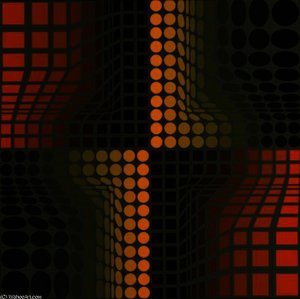
Experience Victor Vasarely’s iconic Monocolor Yellow, a groundbreaking Op Art masterpiece featuring a vibrant yellow square and intricate black dot patterns – a timeless exploration of perception and geometry. Discover this captivating artwork and bring its dynamic energy into your space.
Kunstnerbiografi
Op Art pioneren Victor Vasarely (1906-1997) skabte geometriske illusioner og dynamiske mønstre, der udfordrede vores synsopfattelse. Udforsk hans banebrydende kunst!
§ 3Kommentarer
A Bold Statement in Yellow: Exploring Victor Vasarely’s *Monocolor Yellow*
Victor Vasarely's Monocolor Yellow is more than just a painting; it’s an invitation to reconsider the very nature of perception. This striking work, dominated by a vibrant yellow square punctuated with strategically placed black dots, embodies the core principles of Op Art – Optical Art – and represents a pivotal moment in the development of kinetic art. Created by a visionary artist deeply influenced by geometric abstraction and the Bauhaus movement, this piece offers a glimpse into Vasarely’s relentless pursuit of translating mathematical concepts into visual experiences.
The Genesis of Op Art: Vasarely's Intellectual Foundation
- Early Influences: Born in 1906 in Pécs, Croatia (then part of Austria-Hungary), Vasarely’s artistic trajectory began unexpectedly. Initially drawn to medicine, he ultimately recognized the power of visual expression and embraced painting, a decision profoundly shaped by his studies at the Podolini-Volkmann Academy and, crucially, Sándor Bortnyik's “Műhely” workshop.
- Bauhaus Principles: This workshop provided Vasarely with an invaluable education in functional design and geometric abstraction – concepts central to the Bauhaus movement’s emphasis on form following function. He meticulously analyzed how visual elements could create illusions of movement, depth, and vibration.
- Mathematical Precision: Vasarely's work wasn't simply about aesthetics; it was rooted in a rigorous understanding of mathematics and optics. He employed precise geometric forms – circles, squares, lines – to manipulate the viewer’s perception, creating an almost hypnotic effect.
Decoding *Monocolor Yellow*: Composition and Illusion
The composition of Monocolor Yellow is deceptively simple yet profoundly complex. The large yellow square commands immediate attention, acting as the primary focal point. However, it’s the surrounding black dots that truly elevate the work. Their varying sizes, arrangements, and spatial relationships generate a dynamic visual field, creating an illusion of movement and depth. Vasarely masterfully utilizes negative space to amplify this effect, drawing the eye across the canvas in a seemingly endless loop.
The technique employed is characteristic of Op Art: meticulous layering of paint to create subtle variations in tone and texture that enhance the optical illusion. The precise placement of each dot demonstrates Vasarely’s dedication to achieving maximum visual impact through controlled geometric precision.
Symbolism and Emotional Impact
While ostensibly a study in geometry, *Monocolor Yellow* resonates with deeper symbolic meanings. The yellow square can be interpreted as representing stability, energy, or even the sun – fundamental elements of human experience. The black dots, conversely, might symbolize disruption, chaos, or the inherent complexity within order. Together, they create a tension that mirrors the viewer’s own perceptual processes.
Ultimately, *Monocolor Yellow* is an artwork designed to provoke thought and stimulate the senses. It's a testament to Vasarely's genius – his ability to transform abstract mathematical principles into a captivating visual experience. This hand-painted reproduction captures the essence of this iconic piece, offering a unique opportunity to bring its bold aesthetic into your home or office.
Spørgsmål og svar
Hvor kan jeg finde statistik om "Monocolor Yellow" af Victor Vasarely?
Statistikker for "Monocolor Yellow" af Victor Vasarely findes på værkets Besøgsstatistik-side: månedlige besøg på værket, besøg på kunstnerens øvrige værker samt en opdeling af de seneste besøgende efter land og sprog.
Hvilken kunsthistorisk betydning har "Monocolor Yellow" af Victor Vasarely?
"Monocolor Yellow" af Victor Vasarely er kunsthistorisk klassificeret som Op Art fra Modern-perioden.
Hvilken farvetone dominerer i "Monocolor Yellow"?
"Monocolor Yellow" har en tendens til en Ochre to Sepia nuance.




 Skift til printsalg


 For kunstværker eller reproduktioner, der er større end 105 cm (ca. 41 tommer) på en hvilken som helst side, vil rammen blive leveret som et adskilt sæt. Denne metode sikrer sikker levering og forhindrer skader under transport.


