![[untitled] — Miné Okubo](/media/artworks/images-full/e9/79/e97929bc85eb4d67705f5d2644bd43c2.jpg)
 In echtem Maßstab anzeigen
 Versenden als Grußkarte
 Teilen
 Details anzeigen
 Leitfaden öffnen

 Herunterladen
 Ähnliche Objekte
 Röntgenaufnahme
 Diashow
 Besucherstatistiken
[Untitled]


 Mehr anzeigen
Die auf dieser Seite dargestellten Kunstwerke sind urheberrechtlich geschützt, was bedeutet, dass wir keine identische Reproduktion rechtmäßig erstellen oder verkaufen dürfen. Dieser Schutz wird durch internationale Abkommen wie die Berner Übereinkunft und durch nationale Gesetze, einschließlich derer, die von den ... festgelegt wurden US-Urheberrecht – Titel 17.
Als respektvolle und rechtlich einwandfreie Alternative bieten wir individuelle, handgemalte Kunstwerke an, die vom Original inspiriert sind. Unsere geschickten und professionellen Künstler studieren sorgfältig den Stil, die Stimmung und das künstlerische Wesen des Originals, um ein neues, einzigartiges Werk zu schaffen, das dasselbe Gefühl hervorruft – während es zugleich eine eigenständige Originalschöpfung bleibt.
Diese Methode entspricht vollumfänglich den Urheberrechtsbestimmungen, da sie keine Kopie oder Vervielfältigung des geschützten Kunstwerks darstellt. Stattdessen handelt es sich um eine kreative Neuinterpretation – ein neues Gemälde, das vom Original inspiriert, aber nicht identisch mit ihm ist.
Handgefertigte Ölreproduktion
Handgemaltes Ölgemälde auf Leinwand in Ihrer Wunschgröße und mit Rahmen, auf Bestellung von unseren Künstlern angefertigt. ( Zum Druck wechseln Zum digitalen Bild wechseln)




P118B €10

P118H €10

P118W €10

P438Z €10

P508JH €12

P508YH €12

P805H €10

P805Z €10

P919BZ €10

P919G €10

P919XJ €10

P959ZH €10

P968JZ €12

W106C €8

W218G €10

W218JH €8

W218Y €10

W307PJ €10

W316G €10

W316PJ €8

W316Y €10

W398PJ €8

W4111J €10

W500HY €15

W500JH €15

W692G €12

W849H €8

W940BG €15

W953PJ €8




Wählen Sie aus unseren vordefinierten Formaten, die den ursprünglichen Proportionen des Kunstwerks entsprechen.

Sie können Ihre eigenen Maße eingeben, um einen bestimmten Rahmen oder Platz auszufüllen. Wenn die gewählte Größe nicht den Proportionen des Originalbildes entspricht, werden wir das Kunstwerk entweder beschneiden oder das Gemälde durch zusätzliche, handgemalte Elemente erweitern. Ein digitales Mockup wird Ihnen zur Genehmigung zugesandt, bevor die Produktion beginnt.
Bitte beachten Sie, dass die Bildschirmvorschau nicht die tatsächliche Beschneidung oder Erweiterung widerspiegelt. Nur das Mockup zeigt die endgültige Komposition exakt an.
Obwohl Sondermaße verfügbar sind, empfehlen wir, eine Größe aus der vordefinierten Liste zu wählen, um die ursprünglichen Proportionen beizubehalten.
Nach der Bestellung wird das AllPaintingsStore.com-Team dem Kunden Anweisungen per E-Mail zusenden und eine Mockup-Vorschau bereitstellen.
Weltweiter Versand () in nur 3 bis 4 Wochen statt der üblichen 5 Wochen. (10 Oktober). Keine Kompromisse bei der Qualität.

Kostenloser weltweiter Expressversand

Hochwertige Leinenleinwand

Vollständiger Versicherungsschutz beim Versand

Zollgebühren-Rückerstattungsgarantie

Garantie für exakte Farbtreue

100-tägiges Rückgaberecht (nur bei Mängeln)

100% Geld-zurück-Garantie

Angebot für Mengenrabatt
 Die Glasoption ist nur für Größen unter 110 cm verfügbar.
![[Untitled]](/static/images/allpaintingsstore/artworks/painting.a1e74a1cb7dc.png)
[Untitled]
Reproduktionsmedium
Format der Reproduktion
-


Gesamtpreis
€ 222
A Chronicle in Color: Unveiling Miné Okubo’s “Untitled”
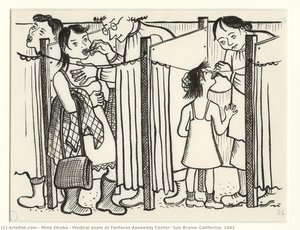
Miné Okubo's "Untitled," painted in 1974, isn't merely a depiction of flowers within a vase; it’s a vibrant testament to resilience forged during a profoundly challenging period. Created amidst the upheaval of World War II and the subsequent internment of Japanese Americans, this artwork embodies a complex tapestry of memory, displacement, and ultimately, an enduring spirit. The painting pulses with a raw energy, born from Okubo's direct observation of life within the Topaz Relocation Center in Utah – a place that simultaneously represented confinement and a space for creative expression.
The style is decidedly abstract expressionist, yet grounded in a meticulous attention to detail. Thick, impasto brushstrokes dominate the composition, lending a tactile quality to the work and suggesting layers of experience. The colors—bold reds, deep blues, sunny yellows, and crisp whites—aren’t employed with photographic realism but rather as vehicles for emotional resonance. Notice how the red dominates the central floral forms, perhaps symbolizing both the intensity of life within the camp and the fiery determination of its inhabitants. The background is a dynamic interplay of fractured planes and contrasting hues, creating a sense of movement and instability that mirrors the psychological landscape of those enduring confinement.
Decoding Symbolism: Flowers, Vessels, and the Human Spirit
While seemingly a still life, “Untitled” is rich with symbolic weight. The arrangement of flowers within a vase immediately evokes traditional Japanese aesthetics – a connection to Okubo’s heritage and a subtle nod to the beauty that persisted even in the face of adversity. However, these aren't delicate, idealized blossoms; they are rendered with a forceful energy, their petals slightly distorted, their forms imbued with a sense of urgency. The vase itself acts as a container, not just holding the flowers but also representing the constraints and limitations imposed by the internment experience.
Crucially, the painting’s power lies in its ambiguity. Okubo deliberately avoids explicit representation, allowing viewers to project their own interpretations onto the scene. The fragmented background hints at a disrupted world, while the vibrant colors suggest an unwavering hope for the future. The signature “Mine Okubo 1974” in the lower right corner serves as a grounding element, anchoring the work within its historical context and reminding us of the artist’s personal journey.
A Window into History: Contextualizing the Artwork
To fully appreciate "Untitled," it's essential to understand the tumultuous era in which it was created. Following Executive Order 9066, nearly 120,000 Japanese Americans – including citizens and legal residents – were forcibly removed from their homes and incarcerated in camps across the Western United States. Miné Okubo’s art became a vital record of this injustice, documenting the daily realities of camp life through her meticulous drawings and paintings. Her work is part of a larger body of art created by Japanese Americans during this period—a powerful collective response to an unprecedented act of discrimination.
The fact that Okubo continued to create art *during* her confinement speaks volumes about her resilience and commitment to bearing witness. Her decision to document her experiences through visual means offered a form of agency and control in the face of overwhelming circumstances. It’s a poignant reminder of the enduring power of art as a tool for survival, remembrance, and social commentary.
Bringing “Untitled” Home: Reproduction and Artistic Impact
Reproductions of Miné Okubo's "Untitled" offer a remarkable opportunity to bring this powerful artwork into your home or office. The vibrant colors and dynamic composition will undoubtedly serve as a focal point, injecting energy and emotion into any space. Consider framing the piece in a simple dark wood frame – allowing the artwork’s intensity to truly shine through—or opting for a more contemporary setting that complements its bold aesthetic.
Beyond its visual appeal, “Untitled” carries a profound historical significance. Owning or displaying a reproduction of this work is an act of remembrance and solidarity with the Japanese American community. It’s a chance to engage with a crucial chapter in American history and honor the artistic legacy of Miné Okubo – a woman who transformed personal suffering into a testament to human resilience.
Fragen & Antworten
Wie lässt sich "[Untitled]" von Miné Okubo in der Inneneinrichtung verwenden?
"[Untitled]" von Miné Okubo wird für Reflective empfohlen, idealerweise in einem Living Room. Verwendung und Raumgestaltung geben gemeinsam Aufschluss darüber, wo eine Reproduktion am besten zur Geltung kommt.
Wie alt war Miné Okubo, als „[Untitled]“ geschaffen wurde?
Miné Okubo schuf „[Untitled]“ im Alter von 62. Der Künstler wurde 1912 geboren, und das Werk datiert auf 1974.
Wie ist die Farbkomposition von "[Untitled]" von Miné Okubo aufgebaut?
Die Farbanalyse von "[Untitled]" von Miné Okubo zeigt einen Gentle Kontrast und eine Discordant Palette Harmonie auf.
Wer hat "[Untitled]" erschaffen?
"[Untitled]" wurde von Miné Okubo geschaffen. Die Informationen auf dieser Seite beschreiben das Originalwerk von Miné Okubo.
Wie hell ist "[Untitled]" insgesamt?
Die wahrgenommene Helligkeit von "[Untitled]" von Miné Okubo beträgt balanced. Sie lässt sich optimal an das Licht des vorgesehenen Raumes anpassen.
Was ist das Entstehungsdatum von "[Untitled]" von Miné Okubo?
"[Untitled]" von Miné Okubo entstand im Jahr 1974.
Welche Druckgröße wird für "[Untitled]" von Miné Okubo empfohlen?
Die empfohlene Druckgröße für "[Untitled]" von Miné Okubo ist Medium.
Ähnliche Kunstwerke


Biografie des Künstlers
Miné Okubo: Leben, Kunst und Vermächtnis
Frühes Leben und Ausbildung
- Geboren: 27. Juni 1912 in Riverside, Kalifornien, als Tochter japanischer Einwanderer.
- Okubo zeigte bereits früh Talent für die Kunst, was von ihrer Familie gefördert wurde.
- Sie absolvierte eine formale künstlerische Ausbildung an der University of California, Berkeley, und reiste später 1938 nach Europa, um ihre Studien fortzusetzen.
- Ihr Aufenthalt in der Schweiz wurde durch die zunehmenden politischen Spannungen vor dem Zweiten Weltkrieg verkürzt.
Internierung und künstlerische Reaktion
- Nach dem Angriff auf Pearl Harbor wurden Okubo und ihr Bruder Benji gewaltsam von ihrem Zuhause entfernt und in amerikanische japanische Internierungslager gebracht.
- Zuerst wurden sie 1942 an das Tanforan Assembly Center geschickt, später jedoch an das Topaz War Relocation Center in Utah.
- Während ihrer Haft begann Okubo ein bemerkenswertes Projekt: Sie dokumentierte akribisch das tägliche Leben innerhalb der Lager durch über 2.000 Zeichnungen und Skizzen.
- Diese Werke erfassten die harten Realitäten des Lagerlebens – die beengten Wohnverhältnisse, bürokratische Prozesse, emotionale Belastung und die Widerstandsfähigkeit der Internierten.
Citizen 13660: Zeugnis von Macht
- Nach ihrer Freilassung im Jahr 1944 ordnete Okubo eine Auswahl von 198 Zeichnungen und begleitendem Text zu einem Buch namens Citizen 13660 zusammen.
- Das Buch, das 1946 veröffentlicht wurde, gilt als wegweisende Arbeit zur Dokumentation der Erfahrung der japanischen Amerikaner in den Internierungslagern.
- Der Titel bezieht sich auf die ihm zugewiesene Nummer innerhalb des Internierungssystems und betont den entwürdigenden Aspekt der zwangsweisen Umsiedlung.
- Die Zeichnungen zeichnen sich durch ihre Direktheit, Ehrlichkeit und emotionale Tiefe aus und bieten einen eindringlichen visuellen Bericht über ein dunkles Kapitel der amerikanischen Geschichte.
Nachkriegsberuf und künstlerische Entwicklung
- Nach dem Krieg zog Okubo nach New York City, wo sie ihre künstlerische Karriere fortsetzte.
- Sie arbeitete als freiberufliche Künstlerin und schuf Illustrationen für Zeitschriften und Bücher sowie verfolgte Wandprojekten.
- Ihr Stil entwickelte sich im Laufe der Zeit, aber sie behielt stets einen Fokus auf soziale Kommentare und humanistisches Thema.
- Okubo erhielt im Laufe ihrer Karriere zahlreiche Auszeichnungen und Anerkennungen, darunter Stipendien vom National Endowment for the Arts.
Einflüsse und Vermächtnis
- Okubos Werk wurde von der Sozialrealistischen Bewegung beeinflusst, die sich darauf konzentrierte, soziale Probleme und den Alltag mit einem Fokus auf Realismus darzustellen.
- Sie ließ sich von Künstlern wie Käthe Kollwitz inspirieren, die für ihre kraftvollen Darstellungen menschlichen Leidens bekannt ist.
- Ihr Vermächtnis liegt in ihrer mutigen Dokumentation der Internierungserfahrung und ihrem Beitrag zur Sensibilisierung für Bürgerrechte und soziale Gerechtigkeit.
- “Citizen 13660” bleibt ein wichtiges historisches Dokument und hallt bis heute nach, erinnert uns an die Bedeutung von Wachsamkeit gegen Vorurteile und Diskriminierung.
Tod und Erinnerung
- Miné Okubo starb am 10. Februar 2001, hinterließ ein mächtiges Werk, das weiterhin inspiriert und unterrichtet.
- Ihre Kunst wird in zahlreichen öffentlichen und privaten Sammlungen aufbewahrt, um ihre Geschichte und Botschaft für zukünftige Generationen zu erhalten.

Miné Okubo
1912 - 2001 , Vereinigte Staaten von Amerika
Eckdaten zum Künstler
- Artistic Movement Or Style: Sozialrealismus
- Artists Who Influenced This Artist: ['Käthe Kollwitz']
- Date Of Birth: 27. Juni 1912
- Date Of Death: 10. Februar 2001
- Full Name: Miné Okubo
- Nationality: Amerikanerin
- Notable Artworks:
- Citizen 13660
- Interior of Mine and Toku
- Place Of Birth: Riverside, Kalifornien
Verwandte Artikel

Lyrical Abstraction: The Emotional Power of Color and Form in Modern Art History
Explore the profound emotional depth of Lyrical Abstraction. Discover how masters like Raymond Parker used color and form to bridge Impressionism and Abstract Expressionism. Learn about this pivotal movement through our expert-led art history guide.

Abstrakter Expressionismus: Die 10 Meisterwerke, die eine Kunstbewegung prägten |
Entdecken Sie die 10 Meisterwerke des Abstrakten Expressionismus! Von Jackson Pollock bis Mark Rothko – erfahren Sie die Geschichten hinter ikonischen Gemälde und finden Sie hochwertige Reproduktionen für Ihr Zuhause. Jetzt bei entdecken!

Beyond the Lines: Mastering the High-Impact World of Contemporary Abstraction
Master the high-impact world of contemporary abstraction. Discover how bold colors, textures, and modern movements like Abstract Expressionism can transform your space with premium, high-energy art curated for the design-conscious professional.

Arthur Dove: Pionier der amerikanischen Abstraktion und die poetische Sprache der Moderne
Entdecken Sie Arthur Dove, den Pionier der amerikanischen Abstraktion! Erfahren Sie mehr über seine künstlerische Entwicklung, Einflüsse und sein bleibendes Vermächtnis. Für Kunstsammler & Kenner.

Geometrische Abstraktion: Die 10 Meisterwerke, die Kunstgeschichte prägten | AllPaintingsStore.com
Entdecken Sie die 10 Meisterwerke der geometrischen Abstraktion! Von Kandinsky bis Mondrian – erleben Sie die Geschichte, Farben & Formen dieser revolutionären Kunstrichtung. Hochwertige Kunstreproduktionen auf AllPaintingsStore.com
![[Unbetitelt]](/media/artworks/images-thumb/da/f5/daf58ec86f2a4b9d0b02cc6cd4383556.jpg)