


 Preview
 Send
Send Share
Share
 Details
 Guide
Guide

 Download
 Similars
 X-Ray
X-Ray Diaporama
 Stats
StatsAgnes Miyakawa


 Read More
Hand Made Oil Reproduction
Hand-painted oil on canvas in your size and frame, made to order by our artists. ( Switch to Print Switch to Digital Image)




P118B $10

P118H $10

P118W $10

P438Z $10

P508JH $12

P508YH $12

P805H $10

P805Z $10

P919BZ $10

P919G $10

P919XJ $10

P959ZH $10

P968JZ $12

W106C $8

W218G $10

W218JH $8

W218Y $10

W307PJ $10

W316G $10

W316PJ $8

W316Y $10

W398PJ $8

W4111J $10

W500HY $15

W500JH $15

W692G $12

W849H $8

W940BG $15

W953PJ $8




Pick from our preset sizes that match the artwork's original proportions.

You may enter your own dimensions to fit a specific frame or space. If your selected size does not match the original image's proportions, we will either crop the artwork or extend the painting with additional hand-painted elements. A digital mockup will be sent for your approval before production begins.
Please note that the on-screen preview does not reflect the actual cropping or extension. Only the mockup will accurately show the final composition.
While custom sizes are available, we recommend selecting a dimension from the predefined list to preserve the original proportions.
After order, AllPaintingsStore.com team will email client for instructions and provide a mockup preview
Worldwide Delivery () in 3/4 weeks instead of standard 5 weeks. (23 September). No compromise on quality.

Free Worldwide Express Shipping

High-Quality Linen Canvas

Full Shipping Insurance

Customs Tax Refund Guarantee

True Color Matching Guarantee

100-Day Return Policy (Defects Only)

100% Money-Back Guarantee

Bulk Discount Offer
 Glass option is only available in size under 110 CM

Agnes Miyakawa
Reproduction Medium
Reproduction Size
-


Total Price
$ 258
Agnes Miyakawa – Alban Maria Johannes Berg’s Portrait of Elegance
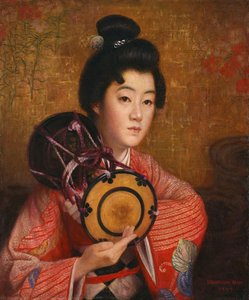
Sacramento Japantown native Agnes Miyakawa (1911-1995) embarked on a journey of artistic exploration, leaving her hometown to pursue singing studies in Paris. This formative experience profoundly shaped her life and career, culminating in a celebrated operatic debut at the Opera Comique in 1931. Her performance as Cio-Cio San in Madame Butterfly captivated audiences and critics alike, establishing her as a luminary of opera and cementing her legacy as one of the most influential vocalists of her era. Miyakawa continued to perform internationally across Japan, Los Angeles, and beyond, showcasing her versatility and unwavering dedication to her craft. Furthermore, she graced the silver screen and radio waves, broadening her artistic reach and solidifying her position within the cultural landscape of the mid-20th century.- Subject Matter: The artwork presents a portrait photograph of Agnes Miyakawa, capturing her likeness with meticulous detail. Her gaze directs towards the viewer, fostering a connection that speaks to both confidence and introspection.
- Style: The image embodies the stylistic conventions of early 20th-century portrait photography—formal, poised, and prioritizing accuracy in representation. It reflects the aesthetic sensibilities prevalent during Schoenberg’s time.
Composition & Visual Elements
The photograph's composition is centered around Miyakawa’s figure, placing her directly at the frame’s midpoint. This deliberate arrangement emphasizes her presence and conveys a sense of stability. The blurred background serves to isolate Miyakawa, highlighting her face and upper body—the focal point of the image. Notably, Miyakawa holds an open fan partially obscuring her lower torso, introducing visual interest and subtly framing her posture.- Color Palette: Utilizing a grayscale palette with varying shades of black, white, and gray, the photograph achieves tonal richness without resorting to color. The careful gradation from deep shadows to bright highlights underscores the artist’s mastery of light and texture.
- Lines & Shapes: Soft lines dominate the image, particularly in Miyakawa's face and hair—a testament to the photographer's skill in capturing subtle nuances of form. The fan introduces curved lines that contrast with the more structured elements of her kimono, adding dynamism to the composition.
Technical Considerations & Artistic Technique
The photograph was produced using traditional darkroom processes—developing and printing techniques honed over decades. These methods ensured optimal tonal accuracy and preserved the image's inherent character. The photographer skillfully employed lighting, diffusing it gently to illuminate Miyakawa’s features without creating harsh shadows—a hallmark of studio portraiture.- Texture: The photograph captures a range of textures—the smoothness of Miyakawa’s skin, the intricate patterns on her kimono (rendered as tonal variations), and the delicate texture of the flowers adorning her hair. These textural elements contribute to the artwork's immersive quality.
Symbolism & Emotional Resonance
The image evokes a sense of formality, grace, and perhaps a hint of melancholy—resonances that align with the historical context surrounding Madame Butterfly and Miyakawa’s artistic journey. Her unwavering gaze conveys strength and conviction, symbolizing resilience and determination amidst personal challenges.Related Artworks




Artist Biography
A Life Immersed in Sound and Emotion
Alban Maria Johannes Berg, born February 9, 1885, in Vienna, Austria, was a composer whose relatively brief life yielded a body of work that profoundly reshaped the landscape of 20th-century music. Though initially drawn to literature, a path he seriously considered pursuing, Berg’s destiny lay within the realm of sound. His father, Konrad Berg, managed a successful export business, providing a comfortable upbringing that allowed for early musical exploration – though largely self-directed at first. He began composing at fifteen, receiving piano lessons from his sister's governess, but it was a pivotal encounter in 1904 with Arnold Schoenberg that irrevocably altered the course of his artistic development. This mentorship wasn’t merely instructional; it was an immersion into a new musical language, one built on principles of developing variation and, later, the revolutionary twelve-tone technique. A complex personal life unfolded alongside his burgeoning career, including the birth of a daughter, Albine, in 1902 to Marie Scheuchl, a family maid – a circumstance that speaks to the societal complexities of the time. In 1911 he married Helene Nahowski, a union that brought both joy and social challenges.Forging a Unique Musical Voice
Berg’s genius wasn't in simply adopting Schoenberg’s innovations but in *transforming* them. He didn’t merely apply the twelve-tone technique as an intellectual exercise; he infused it with a deeply Romantic sensibility, a lyrical expressiveness that distinguished his work from that of his mentor and fellow Second Viennese School member, Anton Webern. His early compositions – five drafts for piano sonatas and a collection of songs including the evocative *Seven Early Songs* (first publicly performed in 1907) – already hinted at this unique blend. The Piano Sonata, Op. 1, completed around 1908-1909, stands as a remarkably mature debut, demonstrating an astonishing mastery of musical structure and foreshadowing the emotional depth that would characterize his later works. Berg wasn’t isolated in his artistic pursuits; he thrived within Vienna's vibrant cultural circle, associating with figures like Alexander von Zemlinsky, the iconic Gustav Klimt, and the incisive writer Karl Kraus. These interactions undoubtedly enriched his perspective and fueled his creative fire. He absorbed influences from Mahler and Wagner, retaining a connection to the Romantic tradition even as he ventured into atonality.Landmark Operas and Chamber Masterpieces
Berg’s most enduring legacy lies in his operas and chamber works. *Wozzeck* (1924), a landmark achievement of 20th-century opera, is a harrowing portrayal of a soldier exploited and driven to despair. Its fragmented scenes, dissonant harmonies, and intensely psychological characterizations broke with operatic conventions and established Berg as a major force in the genre. The *Lyric Suite* (1926), a chamber work for string sextet, showcases his ability to distill profound emotions into concise forms, revealing layers of meaning through subtle motivic development. The Violin Concerto (1935), dedicated to Louis Krasner, is a fascinating synthesis of twelve-tone technique and tonal references, incorporating elements of Bach chorales and Carinthian folk songs – a testament to Berg’s ability to bridge seemingly disparate musical worlds. Perhaps his most ambitious undertaking was *Lulu*, an opera exploring themes of sexuality, power, and societal corruption. Tragically unfinished at his death in 1935, it was later completed by Friedrich Cerha, allowing audiences to experience the full scope of Berg’s vision. The Chamber Concerto (1925) further exemplifies his skill in weaving diverse musical elements into a cohesive and emotionally resonant whole.A Lasting Impact on Modern Music
Alban Berg's untimely death on December 24, 1935, from sepsis following an insect bite robbed the world of a composer at the height of his powers. Yet, despite his relatively short life, he left behind a musical legacy that continues to resonate today. He profoundly influenced the development of modern music, demonstrating the expressive potential of atonality and twelve-tone techniques while simultaneously retaining a commitment to emotional depth and humanism. As a key member of the Second Viennese School, alongside Schoenberg and Webern, Berg contributed to a revolutionary shift in musical aesthetics. His operas, particularly *Wozzeck* and *Lulu*, remain staples of the operatic repertoire, frequently performed worldwide and captivating audiences with their dramatic intensity and psychological insight. His works are not merely studied by musicologists; they continue to inspire composers seeking new ways to express complex emotions through innovative musical structures. Theodor W. Adorno’s observation – that Berg believed “everything was supposed to develop out of something else and yet be intrinsically different” – encapsulates the essence of his compositional philosophy, a principle that continues to guide musicians today. Berg's music stands as a powerful testament to the enduring power of artistic expression in a rapidly changing world.
Alban Maria Johannes Berg
1885 - 1935 , Austria
Quick Facts
- Artistic Movement Or Style: Expressionism, Atonal music
- Artists Or Movements Influenced By This Artist:
- Modern music
- Second Viennese School
- Artists Who Influenced This Artist:
- Arnold Schoenberg
- Mahler
- Wagner
- Date Of Birth: February 9, 1885
- Date Of Death: December 24, 1935
- Full Name: Alban Maria Johannes Berg
- Nationality: Austrian
- Notable Artworks:
- Wozzeck
- Lulu
- Lyric Suite
- Violin Concerto
- Place Of Birth: Vienna, Austria
Related Articles

Timeless Contrast: A Professional Guide to Black and White Photography for Large-Scale Hotel Decor
A professional guide for hotel designers on utilizing black and white photography for large-scale decor. Learn to master scale, texture, and monochrome contrast to create impactful, high-end hospitality environments through efficient, bulk art procurement solutions.

The Lens of Truth: A Cultural History of the Evolution of Documentary Photography
Explore the profound evolution of documentary photography through an art-historical lens. Discover how legendary photographers captured truth, urban life, and human resilience, shaping our cultural understanding of history and the enduring power of the visual narrative.


