Preview
 Send
Send Share
Share
 Details
 Guide
Guide

 Download
 Similars
 X-Ray
X-Ray Diaporama
 Stats
StatsLA ROBE ENSANGLANTEE DE JOSEPH APPORTEE A JACOB


 Read More
Hand Made Oil Reproduction
Hand-painted oil on canvas in your size and frame, made to order by our artists. ( Switch to Print Switch to Digital Image)




P118B $10

P118H $10

P118W $10

P438Z $10

P508JH $12

P508YH $12

P805H $10

P805Z $10

P919BZ $10

P919G $10

P919XJ $10

P959ZH $10

P968JZ $12

W106C $8

W218G $10

W218JH $8

W218Y $10

W307PJ $10

W316G $10

W316PJ $8

W316Y $10

W398PJ $8

W4111J $10

W500HY $15

W500JH $15

W692G $12

W849H $8

W940BG $15

W953PJ $8




Pick from our preset sizes that match the artwork's original proportions.

You may enter your own dimensions to fit a specific frame or space. If your selected size does not match the original image's proportions, we will either crop the artwork or extend the painting with additional hand-painted elements. A digital mockup will be sent for your approval before production begins.
Please note that the on-screen preview does not reflect the actual cropping or extension. Only the mockup will accurately show the final composition.
While custom sizes are available, we recommend selecting a dimension from the predefined list to preserve the original proportions.
After order, AllPaintingsStore.com team will email client for instructions and provide a mockup preview
Worldwide Delivery () in 3/4 weeks instead of standard 5 weeks. (21 September). No compromise on quality.

Free Worldwide Express Shipping

High-Quality Linen Canvas

Full Shipping Insurance

Customs Tax Refund Guarantee

True Color Matching Guarantee

100-Day Return Policy (Defects Only)

100% Money-Back Guarantee

Bulk Discount Offer
 Glass option is only available in size under 110 CM

LA ROBE ENSANGLANTEE DE JOSEPH APPORTEE A JACOB
Reproduction Medium
Reproduction Size
-


Total Price
$ 333
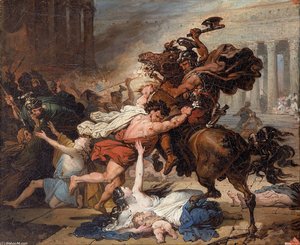
A Dramatic Tableau of Faith: Examining François Joseph Heim’s ‘The Bloodstained Coat of Joseph Brought to Jacob’
François Joseph Heim (1787 – 1865) remains an indelible presence in the annals of French Romantic art, representing a harmonious blend of stylistic innovation and unwavering adherence to classical ideals. Born amidst the turbulent political landscape of Alsace-Lorraine under Napoleonic dominion—a formative experience that instilled within him a profound appreciation for disegno—Heim’s artistic trajectory commenced with an early immersion into the burgeoning Romantic movement, skillfully guided by the mentorship of Horace Vernet. This collaborative apprenticeship solidified his connection to the era's expressive fervor while simultaneously grounding him in the foundational principles of academic art. The Prix de Rome competition of 1806 marked a decisive turning point, securing Heim second place and catapulting him into the vibrant artistic milieu of Paris. Immediately recognizing his prodigious talent alongside Vernet’s own considerable achievements, Heim entered into a dynamic exchange that would profoundly shape his artistic sensibilities for years to come. This prestigious award served as an invaluable springboard, introducing him to influential figures within Parisian society and fostering connections that propelled him toward continued artistic exploration. Heim's stylistic approach is characterized by a masterful command of tonal modulation—a technique honed during his formative years with Vernet—allowing him to convey profound emotional depth through subtle shifts in shading and hue. His canvases pulsate with an energy reminiscent of Turner and Delacroix, yet retain the meticulous precision demanded by the École Supérieure des Beaux-Arts, reflecting a commitment to both artistic dynamism and scholarly rigor. The resulting compositions are imbued with a palpable sense of drama, capturing fleeting moments of psychological intensity—a hallmark of Romantic painting’s preoccupation with human emotion and experience. The artwork itself depicts ‘The Bloodstained Coat of Joseph Brought to Jacob,’ a pivotal scene from the biblical narrative recounted in Genesis. Heim's depiction eschews literal representation, favoring instead an expressive gesture that prioritizes conveying the spiritual significance of the event. The composition centers around two figures—Jacob, aged and burdened with grief, and Rachel, rendered as a spectral presence—illuminated by a single, dominant light source that casts long shadows across the canvas. This theatrical lighting underscores the emotional core of the scene: Jacob’s palpable sorrow over his son Joseph's fate, symbolized by the bloodstained garment presented to him by Joseph’s messenger. The artist skillfully employs hatching and cross-hatching techniques—a hallmark of academic drawing—to sculpt form and texture with remarkable accuracy. These meticulous marks imbue the figures with a sense of physicality while simultaneously conveying the solemnity of the occasion. The muted palette—primarily shades of grey—serves to heighten the emotional impact, mirroring the melancholic atmosphere of the biblical tale. Furthermore, Heim’s deliberate use of perspective subtly recedes into the background, emphasizing the central figures and anchoring them within a spatial framework that reinforces their vulnerability and despair. Beyond its technical prowess, ‘The Bloodstained Coat’ resonates with potent symbolic meaning. The bloodstained garment represents not merely physical injury but also spiritual suffering—the loss of innocence and the burden of familial responsibility. Jacob's posture embodies humility and acceptance of divine providence, while Rachel’s ethereal form symbolizes purity and sorrow. Heim’s masterful rendering captures these nuanced emotions with breathtaking sensitivity, transforming a biblical narrative into an enduring testament to human experience. It stands as a poignant reminder of faith, grief, and the transformative power of artistic vision—a legacy that continues to inspire collectors and interior designers alike.Related Artworks


Artist Biography
The Grandeur of a Romantic Visionary
François Joseph Heim stands as a monumental figure in the tapestry of French art history, embodying the dramatic fervor of the Romantic era while remaining firmly anchored in the rigorous discipline of academic tradition. Born in 1787 in Belfort, within the Alsace-Lorraine region, Heim’s early life was shaped by the shifting borders and Napoleonic influences of his homeland. His artistic journey began with a profound fascination for disegno, a passion nurtured during his formative studies at the École Centrale de Strassburg. It was here that he first demonstrated an exceptional talent that would eventually lead him to the heart of the Parisian art world, establishing a foundation of technical precision that would define his entire oeuvre.
The trajectory of Heim’s career was irrevocably altered by his encounter with the legendary Horace Vernet. This relationship was far more than a mere acquaintance; it was a pivotal artistic apprenticeship that forged deep bonds and shared stylistic ambitions. Together, they navigated the competitive landscape of French neoclassicism and burgeoning Romanticism. Under the subtle guidance of Vernet, Heim learned to master the art of narrative painting, discovering how to infuse large-scale compositions with palpable emotion, atmospheric depth, and meticulous detail. This period of mentorship was essential in preparing him for the intense scrutiny of the Paris Salons, where his ability to blend classical structure with dramatic storytelling would soon earn him international renown.
Triumph at the Salon and the Mastery of History
Heim’s ascent within the prestigious French artistic hierarchy was nothing short of meteoric. The Second Salon of 1807 served as his grand introduction to the public, where he secured first prize for his breathtaking work, The Arrival of Jacob in Mesopotamia. This monumental canvas, commissioned by the influential Vivant Denon, showcased Heim’s ability to handle complex biblical narratives with a sense of epic scale and spiritual gravity. By depicting Moses leading the Israelites through the desert, Heim tapped into the era's fascination with grand historical and religious themes, establishing himself as a premier chronicler of the past.
His success was not a singular event but a sustained period of excellence. The gold medal awarded to him at the Salon of 1812 further solidified his reputation, recognizing his unique ability to convey profound spiritual truths through masterful technique. His works often featured:
- Dramatic Narrative: A focus on pivotal moments in biblical and historical chronicles that captured the imagination of the 19th-century public.
- Technical Precision: An unwavering commitment to the academic standards of anatomy, light, and texture.
- Emotional Resonance: The use of atmosphere and composition to evoke feelings of awe, tragedy, or triumph.
Legacy and Historical Significance
As his career progressed, Heim became a fixture of the French art establishment, known for his ability to satisfy both the intellectual demands of critics and the aesthetic desires of collectors. His depictions of religious figures, such as his celebrated work Saint John, demonstrated a capacity for intimacy that contrasted beautifully with his larger, more turbulent historical compositions like The Massacre of the Jews. This versatility allowed him to navigate the shifting tastes of a century caught between the fading echoes of Neoclassicism and the rising tide of Romanticism.
Ultimately, the significance of François Joseph Heim lies in his role as a bridge between eras. He did not merely follow trends; he synthesized the structural integrity of the old masters with the emotional intensity of his contemporaries. Through his grand Salon paintings and evocative portraits, he helped define the visual language of 19th-century France, leaving behind a legacy of works that continue to command respect for their technical brilliance and their profound ability to transport the viewer into the heart of history.

françois joseph heim
1787 - 1865 , France
Quick Facts
- Artistic Movement Or Style: Academic Art
- Artists Who Influenced This Artist: ['Vincent']
- Date Of Birth: 1787 Belfort France
- Date Of Death: 1865
- Full Name: François Joseph Heim
- Nationality: French
- Notable Artworks:
- The Sack of Jerusalem by the Romans
- LA ROBE ENSANGLANTE DE JOSEPH APPORTEE A JACOB
- La Prise de Troie
- Place Of Birth: Belfort France
Related Articles

Mastering Charcoal: A Professional Guide to Texture and Depth for Large-Scale Interior Art Commissions
Discover professional techniques for mastering charcoal texture and depth. An expert guide for hotel designers and procurement managers looking to integrate high-impact monochrome art into large-scale hospitality projects with precision and scale.