


 Preview
 Send
Send Share
Share
 Details
 Guide
Guide

 Download
 Similars
 X-Ray
X-Ray Diaporama
 Stats
StatsSumo-e, Ukiyo-e prints of Sumo Wrestler,
 Woodblock Print
- Ukiyo-e
 19th Century
 49.0 x 35.0 cm
 Saitama Prefectural Museum of History and Folklore
 Read More
Hand Made Oil Reproduction
Hand-painted oil on canvas in your size and frame, made to order by our artists. ( Switch to Print Switch to Digital Image)




P118B $10

P118H $10

P118W $10

P438Z $10

P508JH $12

P508YH $12

P805H $10

P805Z $10

P919BZ $10

P919G $10

P919XJ $10

P959ZH $10

P968JZ $12

W106C $8

W218G $10

W218JH $8

W218Y $10

W307PJ $10

W316G $10

W316PJ $8

W316Y $10

W398PJ $8

W4111J $10

W500HY $15

W500JH $15

W692G $12

W849H $8

W940BG $15

W953PJ $8




Pick from our preset sizes that match the artwork's original proportions.

You may enter your own dimensions to fit a specific frame or space. If your selected size does not match the original image's proportions, we will either crop the artwork or extend the painting with additional hand-painted elements. A digital mockup will be sent for your approval before production begins.
Please note that the on-screen preview does not reflect the actual cropping or extension. Only the mockup will accurately show the final composition.
While custom sizes are available, we recommend selecting a dimension from the predefined list to preserve the original proportions.
After order, AllPaintingsStore.com team will email client for instructions and provide a mockup preview
Worldwide Delivery () in 3/4 weeks instead of standard 5 weeks. (21 September). No compromise on quality.

Free Worldwide Express Shipping

High-Quality Linen Canvas

Full Shipping Insurance

Customs Tax Refund Guarantee

True Color Matching Guarantee

100-Day Return Policy (Defects Only)

100% Money-Back Guarantee

Bulk Discount Offer
 Glass option is only available in size under 110 CM

Sumo-e, Ukiyo-e prints of Sumo Wrestler,
Reproduction Medium
Reproduction Size
-


Total Price
$ 258
The Dynamic Spirit of Edo: A Glimpse into the Sumo Ring
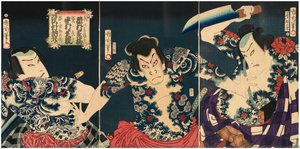
In this captivating Ukiyo-e print, Utagawa Kunisada II captures a moment of raw, kinetic energy that transcends the boundaries of time. The scene depicts two sumo wrestlers locked in a profound struggle, their bodies entwined in a display of strength and technique that is as much about grace as it is about power. One wrestler holds his opponent down upon his knees, a pivotal moment of tension that suggests the climax of a match. Beyond the central figures, the artist invites us into a bustling, lived-in world; spectators sit and stand in quiet observation, their presence adding a layer of communal atmosphere to the spectacle. The composition is rich with the charmingly mundane details of the era—a clock hanging on the wall, a simple bowl resting nearby, and scattered books that hint at the intellectual life existing alongside this physical combat. It is a window into the heart of Japan's Edo and Meiji periods, where the sacred ritual of sumo met the vibrant, everyday pulse of urban life.
The technique employed here is a masterclass in the Sumo-e and Ukiyo-e traditions. Through delicate line work and a sophisticated use of space, Kunisada II achieves a sense of depth and narrative movement that feels almost like a precursor to modern sequential art. The way the figures are rendered—with an emphasis on the muscularity and the dramatic weight of their postures—creates a visceral connection with the viewer. For the collector or interior designer, this piece offers more than just visual interest; it provides a rhythmic complexity. The interplay between the focused intensity of the wrestlers and the scattered objects in the background creates a balanced yet stimulating visual texture that can serve as a sophisticated focal point in any curated space.
Historical Resonance and Artistic Legacy
To understand this work is to understand the legacy of the Utagawa School. As a pupil of the great Kunisada I, the artist known as Kunisada II (or Toyokuni IV) carried forward a tradition of storytelling through printmaking that defined an entire epoch of Japanese art. While his work often focused on the glamorous world of Kabuki actors and beautiful women, this particular print celebrates the cultural icon of the sumo wrestler. This subject matter connects the viewer to the historical roots of Japanese identity, where strength, discipline, and ritual were deeply embedded in the social fabric. The print serves as a bridge between the classical elegance of the Edo period and the transformative shifts of the Meiji era.
For those looking to integrate fine art into a contemporary interior, this reproduction offers an unparalleled emotional impact. It evokes a sense of nostalgia and reverence for craftsmanship. Whether placed in a minimalist modern setting to provide a burst of historical character or layered within a gallery wall of classical works, the print’s ability to command attention through its narrative depth is unmatched. Owning such a piece is not merely about decoration; it is about preserving a fragment of a vanished world, bringing the disciplined beauty and dramatic flair of ancient Japan into the modern home.
Related Artworks




Artist Biography
**early life and training**
utagawa kunisada ii, also known as toyokuni iv, was a renowned japanese ukiyo-e print designer born in edo, japan in 1823. he was a pupil of utagawa kunisada i and signed much of his early work under the name kunimasa iii. around 1850-51, he adopted the name kunisada ii, marking his inheritance of the utagawa school.**artistic style and notable works**
kunisada ii's prints include over 40 series, mostly featuring actors (yakusha-e), as well as portraits of beauties, illustrations of scenes from literature, erotica, and other subjects. one of his most celebrated works is the tale of the eight dog heroes (hakkendun inu no sōshi no uchi), dating from 1852, drawn from kyokutei bakin's epic novel, the satomi clan and the eight dogs (nansō satomi hakkenden).**legacy and later life**
kunisada ii headed the utagawa school and worked in the style of his master, but never achieved the same level of success. his popularity waned in the meiji period (1868–1912), and he appears to have stopped making prints after 1874. he died on july 20, 1880, and was buried at banshōin kōunji. his buddhist posthumous name is sankōin hōkokujutei shinji.**notable mentions in AllPaintingsStore.com**
- view utagawa kunisada ii's artworks on AllPaintingsStore.com
- explore the hokkaido museum of modern art (japan) on AllPaintingsStore.com
- discover nonoyama kōzan's paintings on AllPaintingsStore.com
**key points in kunisada ii's life**
- 1823: born in edo, japan
- 1850-51: adopted the name kunisada ii
- 1852: created the tale of the eight dog heroes
- 1868–1912: meiji period, during which his popularity waned
- july 20, 1880: passed away and was buried at banshōin kōunji
**further reading on AllPaintingsStore.com**

utagawa kunisada ii
1823 - 1880 , Japan
Quick Facts
- Artistic Movement Or Style: Ukiyo-e (yakusha-e)
- Artists Or Movements Influenced By This Artist: ['Utagawa School']
- Artists Who Influenced This Artist: ['Utagawa Kunisada I']
- Date Of Birth: 1823
- Date Of Death: 1880
- Full Name: Utagawa Kunisada II
- Nationality: Japanese
- Notable Artworks:
- Hakkendun Inu no Sōshi no Uchi
- The Osaka actor Kataoka Gado as An no Heibei
- Place Of Birth: Tokyo, Japan
Related Articles

Floating Worlds: The Captivating Magic and Timeless Legacy of Japanese Ukiyo-e Art
Explore the ephemeral beauty of Japanese Ukiyo-e art. From the dynamic warriors of Kuniyoshi to serene landscapes, discover the profound history, masterful techniques, and global influence of these iconic woodblock prints in our deep cultural retrospective.

Suzuki Harunobu: Pioneering Ukiyo-e & the Refinement of Edo Period Printmaking
Discover the revolutionary world of Suzuki Harunobu, a pioneer of ukiyo-e printmaking. Explore his exquisite nishiki-e techniques, diverse subjects & lasting impact on Japanese art history. Learn more at AllPaintingsStore.

Ukiyo-e: Exploring Japan's Floating World & Enduring Artistic Legacy
Explore the captivating world of Ukiyo-e – Japan's iconic woodblock prints! Discover masters like Hokusai & Hiroshige, learn about Edo period culture, and find expert art collecting guidance at AllPaintingsStore.

Hokusai's Masterpieces: 25 Iconic Prints & Paintings for Art Lovers | AllPaintingsStore
Journey through Katsushika Hokusai’s 25 most iconic artworks, including *The Great Wave*. Explore the ukiyo-e master's history, style & timeless Japanese woodblock prints. Find museum-quality reproductions for your home at AllPaintingsStore.com.

Ukiyo-e: The Art of the Floating World and the Legacy of Japanese Woodblock Masters
Explore the profound history of Ukiyo-e, from Hokusai's iconic waves to the vibrant culture of Edo Japan. Discover the intricate craft of woodblock printing and the enduring legacy of these Japanese masterpieces through our expert art history guide.


