


 Preview
 Send
Send Share
Share
 Details
 Guide
Guide

 Download
 Similars
 X-Ray
X-Ray Diaporama
 Stats
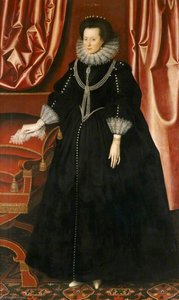
StatsLady Russell (1560–1616), Countess of Cumberland
 Northern Renaissance
 109.0 x 84.0 cm
 Abbot Hall Art Gallery
 Read More
Hand Made Oil Reproduction
Hand-painted oil on canvas in your size and frame, made to order by our artists. ( Switch to Print Switch to Digital Image)




































Pick from our preset sizes that match the artwork's original proportions.

You may enter your own dimensions to fit a specific frame or space. If your selected size does not match the original image's proportions, we will either crop the artwork or extend the painting with additional hand-painted elements. A digital mockup will be sent for your approval before production begins.
Please note that the on-screen preview does not reflect the actual cropping or extension. Only the mockup will accurately show the final composition.
While custom sizes are available, we recommend selecting a dimension from the predefined list to preserve the original proportions.
After order, AllPaintingsStore.com team will email client for instructions and provide a mockup preview
Worldwide Delivery () in 3/4 weeks instead of standard 5 weeks. (21 September). No compromise on quality.

Free Worldwide Express Shipping

High-Quality Linen Canvas

Full Shipping Insurance

Customs Tax Refund Guarantee

True Color Matching Guarantee

100-Day Return Policy (Defects Only)

100% Money-Back Guarantee

Bulk Discount Offer
 Glass option is only available in size under 110 CM

Lady Russell (1560–1616), Countess of Cumberland
Reproduction Medium
Reproduction Size
-


Total Price
$ 258
Related Artworks



Artist Biography
William Larkin: The Weaver of Courtly Splendor
William Larkin, a name largely obscured for centuries, emerges from the shadows of 17th-century England as a remarkably gifted and influential portrait painter. Born around 1580 in London – though precise details of his early life remain elusive – Larkin’s career coincided with a pivotal moment in English art: the waning years of a tradition defined by intricate detail, opulent fabrics, and a profound understanding of courtly fashion. He wasn't a royal painter, nor did he command the fame of contemporaries like Hilliard or Van Dyck, yet his work possesses a unique allure, offering intimate glimpses into the lives and tastes of England’s elite during the reign of James I. Larkin’s legacy lies not in grand historical narratives but in the exquisite rendering of textures, colors, and the subtle gestures that defined the era's aristocratic sensibility.A Life Shrouded in Mystery
The biographical record for William Larkin is frustratingly sparse. He appears to have been born into a modest family – his father was an innkeeper – and entered the world of painting through apprenticeship, likely under Robert Peake, a prominent court painter known for his lavish depictions of royal attire. Larkin’s early career seems to have been marked by relative obscurity; he became a freeman of the Worshipful Company of Painter-Stainers in 1606, a significant achievement indicating recognition within the artistic community. Marriage records suggest he wed before 1612, and he fathered several children – a son born stillborn in 1612, William in 1613, and Mary in 1614/15 – all buried at St Anne Blackfriars. His death occurred sometime between April 1619 (the date of his will) and May 1619, with the parish records tragically destroyed by the Great Fire of London, making a precise date impossible to determine. Despite this lack of concrete biographical information, Larkin’s work speaks volumes about his skill and artistic vision.The Signature Style: Carpets, Curtains, and Courtly Excess
Larkin's distinctive style is immediately recognizable through its meticulous attention to detail and the incorporation of luxurious elements that were hallmarks of Jacobean court fashion. His portraits are not simply representations of individuals; they are elaborate stage sets, meticulously constructed to showcase the wealth and status of his sitters. He became renowned for depicting oriental carpets – a relatively new import into England at the time – with an unprecedented level of realism, capturing their intricate patterns and vibrant colors. Equally prominent were his depictions of draped curtains, often in rich fabrics like velvet and silk, adorned with tassels and fringes that cascaded across the canvas. These elements weren’t merely decorative; they served as visual shorthand for the sitter's position within the social hierarchy, emphasizing their access to luxury and privilege. The portraits frequently feature mirrored poses, a technique borrowed from court miniatures, suggesting an intimacy between the subjects – often male friends or family members – and reinforcing the importance of personal relationships within the aristocratic world.Rediscovery and the Suffolk Collection
For centuries, Larkin’s work remained largely forgotten, attributed to other artists due to a lack of documentation and stylistic similarities. It wasn't until 1952 that art historian James Lees-Milne brought Larkin back into focus, identifying him as the painter behind two portraits at Charlecote Park, Warwickshire – those of Lord Herbert of Cherbury and Sir Thomas Lucy III. Lees-Milne’s identification was based on references within Lord Herbert's autobiography, where he recalled a portrait commissioned by Richard Sackville, 3rd Earl of Dorset, and the striking resemblance between Larkin’s paintings and the described likeness. Subsequent research confirmed this attribution, leading to the recognition of a larger body of work – including the celebrated “Suffolk Collection” at Kenwood House in London. These portraits, characterized by their opulent fabrics, intricate details, and mirrored compositions, cemented Larkin's reputation as a master of courtly portraiture.A Legacy of Detail and a Lost Era
William Larkin’s contribution to English art lies not in grand historical narratives but in his ability to capture the essence of a specific moment in time – the lavish and intricate world of the Jacobean court. His meticulous attention to detail, particularly his rendering of textiles and luxurious furnishings, offers a rare glimpse into the tastes and values of England’s elite. While some scholars have suggested that Larkin employed assistants to execute certain elements of his paintings (particularly the repetitive patterns of carpets and curtains), his overall artistic vision – his understanding of light, color, and composition – remains undeniably his own. Larkin's work represents a fascinating intersection between art and social history, providing valuable insights into the material culture and social dynamics of 17th-century England. His relatively short career—spanning just a few years—marked the end of an era in English portraiture, a tradition characterized by its focus on idealized beauty and restrained elegance, superseded by the more dynamic and expressive styles that would emerge in subsequent decades.
william larkin
1580 - 1619
Quick Facts
- Artistic Movement Or Style: Jacobean Portraiture
- Artists Or Movements Influenced By This Artist: ['Hans Holbein the Younger']
- Artists Who Influenced This Artist: ['Robert Peake']
- Date Of Birth: c. 1580s
- Date Of Death: 1619
- Full Name: William Larkin
- Nationality: English
- Notable Artworks:
- Suffolk Collection Portraits
- Brydges Portrait
- Place Of Birth: London, England
Related Articles
Northern Mannerism: The Dramatic Evolution of European Art through Elegant Distortion and Tension
Explore the dramatic evolution of Northern Mannerism. Discover how 16th-century artists moved from Renaissance harmony to elegant distortion, tension, and complex symbolism in European art history.


