Introduction
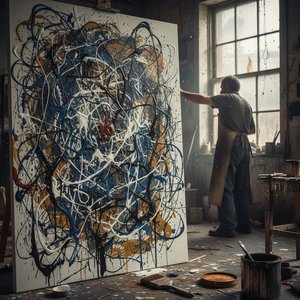
To step into the world of Abstract Expressionism is to abandon the safety of recognizable forms and surrender to the raw, unbridled energy of the human psyche. It is an invitation to feel rather than to see, to find meaning not in the silhouette of a figure or the curve of a landscape, but in the rhythmic dance of pigment across a vast canvas. This movement, which emerged from the turbulent aftermath of World War II, shifted the epicenter of the art world from Paris to New York, marking a moment when art ceased to be a window into another world and instead became a direct, visceral record of existence itself.
Born from a period of profound global reconstruction and existential questioning, these artists sought a new visual language—one capable of expressing the unspeakable anxieties and the soaring spiritual aspirations of a changing era. Through techniques like action painting and color field compositions, they transformed the canvas into an arena of event, where every drip, splash, and sweeping wash of color serves as a permanent trace of a physical and emotional struggle. It was a revolution of spontaneity, where the subconscious was allowed to guide the brush, breaking the boundaries between the artist's inner life and the external reality.
Today, these masterpieces remain profoundly relevant, acting as timeless mirrors to our own complexities. In an age dominated by digital precision, the tactile depth, visible brushstrokes, and heavy textures of these works offer a grounding, human connection to the concept of pure emotion. They remind us that even in chaos, there is a profound, underlying order and beauty. As we journey through this selection, we will explore ten definitive works that do more than just represent an era; they embody the very heartbeat of a movement that redefined what it means to create and what it means to feel.
Number 1, 1949 - Paul Jackson Pollock
 Number 1, 1949 - Paul Jackson Pollock
Before the world recognized him as a titan of modern art, Jackson Pollock was often viewed with skepticism, yet his process for Number 1, 1949 redefined the very physics of painting. By abandoning the easel to lay his canvas directly on the floor, he transformed the act of creation into a rhythmic, physical dance known as "action painting." This masterpiece stands as a cornerstone of the Top 10 Masterpieces That Defined the Abstract Expressionism Art Movement because it replaced traditional subjects with pure, unadulterated energy.
The surface is a dense, hypnotic web of splatters and drips; layers of black, ochre, and white intersect with sudden, delicate traces of reddish-pink. There is no focal point to rest upon, only a continuous, swirling motion that captures the artist's subconscious impulses through thick, tactile impasto. This sense of controlled chaos and boundless movement offers more than just visual intrigue; it provides a profound source of inspiration. Integrating such a dynamic, large-scale work into a modern home office or study can foster an atmosphere of intense focus and sophisticated creativity, mirroring the same revolutionary spirit found within Pollock's legendary strokes.
Composition VIII - Wassily Wassilyevich Kandinsky
 Composition VIII - Wassily Wassilyevich Kandinsky
When you stand before Composition VIII by Wassily Kandinsky , you aren't just looking at a canvas; you are witnessing the birth of a visual symphony. Created in 1923, this masterpiece functions less like a painting and more like a musical score translated into light and geometry. The artist didn’t merely apply pigment—he composed energy. Sharp triangles, floating circles, and intersecting lines dance across the plane, creating a rhythmic tension that feels both chaotic and profoundly ordered.
The brilliance of this work lies in how Kandinsky uses color as a language of the soul. Fiery yellows collide with deep, resonant blues, evoking a synesthetic experience where you can almost hear the dissonance and harmony within the shapes. It is a pivotal moment in the Abstract Expressionism movement, moving away from the physical world to explore pure, non-objective emotion. This painting doesn't just reflect light; it invents its own internal glow, inviting you to find spiritual resonance within its complex, geometric architecture.
Woman I - Willem de Kooning
 Woman I - Willem de Kooning
What story does the chaotic, swirling environment of Woman I by Willem de Kooning tell about a world recovering from global conflict? Created between 1950 and 1952, this masterpiece emerged from the intense energy of the New York School, marking a definitive shift in the history of Abstract Expressionism. De Kooning breaks away from traditional portraiture, using aggressive, gestural brushstrokes and thick impasto to deconstruct the female form into a visceral landscape of post-war anxiety.
The painting’s atmosphere—a jarring clash of fiery reds, acidic greens, and stark whites—creates a sense of profound emotional turbulence. The figure is not merely depicted but is forged through layers of paint that emphasize texture and movement over precise anatomy. For the modern collector, integrating such a powerful work into a curated space offers more than decoration; it provides a window into a pivotal era of artistic rebellion. This piece stands as one of the top 10 masterpieces that defined the Abstract Expressionism movement by transforming raw, psychological distress into an enduring, monumental achievement of modern art.
Anthropometry of the blue period - Yves Klein
 Anthropometry of the blue period - Yves Klein
In Anthropometry of the blue period by Yves Klein, one does not merely observe figures; one feels the rhythmic, spectral pulse of a primal ritual. The artwork captures a profound sense of movement and spiritual yearning through its iconic silhouettes, rendered in the deep, immersive depths of International Klein Blue. These stylized forms, imprinted directly onto the canvas via the artist's revolutionary technique, bypass traditional portraiture to touch upon the very essence of human existence.
As a pivotal work within the broader evolution of Abstract Expressionism and post-war abstraction, this piece serves as a universal mirror for the soul, reflecting themes of vulnerability, ancestry, and the infinite. The stark contrast between the intense ultramarine and the textured, pale background creates a hypnotic visual tension that commands attention. Integrating such a powerful masterpiece into your collection can transform a modern interior into a sanctuary for profound reflection. Its minimalist yet visceral energy offers a calming, meditative atmosphere, making it an essential selection for those seeking to anchor their space with art that transcends the material world.
The Liver is the Cock's Comb - Arshile Gorky
 The Liver is the Cock's Comb - Arshile Gorky
In The Liver is the Cock's Comb by Arshile Gorky, light does not descend from a single source but emerges from within the chaotic, biomorphic forms themselves. There is no traditional chiaroscuro here; instead, Gorky utilizes a vibrant interplay of luminous yellows and searing oranges that seem to pulse against deep, bruised purples and blues. This internal radiance creates a sense of flickering energy, as if the canvas is caught in a moment of sudden, violent illumination. It is this masterful command of light—transforming flat planes into a rhythmic, breathing landscape of color—that secured its place among the top 10 masterpieces that defined the Abstract Expressionism art movement .
The way these pigments interact suggests a profound psychological depth, where light and shadow represent the struggle between memory and trauma. When professionally reproduced as a hand-painted oil, the visible brushstrokes and layered textures capture this spectral glow, allowing the painting's intense emotional resonance to add a sophisticated, multidimensional layer of luxury to any contemporary corporate or residential space.
On White II - Wassily Wassilyevich Kandinsky
 On White II - Wassily Wassilyevich Kandinsky
A symphony of geometric precision and spiritual resonance, On White II by Wassily Kandinsky captures the moment where color transcends the physical world to touch the soul. As a cornerstone of our collection, this 1923 masterpiece is an essential inclusion in the top 10 defining works of abstract evolution; it represents the pivotal shift from fluid expressionism to the structured, rhythmic language of geometric abstraction developed during his Bauhaus tenure.
The painting vibrates with energy, utilizing sharp triangles, intersecting lines, and bold planes of color against a luminous, ethereal background. Kandinsky’s use of form acts as a visual music, where every circle and lance-like shape evokes deep emotional responses—from the tranquility of blue to the passion of red. This work does more than decorate; it transforms space through its intense visual stimulation and layered depth. At AllPaintingsStore.com, we believe in democratizing this profound beauty. Through our high-fidelity, hand-painted oil reproductions, you can bring the transformative presence and intellectual prestige of Kandinsky’s abstract vision into your own home, office, or professional gallery.
Abstract Painting 805-4 - Gerhard Richter
 Abstract Painting 805-4 - Gerhard Richter
To stand before Abstract Painting 805-4 is to witness a controlled explosion of raw emotion. Gerhard Richter captures a primal, universal energy through a fiery palette of reds, oranges, and deep browns that seem to pulse with life. This masterpiece earns its place among the top 10 defining works of the movement due to its unparalleled mastery of texture; the heavy impasto and layered, gestural brushstrokes create a tactile landscape that feels almost three-dimensional.
Richter’s ability to bridge the gap between spontaneous abstraction and technical precision offers a profound emotional resonance that transcends time. The artwork does not merely depict color; it embodies passion and intensity. At AllPaintingsStore.com , we specialize in preserving this visceral impact for your professional or private collections. Our hand-painted oil reproductions meticulously recreate every ridge of paint and subtle tonal shift, ensuring the movement's soul is faithfully brought into your architectural space with museum-grade quality.
First Abstract Watercolor, Collection of Mad - Wassily Wassilyevich Kandinsky
 First Abstract Watercolor, Collection of Mad - Wassily Wassilyevich Kandinsky
In the First Abstract Watercolor, Collection of Mad , the lines of Wassily Kandinsky aren’t merely drawn; they are choreographed . This is not a static composition; it is a dance frozen in time , marking the precise moment when art broke free from the burden of representation to embrace pure, spiritual emotion. Created in 1910, this masterpiece serves as a foundational pillar for the Abstract Expressionism movement, utilizing a vibrant, clashing palette of reds, blues, and yellows that bleed into one another through fluid, wet-on-wet techniques.
As you observe the organic shapes and gestural strokes, you witness a visual symphony where chaos finds its own unique harmony. The work rejects traditional perspective, opting instead for a flattened, energetic plane where color functions as music. Its place in this collection is a tribute to its ability to transform inner turmoil into a rhythmic, breathing aesthetic. What if your professional or private space could hold that same balance? What if your walls could breathe rhythm through the transformative power of such a pioneering abstraction?
Convergence - Paul Jackson Pollock
To stand before Jackson Pollock’s Convergence is to witness a visceral explosion of human emotion captured in mid-motion. It is not merely a painting, but a rhythmic, pulsating field of energy where the boundaries between chaos and control dissolve. This masterpiece earns its place among the top 10 defining works of Abstract Expressionism through its radical rejection of traditional form, replacing recognizable subjects with an "all-over" composition of intricate, interwoven drips and splatters.
Pollock’s revolutionary drip technique—utilizing sticks and poured pigments to create a dense network of black, yellow, white, and vibrant reds—transformed the canvas into an arena of action. The tactile depth of the overlapping layers evokes a sense of profound existential movement that remains as impactful today as it was in the post-war era. At AllPaintingsStore.com, we honor this legacy through our hand-painted oil reproductions. Our artists meticulously recreate every textured peak and gestural stroke on 100% cotton canvas, ensuring that the raw, atmospheric intensity of Pollock’s original vision is preserved for your own collection.
Improvisation 28 (second version) - Wassily Wassilyevich Kandinsky
 Improvisation 28 (second version) - Wassily Wassilyevich Kandinsky
In Improvisation 28 (second version) by Wassily Kandinsky, the canvas ceases to be a mere surface and becomes a rhythmic, visual symphony. As a cornerstone of the movement, this masterpiece captures the precise moment where color and form break free from the constraints of reality to speak directly to the spirit. The composition is an electrifying dance of fragmented shapes and intersecting lines, where bold, impasto textures create a sense of profound depth and movement.
Kandinsky utilizes a vibrant palette—swirling hues that collide and harmonize like notes in a musical score—to evoke deep emotional resonance. There is no static subject here; instead, the viewer experiences a kinetic energy, a chaotic yet controlled explosion of light and shadow. To possess a reproduction of this work is to invite a transformative energy into your space, turning a room into a gallery of the soul where the boundaries between the physical world and pure, abstract emotion dissolve into a breathtaking display of artistic genius.
Conclusion
As the museum lights dim and the quiet shadows of dusk settle over these canvases, we are left with more than just a memory of color and form. To stand before the giants of Abstract Expressionism is to witness a moment where the internal storm of the human spirit was captured in permanent, visceral strokes. These works are not mere relics of a mid-century movement, frozen in time or confined to the sterile halls of history; they are living, breathing forces that continue to pulse with the raw energy of their creation.
The rhythmic drips of Pollock, the luminous depths of Rothko, and the aggressive gestures of de Kooning serve as a bridge between the chaos of the subconscious and the tangible world we inhabit. They remind us that emotion—in all its turbulence and tranquility—is a universal language that transcends era and geography. Even today, these masterpieces find new life in our modern spaces, breathing vitality into contemporary interiors and acting as windows into the profound depths of human feeling.
As you step away from these monumental visions, may you carry with you the realization that art is never truly finished; it continues to evolve through every eye that meets it and every heart it moves. We invite you to continue this journey of discovery and bring a piece of this enduring legacy into your own world by exploring our full collection .