The Genesis of Discontent: World War I and the Birth of Dada
 Wikipedia: Avant-garde
In the arts and literature, the term avant-garde (from French meaning 'advance guard' or 'vanguard') identifies an experimental genre or work of art, and the artist who created it, which usually is aesthetically innovative, whilst initially being ide...
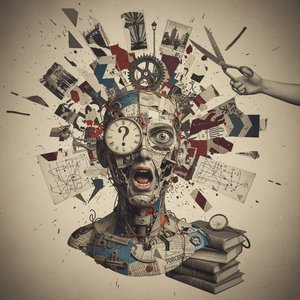
The early 20th century was a crucible, forging not only new technologies but also profound disillusionment. The unprecedented scale of destruction wrought by World War I shattered long-held beliefs in progress, reason, and nationalistic fervor. From this wreckage emerged Dada, an artistic movement less defined by a unified style than by a shared spirit of revolt. Born in neutral Zurich, Switzerland – a haven from the continental carnage – Dada was not so much a deliberate creation as an eruption, a visceral response to what its founders perceived as the madness of a world spiraling into chaos. The Cabaret Voltaire, established in 1916 by Hugo Ball and Emmy Hennings, became the unlikely epicenter of this burgeoning rebellion. It wasn’t merely a performance space; it was a laboratory for dismantling artistic conventions, a sanctuary where poetry fractured into sound poems, paintings rejected representation, and logic itself was held up to ridicule.
The very name “Dada,” reportedly chosen at random by sticking a knife into a dictionary, encapsulates the movement’s rejection of meaning. It suggested childishness, spontaneity, and an utter lack of pretense – qualities deliberately opposed to the grand narratives that had led Europe to war. Tristan Tzara, a Romanian poet who quickly became one of Dada's most prominent voices, articulated this sentiment with characteristic defiance, declaring that Dada was “anti-everything.” This wasn’t nihilism for its own sake, however; it was a strategic dismantling, an attempt to clear away the debris of a bankrupt culture and create space for something new.
Core Principles of Dada: Rejecting Logic, Embracing Absurdity
At its heart, Dada was a philosophical stance as much as an artistic one. It questioned the very foundations of Western thought, challenging the primacy of reason, logic, and aesthetic beauty. The movement’s founders believed that these values had not only failed to prevent war but had actively contributed to it by fostering blind faith in systems and ideologies. The embrace of absurdity, therefore, wasn't simply a stylistic choice; it was a deliberate provocation, an attempt to expose the irrationality at the core of modern society.
This rejection manifested in a profound distrust of traditional art forms. Dadaists saw painting and sculpture as complicit in upholding bourgeois values and sought to subvert them from within. They questioned the role of the artist, challenging the notion of individual genius and embracing chance operations and collaborative creation. The emphasis shifted from the finished product to the process itself – the act of rebellion became more important than the resulting artwork. This spirit extended beyond visual art into literature, poetry, and performance, creating a multifaceted assault on conventional expression.
Techniques and Tactics of Provocation: Collage, Readymades, and Performance
 Wikipedia: Collage
Collage (, from the French: coller, "to glue" or "to stick together") is a technique of art creation, primarily used in the visual arts, but in music too, by which art results from an assembly of different forms, thus creating a new whole. (Compare w...
Dada artists employed a diverse range of techniques to dismantle artistic norms and shock their audiences. Collage, utilizing fragments of newspapers, magazines, and everyday objects, became a powerful tool for disrupting traditional composition and challenging the sanctity of original artwork. Hannah Höch’s photomontages, for example, masterfully juxtaposed images from popular culture to critique gender roles and political hypocrisy in post-war Germany. These weren't simply aesthetic experiments; they were potent acts of social commentary.
Perhaps the most iconic Dadaist technique was Marcel Duchamp’s introduction of “readymades” – ordinary, manufactured objects presented as art with minimal alteration. His infamous “Fountain” (1917), a porcelain urinal signed “R. Mutt,” remains a watershed moment in art history, forcing viewers to question the very definition of art and the role of the artist’s hand. Beyond these visual innovations, Dada embraced performance art as a means of directly confronting audiences and disrupting established conventions. Hugo Ball's sound poems, recited in elaborate costumes, were deliberately nonsensical, rejecting linguistic meaning in favor of pure sonic experience.
Key Figures and Landmark Works: Duchamp, Höch, Tzara, and Beyond
While Dada was a collaborative movement, several figures stand out as particularly influential. Marcel Duchamp’s readymades irrevocably altered the course of art history, challenging traditional notions of authorship and originality. Hannah Höch's photomontages offered a scathing critique of societal norms, particularly those surrounding gender and politics. Tristan Tzara’s prolific writings and manifestos provided the movement with its intellectual framework and unwavering spirit of rebellion.
Other key figures included Jean Arp, whose biomorphic sculptures explored chance and organic forms; Francis Picabia, who embraced a provocative and often satirical style; and Man Ray, whose experimentation with photography pushed the boundaries of the medium. These artists weren’t working in isolation; they were engaged in a constant dialogue, challenging each other and pushing the limits of artistic expression. The Cabaret Voltaire served as a crucial incubator for these ideas, fostering a spirit of collaboration and experimentation that defined the movement.
Dada’s Influence and Legacy: From Surrealism to Contemporary Art
Though relatively short-lived – its most intense period lasted only a few years – Dada exerted an enormous influence on subsequent artistic movements. It directly paved the way for Surrealism, which built upon Dada's rejection of reason but embraced the exploration of the subconscious mind. Many Dada artists, including Duchamp and Arp, transitioned into Surrealism, carrying with them a spirit of experimentation and a distrust of conventional norms.
Dada’s legacy extends far beyond Surrealism, however. Its emphasis on conceptual art, performance art, and anti-establishment critique continues to resonate in contemporary artistic practice. Artists today continue to draw inspiration from Dada's willingness to challenge conventions, question authority, and embrace absurdity as a means of social commentary. The movement’s impact can be seen in everything from punk rock to feminist art, demonstrating its enduring relevance in a world still grappling with questions of power, meaning, and the role of art itself.
The Enduring Questions of Dada: Challenging the Nature of Art Itself
Ultimately, Dada wasn’t about creating beautiful objects; it was about asking fundamental questions about the nature of art. What constitutes art? Who decides what is valuable? What is the role of the artist in society? These questions remain as relevant today as they were a century ago.
Dada's refusal to provide easy answers, its embrace of chaos and contradiction, continues to challenge viewers and artists alike. It reminds us that art isn’t simply about aesthetics; it’s about engaging with the world around us, questioning our assumptions, and challenging the status quo. At AllPaintingsStore.com, we celebrate this spirit of innovation by offering high-quality reproductions of Dada masterpieces, allowing you to bring these provocative works into your own home and continue the conversation they began.