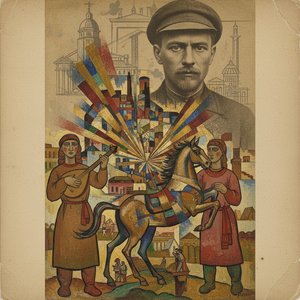
The Genesis of Cubo-Futurism: A Revolt Against Tradition
The early decades of the 20th century witnessed a seismic shift in artistic expression, and at the heart of this revolution lay Russia. While European art movements like Cubism and Futurism were gaining momentum, they found a uniquely potent echo within the Russian landscape – an echo that would coalesce into Cubo-Futurism. This wasn’t merely an adoption of Western styles; it was a radical reimagining, born from a specific socio-political context and fueled by a fervent desire to break free from academic constraints and forge a new artistic language. The weight of tradition, the rigid structures of Tsarist society, and a yearning for modernization all contributed to this explosive burst of creativity. Artists sought not just to depict reality but to dissect it, fragment it, and reconstruct it in ways that reflected the dynamism and speed of the modern world. This spirit of rebellion found its most vocal champion in David Burliuk, a figure whose influence extended far beyond the canvas.
Burliuk’s Role in Shaping Russian Futurism's Aesthetic
The Russian avant-garde was a large, influential wave of avant-garde modern art that flourished in the Russian Empire and the Soviet Union, approximately from 1890 to 1930—although some have placed its beginning as early as 1850 and its end as late a...
David Burliuk wasn’t simply an artist; he was a catalyst, a provocateur, and arguably the central architect of Russian Futurism. Arriving on the St. Petersburg art scene with a defiant energy, Burliuk rejected conventional painting techniques and embraced bold experimentation. He co-founded groups like “Jack of Diamonds” (Bubnov Valet) and later became a leading member of the more radical Hylaeans, actively promoting their ideas through manifestos, exhibitions, and public lectures – often deliberately confrontational events designed to shock and challenge bourgeois sensibilities. His early works, characterized by thick impasto and vibrant color palettes, already hinted at the fragmentation that would become a hallmark of Cubo-Futurism. However, Burliuk’s true genius lay in his ability to synthesize diverse influences—the analytical rigor of French Cubism, the dynamism of Italian Futurism, and a distinctly Russian sensibility steeped in peasant art and icon painting—into something entirely new. He wasn't interested in replicating these styles but rather in using them as building blocks for a uniquely Russian aesthetic.
Key Characteristics of Burliuk’s Art: Fragmentation and Dynamic Composition
Cubo-Futurism (Russian: кубофутуризм, romanized: kubofuturizm) was an art movement, developed within Russian Futurism, that arose in the early 20th-century Russian Empire, defined by its amalgamation of the artistic elements found in Italian Futurism...
To understand Burliuk’s artistic vision is to appreciate the power of fragmentation. His canvases are rarely concerned with realistic representation; instead, they present fractured forms, overlapping planes, and a deliberate disruption of spatial coherence. Figures are broken down into geometric shapes, colors clash in unexpected ways, and perspectives shift jarringly. This wasn't merely an aesthetic choice but a philosophical one—a reflection of the artist’s belief that traditional notions of form and space were inadequate to capture the complexities of modern life. “Morning in the Country after Snowstorm” (1912), for example, exemplifies this approach, with its fragmented landscape and bold use of color creating a sense of energy and movement. Similarly, “The Knifegrinder” (1912) showcases his exploration of dynamic composition, reducing the figure to essential geometric elements while conveying a raw, visceral power. Burliuk’s technique often involved applying paint directly from the tube with a palette knife, creating thick textures and emphasizing the materiality of the medium itself.
Beyond Painting: Burliuk’s Influence on Poetry, Theatre & Design
Burliuk's impact wasn’t confined to painting. He recognized the interconnectedness of art forms and actively sought to break down boundaries between them. He became a pivotal figure in the development of *zaum*, an experimental form of poetry that rejected traditional syntax and semantics in favor of sound and rhythm. Collaborating with poets like Velimir Khlebnikov and Aleksei Kruchenykh, Burliuk pushed language to its limits, creating nonsensical yet powerfully evocative verses. This exploration extended into theatre, where he challenged conventional dramatic structures through improvisational performances and deliberately absurd staging. He even ventured into design, applying his Cubo-Futurist principles to typography and book illustration. His influence can be seen in the theatrical sets of Aleksandra Ekster and the dynamic compositions of Vladimir Mayakovsky’s posters. Burliuk understood that true artistic revolution required a holistic approach—a complete reimagining of how art was created, experienced, and integrated into everyday life.
The Hylaeans and Zaum: Exploring the Boundaries of Language with Burliuk
The Hylaeans, a group co-founded by Burliuk, represented a particularly radical strand within Russian Futurism. Rejecting Symbolism’s emphasis on subjective emotion and spiritual themes, they embraced materiality, dynamism, and a fascination with technology. Central to their artistic practice was *zaum*, often described as “transrational” poetry. This wasn't about creating meaningless noise; rather, it was an attempt to access a primal language beyond the constraints of logic and reason. Burliuk believed that by stripping away conventional meaning, they could unlock new levels of emotional intensity and create a truly universal form of expression. The group’s performances were often chaotic and deliberately provocative, challenging audiences to confront their preconceived notions about art and language. “Dynamic Sensory Experience of a Model” (1913), though a drawing, embodies this spirit—a fragmented study that prioritizes sensation over representation, reflecting the Hylaeans’ broader interest in exploring the limits of perception.
Burliuk's Later Years and Enduring Impact on Modern Art
Despite his pivotal role in shaping the Russian Avant-Garde, Burliuk’s later years were marked by hardship and relative obscurity. Following the Bolshevik Revolution, his radical aesthetic clashed with the emerging doctrine of Socialist Realism, leading to increasing marginalization. He spent much of his life in exile, eventually settling in Paris where he continued to paint and promote his ideas, though largely outside the mainstream art world. However, Burliuk’s legacy has experienced a significant resurgence in recent decades. His pioneering work is now recognized as essential to understanding the development of abstract art and the broader trajectory of modernism. His influence can be seen in countless artists who followed, from the Constructivists to the Abstract Expressionists. Today, collectors and enthusiasts alike seek out his vibrant canvases and appreciate his unwavering commitment to artistic innovation. AllPaintingsStore offers a unique opportunity to experience the power and dynamism of Burliuk’s art through high-quality reproductions, allowing you to bring a piece of this revolutionary movement into your own home.