


Introduction
To encounter the work of Egon Schiele is to stand before a mirror reflecting not just the artist’s soul, but our own deepest vulnerabilities and desires. This collection of his top 25 artworks represents a journey into that profound space – a realm where beauty and anguish intertwine, where the human form is both celebrated and dissected with unflinching honesty.
Born at the turn of the 20th century in Austria, Schiele’s artistic emergence coincided with a period of immense societal upheaval. The fading grandeur of the Habsburg Empire, the rise of psychoanalysis championed by Sigmund Freud, and a growing sense of existential anxiety all permeated the cultural landscape. Vienna, his adopted city, was a crucible of intellectual ferment – a place where traditional values were questioned and new forms of expression sought to capture the complexities of modern life.
Schiele’s paintings are not merely portraits or landscapes; they are visceral explorations of the human condition. He rejected conventional notions of beauty, instead embracing distortion, fragmentation, and raw emotion. His figures often confront us with their nakedness, both physical and psychological, forcing us to acknowledge our own mortality and the fragility of existence. The intensity of his gaze, the angularity of his lines, and the unsettling color palettes create a uniquely powerful aesthetic that continues to captivate and challenge viewers today.
These 25 artworks were selected not only for their technical brilliance but also for their ability to resonate across time. They offer a glimpse into Schiele’s artistic evolution, from his early experiments with symbolism to his mature masterpieces of psychological portraiture. More than a century after their creation, these paintings remain profoundly meaningful because they speak to universal themes – love, loss, desire, and the search for meaning in a chaotic world. Prepare to be moved, disturbed, and ultimately transformed by the extraordinary vision of Egon Schiele.
Portrait of Wally - Egon Schiele
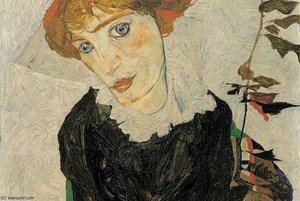 Portrait of Wally - Egon Schiele
Before us hangs a gaze that pierces the veil of time – Portrait of Wally by Egon Schiele , completed in 1912. This is not simply a painting; it’s an encounter with raw emotion, a testament to the turbulent spirit of early Expressionism and a cornerstone of Schiele's enduring legacy.
Vienna at the dawn of the 20th century was a city grappling with change, and Schiele, alongside Klimt, dared to reflect that unease. Wally Neuzil, his lover and muse, is presented not as an idealized beauty but as a figure stripped bare – psychologically exposed. The painting’s power lies in its rejection of convention; the distorted forms, the unsettling palette of greens and yellows, and the energetic brushstrokes all contribute to a sense of immediacy and vulnerability.
Schiele's masterful use of impasto lends a sculptural quality to Wally’s form, while her direct stare challenges the viewer. The inclusion of foliage hints at life and growth, yet the overall mood remains melancholic, reflecting the complexities of their relationship and Schiele’s own internal struggles. Portrait of Wally is included among his top 25 artworks for its groundbreaking technique, its unflinching honesty, and its ability to capture a fleeting moment of human experience with such profound intensity.
Today, this painting continues to resonate because it speaks to the universal search for connection and meaning. It reminds us that true beauty often lies in imperfection, and that art has the power to transform spaces – and our emotions – by revealing the hidden depths within ourselves.
The Self-Seers II (Death and Man) - Egon Schiele
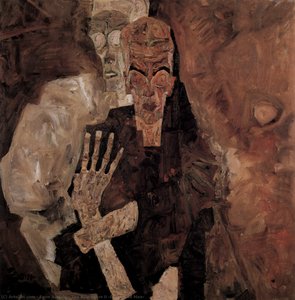 The Self-Seers II (Death and Man) - Egon Schiele
A chill settles upon you as you approach – not from the temperature, but from the weight of contemplation. The Self-Seers II (Death and Man) by Egon Schiele, painted in 1911, is a haunting vision of mortality that transcends mere representation. It’s an encounter with existential dread, rendered with a rawness rarely seen in art history.
Vienna, on the cusp of modernity, bred a generation grappling with societal upheaval and inner turmoil. Schiele, alongside Klimt, dared to confront these anxieties head-on. Here, a gaunt figure is confronted by a skeletal hand reaching from the darkness – an unambiguous symbol of fate. The thick impasto technique, layers of rich oil paint applied with visible urgency, amplifies the painting’s unsettling energy.
The ambiguous form to the left adds another layer of complexity; perhaps it's a lost memory, or the subject’s own shadow self wrestling with its inevitable end. The somber palette – browns, ochres, and muted reds – evokes a profound sense of isolation. This artwork earns its place among Schiele’s top 25 for its unflinching honesty and its ability to capture a universal human experience.
To bring this painting into your space is to invite introspection, to acknowledge the fragility of life, and to embrace the beauty found within vulnerability. It's a powerful statement piece that sparks conversation and reminds us of art’s enduring capacity to illuminate the deepest corners of the human psyche.
Mother with Two Children - Egon Schiele
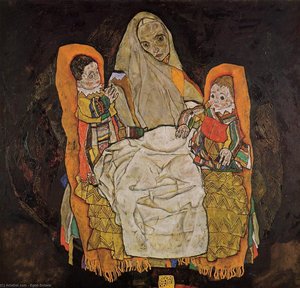 Mother with Two Children - Egon Schiele
A quiet sorrow emanates from Mother with Two Children by Egon Schiele, painted in 1917 – a work that transcends portraiture to become a haunting meditation on familial bonds and the anxieties of a world at war. This painting isn’t about idyllic domesticity; it's an exploration of vulnerability, resilience, and the weight of unspoken grief.
Schiele masterfully arranges the mother and children within a tightly-knit composition, yet their isolation is palpable. The elongated forms and angular lines, hallmarks of his Expressionist style, create a sense of ethereal fragility. A restrained palette of earthy tones – grays, beiges, and browns – underscores the somber mood, punctuated by subtle accents of color in the children’s clothing, hinting at a flicker of hope.
This artwork earns its place among Schiele's top 25 for its raw emotional honesty and technical brilliance. The loose brushstrokes and rich texture imbue the canvas with energy, inviting us to connect with the subjects on a deeply personal level. Painted during WWI, it reflects the pervasive sense of loss that permeated Europe.
Today, *Mother with Two Children* resonates because it speaks to universal themes of love, protection, and the enduring power of the human spirit. Its muted palette and evocative composition lend themselves beautifully to modern interiors, creating a space for quiet contemplation and emotional depth – a reminder that even in darkness, beauty can endure.
The Family - Egon Schiele
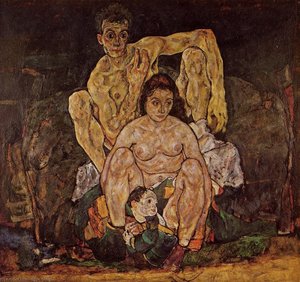 The Family - Egon Schiele
A quiet tension hangs within The Family by Egon Schiele – a portrait not merely observed, but *felt*. Painted in 1917, this work transcends the simple depiction of familial bonds to become a profoundly moving exploration of connection, vulnerability, and the anxieties that permeate human relationships.
Schiele’s signature style is immediately apparent: jagged lines vibrate with emotion, distorted forms reject conventional beauty, and thick impasto adds a tactile weight. The restricted palette – earthy browns, muted greens, and ochre yellows – underscores the somber mood, drawing us into the intimate space shared by these figures.
This painting earns its place among Schiele’s top 25 for its raw honesty and psychological depth. The composition—the man protectively positioned behind the woman, the child facing outward—creates a dynamic tension that speaks to both resilience and isolation. It is a testament to his mastery of Expressionism.
Today, *The Family* resonates because it captures something universal about the human condition. Its muted tones and evocative composition lend themselves beautifully to modern interiors, creating a space for quiet contemplation and emotional depth – a reminder that even in moments of uncertainty, connection endures.
schiele gerti schiele - Egon Schiele
 schiele gerti schiele - Egon Schiele
A whisper of melancholy hangs around Gerti Schiele by Egon Schiele – a portrait that captures not just a likeness, but the fragile beauty and nascent anxieties of youth. Painted around 1909, this work is an irreplaceable part of his top 25 for embodying the pivotal transition from Art Nouveau’s elegance to the raw emotional intensity that would define Expressionism.
Schiele, mentored by Klimt, yet forging his own path, beautifully balances decorative curves with a growing psychological depth. Gerti, partially turned away, hints at both maturity and mystery. The subtle suggestion of a corset speaks volumes about societal constraints, adding layers of symbolic weight to the composition.
The delicate rendering of her hair contrasts sharply with the angular lines defining her form, creating a visual tension that mirrors inner complexity. A limited palette – blacks, grays, and subtle flesh tones – enhances the painting’s somber mood. This is not merely observation; it's an attempt to convey *what it felt like* to exist within this moment.
Today, Gerti Schiele resonates because of its timeless elegance and quiet introspection. Its muted tones and refined composition lend themselves beautifully to modern interiors, creating a space for contemplation – a reminder that beauty can be found even in moments of vulnerability.
House on a River (also known as Old House I) - Egon Schiele
 House on a River (also known as Old House I) - Egon Schiele
Unveiled to discerning eyes, House on a River (also known as Old House I) by Egon Schiele is more than a landscape; it’s an emotional echo of a turbulent era. Created in 1915, this painting secures its place among his top 25 works for its haunting beauty and profound psychological depth.
Schiele transforms a seemingly simple subject – a solitary house beside a tranquil river – into a vessel for melancholy and anxiety. Bold brushstrokes and deliberately distorted forms prioritize subjective feeling over objective representation, hallmarks of Expressionism. The weathered house, with its dominating window, draws the eye upwards, emphasizing verticality and hinting at hidden stories within.
Influenced by Klimt yet forging his own path, Schiele imbues the scene with a palpable sense of history and vulnerability. The muted palette – earthy browns and subtle greens – enhances the painting’s somber mood, reflecting the anxieties prevalent during wartime Vienna. This is not merely observed; it's *felt*.
Today, House on a River resonates because it speaks to our universal longing for solitude and contemplation. Its refined composition and evocative atmosphere lend themselves beautifully to modern interiors, creating a space for quiet reflection – a testament to the enduring power of Schiele’s vision.
Self Portrait as St. Sebastian (poster) - Egon Schiele
 Self Portrait as St. Sebastian (poster) - Egon Schiele
A haunting premonition captured on paper – Self Portrait as St. Sebastian (poster) by Egon Schiele is more than a striking image; it’s a visceral embodiment of anxiety and artistic vulnerability. Created in 1914, this work earns its place among his top 25 for its raw emotional intensity and profound symbolism.
Schiele doesn't simply depict the saint; he *becomes* him, transforming personal anguish into a universally resonant image. The elongated figure, rendered with bold lines and vibrant yet unsettling colors, dominates the composition. Notice how the red suit amplifies the sense of drama and foreboding.
This poster beautifully showcases Schiele’s masterful draftsmanship and his commitment to subjective experience over realistic representation. Elements like the clock on the wall subtly hint at the passage of time and societal constraints, adding layers to the narrative. Created on the cusp of World War I, it reflects the anxieties of a world descending into chaos.
Today, Self Portrait as St. Sebastian resonates because it speaks to our universal longing for resilience in the face of adversity. Its stark composition and evocative atmosphere lend themselves beautifully to modern interiors, creating a space for contemplation – a timeless reminder of art’s power to confront even the darkest aspects of the human condition.
Autumn Trees - Egon Schiele
 Autumn Trees - Egon Schiele
A quiet melancholy settles upon you as you gaze at Autumn Trees by Egon Schiele – a landscape not merely observed, but *felt*. Created in 1911, this work earns its place among his top 25 for its unique ability to convey intense emotion through distorted forms and vibrant colors.
Schiele transforms the simple subject of three slender trees into a powerful expression of vulnerability and transition. Horizontal bands of color create a sense of flatness, while bold lines delineate skeletal branches against a hazy sky. The textured surface and diffused lighting evoke a dreamlike atmosphere, inviting contemplation.
This painting exemplifies Expressionist principles through its exaggerated forms and emotive use of color. While simplified, the trees possess a raw energy that speaks to Schiele’s fascination with nature and his exploration of psychological states. A serene boat in the background offers a contrasting element of tranquility, balancing the intensity of the natural world.
Today, Autumn Trees resonates because it captures a universal longing for peace amidst change. At AllPaintingsStore, we are proud to offer faithful reproductions that preserve the emotion and texture of this masterpiece, allowing you to bring Schiele’s vision into your own home – a timeless reminder of art’s power to connect us with the beauty and fragility of life.
untitled (893) - Egon Schiele
 untitled (893) - Egon Schiele
untitled (893) by Egon Schiele is not simply a portrait; it’s an encounter, a gaze that transcends time and convention. The woman depicted, rendered in earthy browns, meets the viewer with unsettling directness – not to please, but to *be* seen.
This work earns its place among Schiele’s top 25 for its profound psychological intensity, characteristic of his Expressionist approach. The simplicity of her attire draws attention not to status, but to the figure herself, emphasizing her presence and vulnerability. A casually placed handbag grounds the image in everyday reality, hinting at a life beyond the canvas.
To understand this painting, one must consider the turbulent artistic climate of early 20th-century Vienna – a city steeped in tradition yet simmering with rebellion. Schiele pushed boundaries, stripping away decorative elements to delve into the darker recesses of the human psyche. His technique—angular lines, distorted proportions, and rough application of paint—is integral to its emotional impact.
Today, untitled (893) invites us to confront our own perceptions of beauty and humanity. Its raw honesty and unwavering gaze continue to captivate audiences, making it a timeless addition to any curated collection – a conversation between culture, decor, and the enduring power of self-expression.
Sunflower - Egon Schiele
 Sunflower - Egon Schiele
Imagine a moment of quiet contemplation—a single bloom reaching towards the light amidst shadows. Sunflower by Egon Schiele, painted in 1909, is not merely a floral depiction; it’s an embodiment of vulnerability and resilience.
This unassuming painting transcends botanical representation, revealing itself as a poignant exploration of mortality—a theme deeply ingrained in Schiele's artistic sensibility. Marked by personal tragedy—the loss of his father and sister—he wrestled with grief throughout his life, experiences that permeate his work. Yet, amidst this darkness lies an astonishing capacity for capturing fleeting moments of grace.
Schiele’s masterful technique is crucial to understanding the painting’s impact. Employing oil paint on canvas, he achieved a remarkable level of detail while simultaneously conveying an unsettling sense of unease. The textured brushstrokes and deliberate contours invite contemplation, mirroring Schiele's own internal battles.
Today, Sunflower resonates because it speaks to our universal longing for beauty amidst suffering. Its raw honesty and unwavering gaze continue to captivate audiences, making it a timeless addition to any curated collection – a reminder of art’s power to connect us with the fragility and grace of life.
Self-Portrait in Yellow Vest, 1914 - Egon Schiele
 Self-Portrait in Yellow Vest, 1914 - Egon Schiele
Consider a moment suspended between vulnerability and defiance—a gaze that pierces through time. Egon Schiele’s *Self-Portrait in Yellow Vest*, painted in 1914, is not merely an image of the artist; it's a raw excavation of the human psyche.
Created during a period of intense personal struggle, this work embodies Schiele’s signature style—a potent blend of honesty and unease. The arresting color palette, dominated by a vibrant yellow vest juxtaposed against darker hues, speaks to an underlying tension, a feeling of being both exposed and fiercely guarded.
To understand this portrait, one must acknowledge the profound grief that permeated Schiele’s life—the early loss of his father fueling a preoccupation with mortality. The outstretched arms, almost reaching for something beyond grasp, can be interpreted as a desperate attempt to hold onto existence itself. Schiele was a key figure in the Expressionist movement, and this painting exemplifies his distinctive approach: distorted forms, exaggerated features, and intense emotionality.
Today, *Self-Portrait in Yellow Vest* continues to captivate audiences with its raw honesty and unwavering gaze. Its timeless presence reminds us of art’s power to transform spaces—and emotions—offering a glimpse into the depths of the human condition.
Two Women Embracing - Egon Schiele
 Two Women Embracing - Egon Schiele
“Two Women Embracing” by Egon Schiele is a moment frozen in crimson and rose—a testament to intimacy amidst the anxieties of a changing world. Painted in 1915, this work transcends mere depiction; it’s an exploration of connection, vulnerability, and the silent language of human emotion.
Schiele's artistic journey unfolded against the backdrop of Vienna’s Secession movement, where he absorbed Klimt’s influence before forging his own distinctive voice—a raw, unflinching style that prioritized psychological truth over idealized beauty. The painting immediately commands attention through its arresting composition: two figures locked in an embrace, their postures conveying both physical closeness and emotional resonance.
Schiele employed a meticulous etching technique, characterized by precise linework and subtle tonal gradations. This painstaking process allowed him to capture nuanced expressions of emotion and create textures that mirrored the psychological intensity of the scene. The deliberate distortion of form—a hallmark of Expressionism—isn’t simply about visual accuracy; it's about channeling inner turmoil onto the canvas.
Today, “Two Women Embracing” continues to resonate with audiences because it speaks to our universal longing for connection and understanding. Its raw honesty and unwavering gaze make it a timeless addition to any curated collection—a reminder of art’s power to illuminate the deepest recesses of the human heart.
I Will Gladly Endure for Art and My Loved Ones, 1912 - Egon Schiele
 I Will Gladly Endure for Art and My Loved Ones, 1912 - Egon Schiele
“I Will Gladly Endure for Art and My Loved Ones,” painted by Egon Schiele in 1912, is not merely a depiction of suffering; it’s a raw, visceral embodiment of the artist's own tumultuous existence.
The image immediately confronts the viewer with a figure consumed by distress—a young person rendered in an unsettling manner. Their hands pressed against their face are simultaneously pleading and defensive, suggesting an overwhelming internal struggle. The watercolor technique, characterized by loose washes and fragmented lines, contributes to the painting’s sense of instability and emotional vulnerability.
Schiele's signature style is evident here—a blend of Expressionism and Symbolism prioritizing emotional impact over realistic representation. Dominated by muted blues, greens, and browns, the palette evokes melancholy and decay, amplifying the feeling of confinement. The tightly framed composition intensifies the viewer’s sense of intimacy with their suffering.
To understand this work, one must delve into Schiele's life—a man profoundly shaped by loss and illness from an early age. “I Will Gladly Endure for Art and My Loved Ones” can be interpreted as a direct reflection of personal trauma, a desperate attempt to grapple with grief. Today, it continues to resonate because it speaks to our universal longing for connection and understanding, reminding us of art’s power to illuminate the deepest recesses of the human heart.
Nude with Blue Stockings, Bending Forward - Egon Schiele
 Nude with Blue Stockings, Bending Forward - Egon Schiele
Egon Schiele’s “Nude with Blue Stockings, Bending Forward,” painted in 1912, is not merely a depiction of the female form; it’s a raw and intensely personal exploration of mortality, fragility, and the unsettling beauty of human vulnerability.
This arresting image captures a moment suspended between defiance and surrender—a young woman poised on the precipice of something unknown. The inclusion of two indistinct figures in the background hints at a private world, inviting viewers to project their own interpretations onto the scene. Schiele was a pivotal figure in the Vienna Secession movement, rejecting academic traditions for subjective expression.
“Nude with Blue Stockings” exemplifies this approach through its use of color—a muted palette dominated by cool blues and browns, punctuated by the striking vibrancy of the blue stockings themselves. These aren’t simply decorative; they are a deliberate focal point, drawing attention to her body while hinting at vulnerability.
At AllPaintingsStore, we believe in making great art accessible—transforming spaces into personal sanctuaries. “Nude with Blue Stockings” embodies this philosophy, offering a timeless conversation between culture and decor. Its raw honesty and unwavering gaze make it an irreplaceable addition to any curated collection—a reminder of art’s power to illuminate the deepest recesses of the human heart.
Standing Woman in a Patterned Blouse - Egon Schiele
 Standing Woman in a Patterned Blouse - Egon Schiele
Egon Schiele’s “Standing Woman in a Patterned Blouse,” painted between 1910 and 1914, is not merely a portrait; it’s a distilled essence of anxiety, longing, and the precarious beauty of existence.
The subject herself is presented in a strikingly unconventional manner. Her back is turned to the viewer, immediately establishing a sense of detachment and privacy. This deliberate technique—a Rückenfigur—forces us to project our own feelings onto her, creating a deeply personal connection despite her physical absence.
Schiele’s technical approach is characterized by an almost brutal honesty. Visible brushstrokes reject academic smoothness in favor of conveying immediacy and feeling. He employs a limited palette, dominated by muted browns and blacks, punctuated by the vibrant polka dots on her blouse—a contrast that speaks to underlying tension.
At AllPaintingsStore, we believe art should resonate within your living space. “Standing Woman in a Patterned Blouse” embodies this philosophy, offering a timeless conversation between culture and decor. Its raw honesty and unwavering gaze make it an irreplaceable addition to any curated collection—a reminder of art’s power to illuminate the deepest recesses of the human heart.
Lovemaking - Egon Schiele
 Lovemaking - Egon Schiele
Egon Schiele’s “Lovemaking,” painted in 1915, is not a celebration of romantic bliss; rather, it’s a brutally honest and profoundly unsettling exploration of human connection—a moment suspended between vulnerability and raw physicality.
The scene unfolds with stark realism, depicting two individuals locked in an embrace. The male figure dominates the composition, conveying both strength and a certain vulnerability. His gaze is averted, suggesting preoccupation with the act itself. The woman’s posture is arresting—she lies passively beneath him, her face partially obscured.
To understand “Lovemaking,” it's crucial to consider Schiele’s life during this period. 1915 was marked by immense personal tragedy – his sister Elvira died in childbirth, a recurring motif in his work. The pervasive atmosphere of illness and death casts a long shadow over the painting.
At AllPaintingsStore, we believe art should provoke thought and emotion. “Lovemaking” embodies this philosophy, offering a timeless conversation between culture and decor. Its raw honesty and unwavering gaze make it an irreplaceable addition to any curated collection—a reminder of art’s power to illuminate the deepest recesses of the human heart.
Crouching Woman with Green Headscarf - Egon Schiele
 Crouching Woman with Green Headscarf - Egon Schiele
Egon Schiele’s “Crouching Woman with Green Headscarf,” executed in 1914, transcends mere visual representation; it embodies a profound exploration of human emotion and psychological complexity.
Schiele’s stylistic approach firmly establishes him within the Expressionist movement, prioritizing subjective experience. Unlike Impressionists who captured fleeting moments of light, Schiele aimed to convey inner turmoil—to distill emotion onto the canvas with unflinching honesty. The painting's distorted figures, angular lines, and muted palette reflect a preoccupation with themes of illness, death, and desire.
Schiele employed a masterful combination of charcoal and pastel pigments to achieve an arresting textural effect. Layered charcoal strokes sculpt the woman’s form, conveying vulnerability, while delicate pastel hues soften contours and imbue depth. This dual technique allows Schiele to simultaneously depict anatomical precision and emotional resonance.
At AllPaintingsStore, we believe art should transform spaces. “Crouching Woman with Green Headscarf” embodies this philosophy, offering a timeless conversation between culture and decor. Its raw honesty and unwavering gaze make it an irreplaceable addition to any curated collection—a reminder of art’s power to illuminate the deepest recesses of the human heart.
Kneeling Female in Orange-Red Dress - Egon Schiele
 Kneeling Female in Orange-Red Dress - Egon Schiele
Egon Schiele’s “Kneeling Female in Orange-Red Dress,” painted in 1910, is not merely a depiction of a woman; it’s an exquisitely rendered distillation of introspection and the unsettling beauty of mortality.
Schiele's artistic journey was profoundly shaped by personal tragedy. Born in Vienna in 1890, he experienced early loss – events that instilled within him a preoccupation with illness, decay, and the ephemeral nature of life. The muted palette, dominated by earthy tones punctuated by vibrant red, mirrors this thematic concern.
Schiele’s technique is immediately recognizable—characterized by intensely expressive lines and deliberate distortion of form. He eschewed academic precision in favor of capturing raw emotion, employing loose brushstrokes that imbue the painting with a palpable sense of movement. The simplification of features directs attention to the eyes, which hold a gaze that is both mournful and intensely aware.
At AllPaintingsStore, we believe art should resonate within your living space. “Kneeling Female in Orange-Red Dress” embodies this philosophy, offering a timeless conversation between culture and decor. Its raw honesty and unwavering gaze make it an irreplaceable addition to any curated collection—a reminder of art’s power to illuminate the deepest recesses of the human heart.
Seated Couple, 1915 - Egon Schiele
 Seated Couple, 1915 - Egon Schiele
Egon Schiele’s “Seated Couple,” completed in 1915, transcends mere depiction; it embodies a profound exploration of intimacy and vulnerability against the backdrop of a turbulent era.
Schiele’s signature style is instantly recognizable—characterized by angular figures rendered in simplified forms, conveying raw emotion rather than precise anatomical accuracy. The watercolor medium lends an ethereal quality to the composition, allowing for subtle gradations of color and creating a sense of immediacy that captures the fleeting nature of human connection.
Created during a period of significant artistic ferment in Vienna—a city grappling with anxieties surrounding World War I—the painting’s unsettling gaze resonates with the pervasive sense of unease gripping Europe. The seated position represents closeness, yet the woman’s averted gaze suggests hidden emotion or reluctance.
At AllPaintingsStore, we believe art should resonate within your living space. “Seated Couple” embodies this philosophy, offering a timeless conversation between culture and decor. Its raw honesty and unwavering gaze make it an irreplaceable addition to any curated collection—a reminder of art’s power to illuminate the deepest recesses of the human heart.
Girl Nude with Folded Arms, 1910 - Egon Schiele
 Girl Nude with Folded Arms, 1910 - Egon Schiele
Egon Schiele’s “Girl Nude with Folded Arms,” created in 1910, transcends mere depiction; it embodies a profound exploration of human emotion and the unsettling beauty of mortality.
Schiele’s formative years were marked by devastating loss—experiences that irrevocably shaped his worldview. Unlike many artists striving for idealized beauty, Schiele deliberately rejected conventional aesthetics, opting instead for raw emotion conveyed through distorted forms and unsettling perspectives.
Schiele’s masterful use of watercolor is crucial to understanding the painting’s impact. The medium lends itself beautifully to capturing subtle nuances of light and shadow, creating an atmosphere of palpable tension. Notice how he employs a muted palette—primarily earthy tones punctuated by flashes of crimson—to heighten the sense of unease.
At AllPaintingsStore, we believe art should resonate within your living space. “Girl Nude with Folded Arms” embodies this philosophy, offering a timeless conversation between culture and decor. Its raw honesty and unwavering gaze make it an irreplaceable addition to any curated collection—a reminder of art’s power to illuminate the deepest recesses of the human heart.
Mother and Daughter - Egon Schiele
 Mother and Daughter - Egon Schiele
The painting “Mother and Daughter,” created by Austrian Expressionist Egon Schiele in 1913, transcends mere representation; it embodies a profound exploration of maternal tenderness and the delicate bond between women.
Schiele's distinctive style is immediately recognizable through his elongated figures rendered with angular lines—a hallmark of Expressionism—which convey a palpable sense of unease and psychological depth. The artist meticulously crafted each stroke, utilizing thick impasto – applying paint thickly onto the canvas – creating textured surfaces that heighten the emotional impact.
“Mother and Daughter” emerged during a turbulent period in Viennese art history—the waning years of Austro-Hungarian Empire. Schiele's work reflects the broader artistic preoccupation with themes of mortality, sexuality, and psychological disturbance prevalent in Expressionist circles.
At AllPaintingsStore, we believe art should resonate within your living space. “Mother and Daughter” embodies this philosophy, offering a timeless conversation between culture and decor. Its raw honesty and unwavering gaze make it an irreplaceable addition to any curated collection—a reminder of art’s power to illuminate the deepest recesses of the human heart.
Black-Haired Girl with Lifted Skirt - Egon Schiele
 Black-Haired Girl with Lifted Skirt - Egon Schiele
Egon Schiele's "Black-Haired Girl with Lifted Skirt," painted in 1911, is not merely a portrait; it’s a visceral exploration of the human condition, rendered with an unsettling intensity that continues to captivate viewers over a century later.
Schiele's technique is immediately recognizable as deeply rooted in Expressionism. He eschewed the smooth surfaces and idealized forms of academic painting, instead favoring bold, gestural lines that vibrate with energy and emotion. The drawing’s surface is a complex tapestry of charcoal and pastel—a deliberate layering of textures that creates an almost sculptural effect.
At AllPaintingsStore, we believe art should resonate within your living space. “Black-Haired Girl with Lifted Skirt” embodies this philosophy, offering a timeless conversation between culture and decor. Its raw honesty and unwavering gaze make it an irreplaceable addition to any curated collection—a reminder of art’s power to illuminate the deepest recesses of the human heart.
Male Nude, Propping Himself Up - Egon Schiele
 Male Nude, Propping Himself Up - Egon Schiele
Egon Schiele's "Male Nude, Propping Himself Up" stands as a haunting testament to the anxieties of its time and a profound meditation on human fragility.
Schiele eschews idealized beauty, presenting instead an unflinching depiction of the human body stripped bare. The figure is positioned horizontally against a stark white wall, emphasizing vulnerability and suggesting a confrontation with solitude. Characteristic of Schiele's oeuvre is his distinctive style—a blend of angular lines, flattened perspective, and a palpable sense of unease.
At AllPaintingsStore, we believe art should resonate within your living space. “Male Nude, Propping Himself Up” embodies this philosophy, offering a timeless conversation between culture and decor. Its raw honesty and unwavering gaze make it an irreplaceable addition to any curated collection—a reminder of art’s power to illuminate the deepest recesses of the human heart.
One-Year Volunteer Lance-Corporal - Egon Schiele
 One-Year Volunteer Lance-Corporal - Egon Schiele
Egon Schiele's "One-Year Volunteer Lance-Corporal," created in 1916, transcends mere depiction; it embodies a profound meditation on vulnerability and the burden of duty amidst the turbulent backdrop of World War I.
Schiele eschews idealized beauty, presenting instead an unflinching depiction of the human body stripped bare. His gaze is averted downwards, conveying a palpable sense of introspection—a deliberate choice that underscores Schiele’s fascination with capturing inner turmoil rather than presenting an idealized image of heroism.
At AllPaintingsStore, we believe art should resonate within your living space. “One-Year Volunteer Lance-Corporal” embodies this philosophy, offering a timeless conversation between culture and decor. Its raw honesty and unwavering gaze make it an irreplaceable addition to any curated collection—a reminder of art’s power to illuminate the deepest recesses of the human heart.
Moa - Egon Schiele
 Moa - Egon Schiele
Egon Schiele's “Moa,” painted in 1911, isn’t merely a portrait; it’s a carefully constructed exploration of form, emotion, and the shifting boundaries between representation and abstraction.
Schiele eschews idealized beauty, presenting instead an unflinching depiction of the human body stripped bare. His gaze is averted downwards, conveying a palpable sense of introspection—a deliberate choice that underscores Schiele’s fascination with capturing inner turmoil rather than presenting an idealized image of heroism.
At AllPaintingsStore, we believe art should resonate within your living space. “Moa” embodies this philosophy, offering a timeless conversation between culture and decor. Its raw honesty and unwavering gaze make it an irreplaceable addition to any curated collection—a reminder of art’s power to illuminate the deepest recesses of the human heart.
Conclusion
As we conclude our journey through the most compelling canvases of Egon Schiele, it’s vital to remember that these are not simply relics of a bygone era—they are living embodiments of human emotion, raw vulnerability, and an unwavering pursuit of truth. Each brushstroke carries the weight of a life lived intensely, a spirit grappling with mortality, desire, and the very essence of existence.
At AllPaintingsStore.com, we believe in making these profound experiences accessible. We don’t merely reproduce paintings; we meticulously recreate them by hand, preserving the texture, depth, and emotional resonance that Schiele poured into his work. For interior designers and architects seeking to transform spaces into havens of beauty and contemplation, our collection offers a unique opportunity to curate environments that speak volumes—to evoke emotion, inspire conversation, and create lasting impressions.
Whether envisioning a dramatic focal point for a hotel lobby or adding a touch of soulful introspection to a private villa, we offer custom collections tailored to your specific vision. Our art mockups allow you to visualize the impact of each piece within your space before committing, ensuring a seamless integration of artistry and design. Explore our full collection and discover how Schiele’s masterpieces can elevate your projects from mere interiors to artistic statements—transforming every room into a gallery of the soul.





