

The Elusive Life of Giorgione: Beyond Vasari’s Romanticism
Giorgio Barbarelli da Castelfranco (Venetian: Zorzi; 1470s – 17 September 1510), known as Giorgione, was an Italian painter of the Venetian school during the High Renaissance, who died in his thirties. He is known for the elusive poetic quality of hi...
Giorgio Barbarelli da Castelfranco, known to history as Giorgione, remains one of the most captivating and frustratingly obscure figures of the High Renaissance. Born in the 1470s near Venice, his brief career – tragically cut short by plague in 1510 – left behind a remarkably small but profoundly influential body of work. Much of what we believe about Giorgione’s life stems from the writings of Giorgio Vasari, whose accounts, penned decades after the artist's death, are imbued with a romanticism that blurs the line between fact and legend. Vasari paints a portrait of a charming polymath – a gifted musician, lute player, and lover – as much as an artist. While this image adds to Giorgione’s allure, it also obscures a deeper understanding of his artistic development and motivations. Contemporary records reveal he was commissioned by prominent Venetian citizens early in his career, suggesting a level of established skill and patronage that contradicts the notion of a purely intuitive genius emerging from obscurity. The very scarcity of documented details contributes to the enduring mystery surrounding him; each surviving painting becomes not just an artwork but a precious clue in deciphering a life largely lost to time.
Venice as Muse: The Distinctive Character of Giorgionismo
The Venetian Renaissance had a distinct character compared to the general Italian Renaissance elsewhere. The Republic of Venice was topographically distinct from the rest of the city-states of Renaissance Italy as a result of their geographic locatio...
To understand Giorgione, one must first understand Venice. Unlike Florence, the epicenter of early Renaissance disegno (drawing-based art), Venice was a city defined by color, light, and atmosphere. Its unique geographical position – a maritime republic built on lagoons – fostered a distinct artistic sensibility. Venetian painters were less concerned with precise anatomical rendering and linear perspective than with capturing the shimmering effects of water, the richness of fabrics, and the subtle nuances of human emotion. Giorgione became the embodiment of this *Venetian school*, pioneering a style characterized by its poetic quality and evocative mood. This “Giorgionismo,” as it came to be known, prioritized overall impression over meticulous detail. His paintings weren’t simply representations of reality; they were imbued with a lyrical sensibility that resonated deeply with the city's sophisticated clientele. The landscape itself became a protagonist in his work, often serving as a mirror for the inner states of his figures. This emphasis on atmosphere and emotional resonance set Venetian painting apart and profoundly influenced artists like Titian, who would carry Giorgione’s legacy forward.
Revolutionizing Composition: Giorgione's Poetic Use of Space and Light
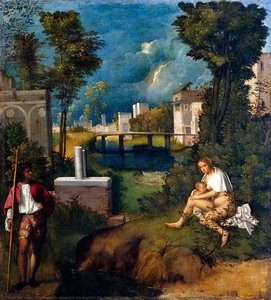
Giorgione’s compositional innovations were as striking as his use of color. He moved away from the clear narrative structures common in Florentine painting, favoring ambiguous scenes that invited contemplation rather than direct interpretation. Take, for example, “The Tempest,” a work whose very subject remains debated. The dramatic storm clouds, the enigmatic figures, and the fragmented architectural elements create an atmosphere of unease and mystery. This deliberate lack of clarity wasn’t a deficiency but a conscious artistic choice – a rejection of didactic storytelling in favor of evoking a specific mood or psychological state. Furthermore, Giorgione masterfully employed *sfumato*, a technique popularized by Leonardo da Vinci, to soften outlines and create a sense of atmospheric depth. This blurring of edges contributed to the dreamlike quality of his paintings, enveloping figures in a haze of light and shadow. He didn’t build up compositions with precise underdrawings; instead, he worked directly on the canvas, allowing the painting to evolve organically through layers of color and tone.
Key Works & Lasting Influence: ‘Castelfranco Madonna’, ‘The Tempest’, and Beyond
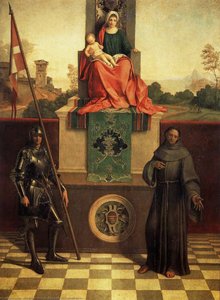 Castelfranco Madonna
Discover Giorgione's 'Castelfranco Madonna,' a Venetian masterpiece renowned for its ethereal beauty and innovative composition, capturing the spirit of Renaissance Venice.
Though his oeuvre is small – fewer than six paintings are universally accepted as authentic – Giorgione’s impact on Western art is immense. The ‘Castelfranco Madonna’, painted in 1503, exemplifies his early style: a serene depiction of the Virgin Mary with the infant Jesus, set against a lush landscape. Its ethereal beauty and innovative composition—the figures seemingly floating within the space—captivated contemporary viewers and continue to resonate today. ‘The Tempest’, created around 1508, is perhaps his most famous work, renowned for its enigmatic subject matter and atmospheric intensity. The painting's ambiguous narrative sparked centuries of debate, solidifying Giorgione’s reputation as a master of poetic symbolism. Even works with contested authorship, like “Portrait of a Gentleman in Armor,” demonstrate his exceptional skill in capturing psychological depth and subtle emotion. His influence extended beyond Titian; artists throughout the 16th century sought to emulate his use of color, light, and atmospheric perspective, shaping the course of Venetian painting for generations.
Giorgione’s Technique: Sfumato, Colorism, and the Venetian Approach
Giorgione's technical prowess lay not in meticulous detail but in a masterful manipulation of color and light. He rejected the Florentine emphasis on line and form, instead prioritizing *colorism* – the use of vibrant hues to create mood and atmosphere. His palette was rich and nuanced, employing layers of translucent glazes to achieve an unparalleled luminosity. The application of paint itself was revolutionary; he worked *alla prima*, meaning “at first attempt,” building up compositions directly on the canvas without extensive underdrawings. This allowed for a spontaneity and fluidity that was rare in Renaissance painting. The sfumato technique, borrowed from Leonardo da Vinci, played a crucial role in softening outlines and creating a sense of atmospheric depth. He often used his fingers to blend colors directly on the canvas, further enhancing the softness and subtlety of his effects. This approach resulted in paintings that appear less like precise representations of reality and more like dreamlike visions, imbued with a poetic sensibility.
The Legacy of Mystery: Giorgione's Enduring Appeal to Artists and Collectors
Despite – or perhaps because of – the scarcity of information surrounding his life and work, Giorgione continues to fascinate artists and collectors alike. His paintings are not easily deciphered; they resist easy interpretation, inviting viewers to engage with them on a deeply personal level. This ambiguity is precisely what makes his work so compelling. Giorgione’s legacy extends beyond the realm of painting; he represents a spirit of artistic freedom and innovation that continues to inspire. The enduring appeal of his works lies in their ability to evoke emotion, capture atmosphere, and transport viewers to another world. At AllPaintingsStore, we are dedicated to bringing the beauty and mystery of Giorgione’s masterpieces into your home through meticulously crafted reproductions, allowing you to experience the magic of the Venetian Renaissance firsthand. Explore our collection today and discover the timeless allure of this enigmatic artist.