



Early Life & Artistic Foundations: From Marseille to Parisian Satire
 Wikipedia: Honoré Daumier
Honoré-Victorin Daumier (French: [ɔnɔʁe domje]; February 26, 1808 – February 10 or 11, 1879) was a French painter, sculptor, and printmaker, whose many works offer commentary on the social and political life in France, from the Revolution of 1830 to ...
Honoré-Victorin Daumier, born in Marseille in 1808, emerged from a family steeped not in wealth but in artisan tradition—his father initially a glazier with poetic aspirations. This early exposure to both the practical and the imaginative would prove formative. The relocation to Paris in 1816 marked a turning point, immersing the young Daumier in a world teeming with political ferment and artistic possibility. While he received some initial mentorship from Alexandre Lenoir, it was his association with Charles Philipon, a publisher known for his boldly satirical publications, that truly ignited his career. Paris at this time was a city of stark contrasts—a burgeoning metropolis grappling with social inequality and political upheaval following the Restoration of the monarchy. Daumier’s keen eye quickly absorbed these tensions, finding expression in sketches and early lithographs that captured the spirit of the age.
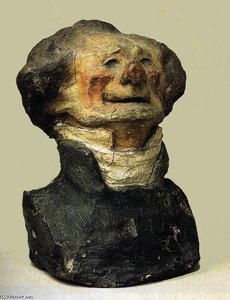
The July Revolution of 1830 proved a catalyst, loosening censorship laws and allowing for a more direct engagement with political themes. Daumier began contributing to publications like La Caricature, rapidly establishing himself as a master of caricature—a form he elevated from mere comic illustration to potent social commentary. His early works weren’t simply funny; they were incisive critiques of the ruling class, lampooning their excesses and hypocrisy with remarkable skill.
The Power of Lithography: Daumier’s Medium for Social Critique
Lithography (from Ancient Greek λίθος (líthos) 'stone' and γράφω (gráphō) 'to write') is a planographic method of printing originally based on the immiscibility of oil and water. The printing is from a stone (lithographic limestone) or a metal plat...
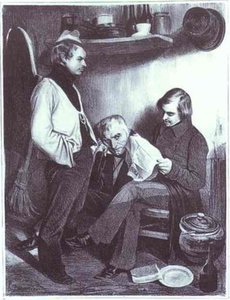
Daumier's choice of lithography as his primary medium was no accident. Invented in 1796, the process—based on the immiscibility of oil and water on stone—allowed for a unique combination of artistic freedom and mass production. Unlike engraving, which required laborious carving, lithography enabled Daumier to create images with a spontaneity and directness that perfectly suited his satirical intent. The relative ease of reproduction meant his work could reach a wide audience, circulating rapidly through the streets of Paris and fueling public debate.
His lithographs weren’t merely reproductions of drawings; they were carefully crafted artworks in their own right, exhibiting a remarkable range of tonal values and expressive line work. Consider Le Dimanche, a stark depiction of a Napoleonic execution—a powerful image that transcends simple political protest to become a meditation on the brutality of power and the indifference of society. The use of light and shadow isn’t merely descriptive; it's emotionally charged, conveying a sense of despair and injustice. Daumier understood the power of visual storytelling, using his medium to expose uncomfortable truths and challenge prevailing norms.
Navigating Censorship & Political Turmoil: Themes in Daumier's Work
 Le Dimanche, lithographie Sunday, lithographs
Explore Honoré Daumier’s 'Le Dimanche,' a stark lithograph depicting a Napoleonic execution. Witness powerful realism & social commentary in this historical engraving.
The very success of Daumier’s satire inevitably drew the ire of the authorities. His relentless lampooning of King Louis-Philippe I culminated in his imprisonment in 1832 for Gargantua, a particularly scathing caricature depicting the king as a monstrous glutton. This experience, and subsequent legal battles, underscored the precariousness of artistic freedom in Restoration France. The passage of the September Laws in 1835 further tightened censorship, forcing Daumier to adopt more oblique strategies.
While overtly political works became less frequent, his social commentary didn’t cease—it simply shifted its focus. He turned his attention to the bourgeoisie, the legal system, and the everyday lives of Parisians, exposing their foibles and hypocrisies with equal wit and precision. Recurring themes emerged: the corrupting influence of money, the injustices faced by the working class, and the absurdity of bureaucratic institutions. His depictions of courtroom scenes, for example, are particularly biting, revealing a system rigged against the poor and vulnerable.
Beyond Caricature: Daumier as a Painter and Sculptor of Realism
In art, realism is generally the attempt to represent subject-matter truthfully, without artificiality, exaggeration, or speculative or supernatural elements. The term is often used interchangeably with naturalism, although these terms are not necess...
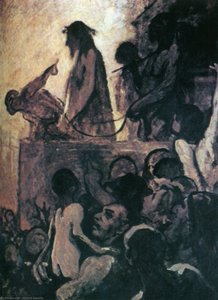
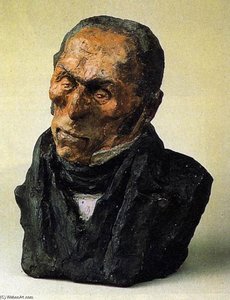
Though best known for his lithographs, Daumier was also a serious painter and sculptor. He initially struggled to gain recognition in these mediums, largely overlooked by the established art world. However, his paintings—often depicting scenes of everyday life—anticipated many of the techniques that would later define Impressionism. He embraced realism, portraying subjects with honesty and directness, eschewing idealized forms for a more authentic representation of the human condition.
The Third-Class Carriage, painted between 1862 and 1864, is perhaps his most iconic painting—a poignant depiction of urban life and the anonymity of the working class. The composition, with its dynamic arrangement of figures and masterful use of light and shadow, captures a fleeting moment in time, revealing the hardships and quiet dignity of ordinary people. His sculptures, though fewer in number, similarly reflect his commitment to realism, portraying subjects with a raw emotional intensity.
Daumier’s Enduring Legacy: Influence on Modern Art & Social Commentary
Despite facing financial hardship throughout much of his life, Honoré Daumier left an indelible mark on the art world. While largely unrecognized during his lifetime, his work profoundly influenced a younger generation of artists—including Impressionists and Post-Impressionists—who admired his commitment to realism and his willingness to challenge convention. His exploration of social themes paved the way for later movements that sought to engage with political issues.
Today, Daumier is celebrated as one of the great French artists of the 19th century. His lithographs, paintings, and sculptures continue to resonate with audiences, offering a powerful glimpse into a turbulent era—and reminding us of the enduring importance of social commentary in art. At AllPaintingsStore.com, we are proud to offer high-quality reproductions of Daumier’s masterpieces, allowing you to experience his artistry firsthand and bring a touch of 19th-century French realism into your home.





