


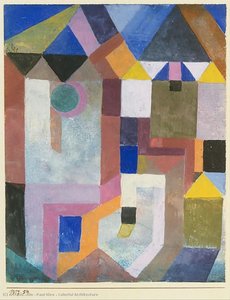


Early Influences & Artistic Foundations: Klee’s Journey to Abstraction
 Wikipedia: Paul Klee
Paul Klee (German: [paʊ̯l ˈkleː]; 18 December 1879 – 29 June 1940) was a Swiss-born German artist. His highly individual style was influenced by movements in art that included expressionism, cubism, and surrealism. Klee was a natural draftsman who ex...
Paul Klee, a name synonymous with poetic abstraction and playful intellectualism, didn't emerge fully formed as the visionary artist we know today. His path was one of deliberate exploration, a gradual shedding of conventional representation in favor of a deeply personal visual language. Born in 1879 in Münchenbuchsee, Switzerland, Klee’s early life was steeped in artistic sensibility; his father was a music teacher and his mother a singer, fostering an environment where creativity flourished. While initially encouraged to pursue musical training – he displayed considerable talent on the violin – Klee found himself increasingly drawn to drawing, captivated by its immediate expressive power. This early duality, the interplay between auditory and visual experience, would become a defining characteristic of his oeuvre.
His formal education at the Academy of Fine Arts in Munich exposed him to Impressionism and Expressionism, movements that initially shaped his work. However, Klee quickly felt constrained by their limitations, seeking something beyond mere depiction. He traveled extensively throughout Italy in 1901-1902, immersing himself in Renaissance art, yet even amidst the masterpieces of the past, he sensed a disconnect, a yearning for a new artistic vocabulary. This period wasn’t about imitation but rather a critical engagement with tradition, a questioning of its fundamental principles. His diaries from this time reveal a restless spirit, grappling with questions of form, color, and meaning – seeds that would blossom into his unique style.
The early landscapes, though skillfully rendered, betray a growing dissatisfaction with purely observational art. Klee began to experiment with caricature and satire, hinting at the symbolic depth that would later characterize his mature works. He wasn’t simply interested in *what* he saw but rather *how* he saw it – a subjective interpretation of reality filtered through his own emotional landscape. This nascent exploration laid the groundwork for his eventual embrace of abstraction, a journey fueled by intellectual curiosity and an unwavering commitment to personal expression.
The Bauhaus Years: Color Theory, Pedagogy, and Geometric Harmony
The Staatliches Bauhaus (German: [ˈʃtaːtlɪçəs ˈbaʊˌhaʊs] ), commonly known as the Bauhaus (German for 'building house'), was a German art school operational from 1919 to 1933 that combined crafts and the fine arts. The school became famous for its ap...
In 1921, Paul Klee accepted a teaching position at the Staatliches Bauhaus in Weimar, Germany – a pivotal moment that profoundly influenced his artistic development. The Bauhaus, founded by Walter Gropius, was a revolutionary art school dedicated to unifying crafts and fine arts, emphasizing functionality and mass production. While not inherently aligned with all of the school’s principles, Klee found within its walls an environment conducive to experimentation and intellectual exchange. His lectures on form and design theory – later published as the influential “Paul Klee Notebooks” – are considered foundational texts for modern art, offering a systematic exploration of color, line, and composition.
Klee’s time at the Bauhaus wasn't merely academic; it directly impacted his artistic practice. He delved deeper into color theory, believing that colors possessed inherent emotional qualities and could be combined to create specific psychological effects. This fascination led to a more deliberate and nuanced use of hue in his paintings, moving beyond representational accuracy towards an exploration of pure chromatic relationships. The geometric abstraction prevalent at the Bauhaus also resonated with Klee, influencing his compositions and encouraging him to simplify forms and explore underlying structures.
His pedagogical approach was equally innovative. He encouraged students to embrace childlike spontaneity, to “take a line for a walk,” allowing intuition to guide their creative process. This emphasis on experimentation fostered a spirit of freedom and individuality within the Bauhaus workshops. Klee’s own work during this period reflects this ethos – paintings characterized by playful geometric shapes, vibrant colors, and a sense of harmonious balance. The Bauhaus years were not simply a chapter in Klee's biography but rather a crucible where his artistic vision was refined and solidified.
Decoding Klee's Symbolic Language: Motifs, Myth, and Personal Expression
 Zentrum Paul Klee
Discover the world’s largest Paul Klee collection at Zentrum Paul Klee in Bern! Explore modern & contemporary art in a Renzo Piano building, plus exhibitions & events.
To truly understand Paul Klee’s art is to embark on a journey of decipherment. His paintings are rarely straightforward narratives; instead, they are layered with symbolism, personal mythology, and evocative imagery that invites multiple interpretations. Recurring motifs – castles, gardens, faces, animals – appear throughout his oeuvre, each imbued with complex meanings that shift and evolve over time. The castle, for instance, often represents a sense of longing or nostalgia, while the garden symbolizes growth, renewal, and the subconscious mind.
Klee’s fascination with primitive art, particularly African masks and tribal sculptures, played a significant role in his symbolic vocabulary. He wasn't interested in mere imitation but rather in the underlying principles of these forms – their ability to convey emotion and spirituality through simplified shapes and bold lines. This influence is evident in his use of abstracted figures and faces, often rendered with a childlike simplicity that belies their profound emotional depth.
His work also reflects a deep engagement with literature and music. He frequently drew inspiration from poetry, incorporating rhythmic patterns and lyrical themes into his compositions. The titles of his paintings – “Ancient Sound,” “Ad Parnassum,” “Polyphony” – often allude to musical concepts or mythological narratives, adding another layer of complexity to their interpretation. Ultimately, Klee’s symbolism isn't fixed but rather fluid and personal, reflecting his own inner world and the ever-changing currents of his emotional landscape.
Klee’s Unique Approach to Composition: Layering, Texture, and the ‘Line for a Walk’
Paul Klee’s compositional techniques were as innovative as his use of color and symbolism. He rejected traditional perspective and spatial conventions, opting instead for layered compositions that create a sense of depth and ambiguity. His paintings often resemble mosaics or tapestries, built up from delicate washes of color, intricate lines, and carefully placed forms. This layering wasn’t merely aesthetic; it reflected Klee’s belief in the interconnectedness of all things, the idea that reality is not a single unified surface but rather a complex interplay of forces.
Texture played a crucial role in his work. He experimented with various materials and techniques – oil paint, watercolor, gesso, even glue – to create surfaces that were both visually and tactilely engaging. This emphasis on texture added another dimension to his paintings, inviting viewers to engage with them on a more visceral level. The “line for a walk,” as he famously described it, wasn’t simply about outlining shapes but rather about allowing the line itself to lead the creative process, to wander freely across the canvas and reveal unexpected forms.
Klee often employed a grid-like structure as a foundation for his compositions, providing a sense of order amidst the apparent chaos. However, this grid was rarely rigid; it was often distorted or fragmented, creating a dynamic tension between control and spontaneity. His paintings are not static but rather evolving organisms, constantly shifting and changing before our eyes. This unique approach to composition reflects Klee’s belief in the power of intuition and his unwavering commitment to personal expression.
Beyond Painting: Music, Literature, and the Intellectual Depth of Klee’s Art
To view Paul Klee solely as a painter is to overlook the breadth of his intellectual curiosity. His art was deeply intertwined with other disciplines – music, literature, philosophy – forming a holistic worldview that informed every aspect of his creative practice. As previously mentioned, his father was a musician and Klee himself possessed considerable musical talent, which profoundly influenced his understanding of rhythm, harmony, and structure.
He frequently drew parallels between painting and music, believing that both were forms of abstract expression capable of evoking emotions and conveying ideas without resorting to literal representation. The titles of his paintings – “Polyphony,” “Fugue in Red” – are testament to this connection. He also had a deep appreciation for literature, drawing inspiration from poetry, mythology, and philosophical texts.
Klee’s writings on art theory – the “Paul Klee Notebooks” – reveal a profound intellectual depth that transcends mere technical instruction. He explored questions of form, color, and composition with a rigor and precision rarely found in artists. His work wasn't simply about aesthetics; it was about understanding the underlying principles of reality, the interconnectedness of all things. This intellectual curiosity, combined with his playful imagination and unwavering commitment to personal expression, makes Paul Klee one of the most compelling and enduring figures in modern art.
Discover the captivating world of Paul Klee’s artistry through AllPaintingsStore.com, where high-quality reproductions bring his masterpieces to life. Explore our collection today and experience the poetic genius of a true visionary.





