The Rise of Landscape: Challenging Academic Tradition
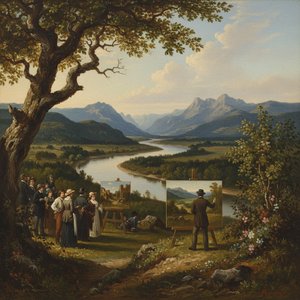
Before the Barbizon school, landscape painting occupied a decidedly secondary position within the French art hierarchy. The prestigious Académie des Beaux-Arts championed historical and mythological subjects, demanding rigorous training in classical ideals and idealized forms. Nature was permissible only as a backdrop – a stage for grand narratives, not a subject worthy of independent exploration. Artists who dared to prioritize the observation of the natural world often faced ridicule or were relegated to minor status. This established order, steeped in tradition and patronage, began to subtly shift in the early 19th century with a renewed Romantic interest in emotion and individual experience. However, it was a group of artists seeking refuge in the Forest of Fontainebleau who would truly dismantle these conventions, paving the way for Realism and ultimately influencing generations of painters.
The seeds of this rebellion were sown by figures like John Constable, whose rural scenes exhibited at the Paris Salon of 1824 captivated a younger generation. His directness and unvarnished portrayal of the English countryside offered an alternative to the polished artifice favored by the Academy. But it wasn’t merely a stylistic shift; it was a philosophical one. These artists weren't simply depicting *what* they saw, but *how* they felt in response to nature – a radical departure from the prescribed academic approach. This burgeoning appreciation for landscape coincided with increased accessibility to rural areas and a growing middle class seeking respite from urban life, creating both an artistic impetus and a receptive audience.
Barbizon’s Circle: Artists, Influences & Shared Ideals
The village of Barbizon, nestled on the edge of the vast Forest of Fontainebleau, became an unlikely epicenter for this burgeoning movement. Beginning in the 1820s, artists were drawn to its proximity to a landscape rich with varied terrain – dense woods, open meadows, rocky gorges, and shimmering marshes. It was here, at the Auberge Ganne, that a loose collective of painters began to coalesce, sharing not only lodging but also a common artistic vision. Théodore Rousseau is often considered the spiritual leader of the group, advocating for landscape as a legitimate genre and championing its inherent dignity.
Charles-François Daubigny, Jules Dupré, Jean-François Millet, Constant Troyon, Charles Jacque, and Narcisse Virgilio Díaz were among the core members. While each artist possessed a distinct style, they were united by a rejection of academic artifice and a commitment to painting directly from nature. Early influences included the 17th-century masters Nicolas Poussin and Claude Lorrain, whose compositions offered models for structure and harmony. However, the Barbizon painters sought to infuse these classical principles with a newfound sense of immediacy and authenticity. They shared a “mutually reinforcing pleasure in nature,” as Dita Amory notes, fostering an environment of collaboration and mutual encouragement.
Aesthetic Characteristics: Tonal Qualities, Brushwork & Subject Matter
Landscape painting, also known as landscape art, is the depiction in painting of natural scenery such as mountains, valleys, rivers, trees, and forests, especially where the main subject is a wide view—with its elements arranged into a coherent compo...
The Barbizon school’s aesthetic is characterized by a deliberate departure from the bright, idealized colors and smooth brushwork of Neoclassicism. Instead, they embraced a more subdued palette – rich browns, greens, and grays that captured the atmospheric nuances of the forest. Tonal qualities were paramount; artists meticulously rendered light and shadow to convey depth, mood, and the passage of time. Loose brushwork became another defining feature, allowing for a greater sense of spontaneity and texture. This wasn’t about precise replication but rather capturing the *impression* of nature.
Subject matter shifted dramatically as well. While some paintings included figures – farmworkers tending fields or peasants going about their daily lives – these were rarely the central focus. The landscape itself was the protagonist, imbued with a sense of quiet dignity and inherent beauty. Genre scenes often served to complement the natural setting, highlighting the harmonious relationship between humanity and the environment. The Barbizon painters weren’t interested in grand historical narratives or exotic locales; they found their inspiration in the everyday realities of rural France.
Life in the Forest of Fontainebleau: A Sanctuary for Realism
The Forest of Fontainebleau wasn't merely a picturesque location; it was integral to the Barbizon school’s artistic philosophy. The forest offered an escape from the constraints of Parisian society and the pressures of the Salon system. It provided a space where artists could immerse themselves in nature, free from the expectations of patrons and critics. The varied terrain presented endless opportunities for study – different types of trees, changing weather conditions, and subtle shifts in light throughout the day.
Artists typically spent their days painting *en plein air* – directly outdoors – making sketches and studies that they would later develop into finished works in their studios. The Auberge Ganne became a hub for artistic exchange, where painters shared ideas, techniques, and critiques. This communal lifestyle fostered a sense of camaraderie and mutual support, allowing them to collectively challenge the established norms of the art world. The forest’s relative isolation also allowed them to experiment with new approaches without fear of immediate judgment.
The Barbizon Legacy: Impact on Impressionism and Beyond
The impact of the Barbizon school extended far beyond its relatively short lifespan (roughly 1830-1870). Their commitment to painting directly from nature, their emphasis on tonal qualities, and their rejection of academic artifice laid the groundwork for Impressionism. Artists like Claude Monet, Pierre-Auguste Renoir, Alfred Sisley, and Frédéric Bazille visited Fontainebleau in the 1860s, drawn by the Barbizon painters’ example. While the Impressionists would ultimately push the boundaries of realism even further – focusing on fleeting moments of light and color – they owed a significant debt to their predecessors.
The Barbizon school also influenced subsequent generations of landscape painters in Europe and beyond. Their emphasis on authenticity, their appreciation for rural life, and their profound connection to nature continue to resonate with artists today. Their work serves as a powerful reminder of the transformative power of observation and the enduring beauty of the natural world.
Key Figures of the School: Rousseau, Millet, Corot & Daubigny
Théodore Rousseau (1812-1867) is often considered the leading figure of the Barbizon school. His paintings, characterized by a somber palette and a sense of quiet dignity, captured the essence of the forest with remarkable sensitivity. Jean-François Millet (1814-1875), while residing in Barbizon for only a portion of his career, became renowned for his depictions of peasant life – works like *The Gleaners* offering a poignant commentary on social inequality. Jean-Baptiste-Camille Corot (1796-1875) was the earliest member of the group to paint in Fontainebleau, bridging Neoclassicism and Impressionism with his atmospheric landscapes.
Charles-François Daubigny (1817-1878) developed a unique technique of painting directly on large canvases outdoors, capturing expansive views of the countryside. These artists, along with others like Jules Dupré and Constant Troyon, collectively redefined landscape painting in France, challenging academic conventions and paving the way for modern art. Their legacy continues to inspire artists and captivate audiences worldwide.