The Visionary of the Wild: The Life and Legacy of Arthur Fitzwilliam Tait
Arthur Fitzwilliam Tait stands as a monumental figure in the annals of Victorian British art, a painter whose brush breathed life into the untamed spirit of the natural world. Born in Liverpool in 1819, his early years were shadowed by the sudden financial instability following his father's bankruptcy. Yet, it was perhaps this very hardship that forged his profound connection to the animal kingdom, fostering a lifelong sensitivity to the rhythms of nature. As a young boy sent to live with relatives in Lancaster, Tait began to cultivate an observant eye, transforming the simple landscapes of his youth into a foundation for a career defined by meticulous detail and emotional depth.
His ascent into the professional art world was as unexpected as it was serendipitous. At just twelve years old, he was discovered by the prestigious Agnew & Zanetti repository of art. Recognizing a raw, innate talent, they did not merely employ him but actively nurtured his development, encouraging a path of self-directed learning in painting techniques. This early mentorship allowed Tait to master the nuances of lithographic reproduction, a skill that would later serve as a bridge between his fine art and the wider public consciousness through his legendary collaborations with Currier & Ives.
A Transatlantic Journey and the American Frontier
The trajectory of Tait’s life changed forever following an encounter with George Catlin's exhibition in Paris. The vibrant, rugged imagery of the American frontier ignited a fire within him, prompting his immigration to the United States in 1850. This move was more than a change of geography; it was a spiritual homecoming for an artist seeking the grandeur of the wilderness. Establishing a seasonal painting camp in the Adirondacks, Tait spent his summers immersed in the breathtaking landscapes of North America, capturing the essence of the wild with an authenticity that only direct experience could provide.
During this period, his work began to reflect a sophisticated blend of British academic precision and American romanticism. His ability to render the texture of fur, the shimmer of light on water, and the quiet tension of a forest scene made him a favorite among collectors. The success of his prints through Currier & Ives ensured that his vision of the American West reached far beyond the galleries of New York, becoming part of the visual fabric of 19 and early 20th-century American life.
Mastery of Technique and Artistic Significance
Tait’s technical prowess is perhaps most evident in his ability to balance realism with atmosphere. Whether working in oil on canvas or more intimate studies on panel, he possessed a remarkable command over light and color. His compositions often featured:
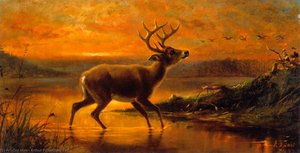
- Dynamic Wildlife Portraits: From the majestic Ten Point Buck in Evening Twilight to the spirited depictions of deer and birds, his subjects were never mere specimens but characters within a living narrative.
- Atmospheric Landscapes: He utilized warm tones and soft brushstrokes to evoke the serene, often melancholic beauty of twilight or the rugged energy of a sun-drenched prairie.
- Narrative Realism: Works such as The Prairie Hunter: One Rubbed Our demonstrate his skill in capturing human interaction with the landscape, blending sporting art with profound environmental storytelling.
By the time he was elected to full membership of the National Academy of Design in New York in 1858, Tait had already secured his place as a pioneer of wildlife painting. His legacy resides not only in the museums that house his masterpieces, such as the Detroit Institute of Arts and the Autry Museum of the American West, but in the way he bridged two continents through art. He remains a celebrated chronicler of a vanishing wilderness, an artist who captured the fleeting beauty of the natural world with a permanence that continues to captivate the modern imagination.
Questions & Answers
Where can I see the color profile of Arthur Fitzwilliam Tait's work?
The color profile of Arthur Fitzwilliam Tait's work is shown on the artist's Palette Genome page.
How many artworks by Arthur Fitzwilliam Tait are available to browse?
You can browse 63 artworks by Arthur Fitzwilliam Tait on the All Artworks page.
How do I find works by Arthur Fitzwilliam Tait in a specific palette?
Arthur Fitzwilliam Tait's works can be browsed by color palette on the artist's By Palettes page.