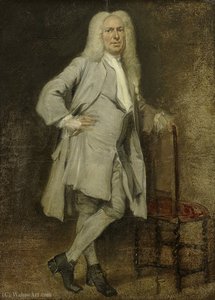
A Window into Amsterdam’s Golden Age
Cornelis Troost, a name inextricably linked to the vibrant tapestry of 18th-century Amsterdam, was more than just an artist; he was a keen observer and masterful recorder of his era. Born in the heart of the Dutch Republic on October 8, 1696, in Amsterdam, Troost’s journey from aspiring actor to celebrated painter reveals a fascinating confluence of artistic passions and personal transformation. Initially trained as a performer on the stage, he found his true calling not amidst applause and drama, but within the meticulous detail and subtle nuances of painting. His life's trajectory is marked by a deliberate shift – a conscious rejection of the spotlight for the quiet contemplation of brushstrokes, ultimately leading him to become one of the most significant figures in Dutch Rococo genre art.
Troost’s artistic education began under the tutelage of Arnold Boonen, a respected portraitist who recognized his student's innate talent. This apprenticeship provided a crucial foundation, but it was Troost’s early drawings that truly showcased his distinctive style – particularly one dated 1708 depicting Prince Eugene of Savoy and the notorious bookseller and spy, Louis Renard, engaging in clandestine activities within a luxurious Amsterdam brothel. This piece, brimming with wit and intrigue, hinted at the themes he would later explore with such captivating skill: the complexities of social life, the allure of pleasure, and the hidden currents beneath the veneer of respectability.
The Elegance of Rococo and Social Narrative
As his career matured, Troost became a master of capturing the delicate balance between frivolity and sophistication. His work was undoubtedly influenced by the prevailing artistic trends of his time, including the dramatic compositions of William Hogarth, known for his satirical depictions of London society, and the elegant grace of French masters like Watteau, Boucher, and Lancret. This synthesis of Dutch realism and French Rococo elegance allowed him to create works that were both deeply grounded in local reality and exquisitely refined.
His repertoire was remarkably diverse, ranging from intimate portraits to monumental group compositions. Some of his most enduring contributions to the art world include:
- Portrait of the Inspectors of the Collegium Medicum (1724): A stunning Rococo oil painting that showcases the height of 18th-century Dutch artistry and institutional elegance.
- Portrait of Maria Magdalena Stavenisse (c. 1726): A Baroque masterpiece that utilizes refined detail to showcase aristocratic wealth and status.
- Regents of the Aalmoezeniersweeshuis Orphanage (1729): A monumental group portrait that serves as a window into the social structures of Amsterdam, utilizing dramatic lighting and an opulent setting to convey a sense of civic importance.
Legacy of a Master Observer
The significance of Cornelis Troost lies in his ability to act as a visual historian for a period of transition. While the era of the great Dutch Golden Age masters had passed, Troost breathed new life into the Dutch tradition by infusing it with the lightheartedness and decorative charm of the Rococo movement. His paintings do not merely depict faces; they capture the spirit of an age—the rustle of silk, the flicker of candlelight, and the subtle social hierarchies of Amsterdam's upper class.
Through his witty portraits and captivating genre scenes, Troost left behind a legacy that continues to enchant viewers. He remains a pivotal figure who bridged the gap between the heavy, dramatic traditions of the 17th century and the airy, graceful aesthetics of the 18th century, ensuring that the social nuances of his beloved Amsterdam would be preserved in pigment for generations to come.
Questions & Answers
Is there a 3D virtual tour of Cornelis Troost's works?
Cornelis Troost's artworks can be seen in a 3D gallery on the artist's 3D Museum page.
What aliases or alternate names does Cornelis Troost have?
Cornelis Troost appears under the alternate names Trooft, C. Troost, Corneille Trost, Troost, Cornelius Troost.
Where can I see the color profile of Cornelis Troost's work?
Cornelis Troost's use of color across the works listed on this website can be studied on the artist's Palette Genome page.