The Shadow and the Light of Modena
Francesco Stringa moves through the narrow streets of Modena, a man defined by the weight of the objects he observes. Born in 1578, his hands are trained to grasp the textures of the physical world, finding a quiet presence in the service of the Este court. He does not seek to reinvent the heavens but to record the way light settles upon a surface, a task that eventually leads him to the position of superintendent of the Galleria Estense. His life is a steady devotion to the visual language of the Baroque, a period where the tension between soft edges and sharp, decisive marks defines the very air of the seventeenth century.
The atmosphere of his work is built upon the foundations of his Emilian contemporaries. He navigates the space between the soft transitions of sfumato and the heavy, dramatic shadows of chiaroscuro. His brushwork reveals a preoccupation with how light defines an edge, making a painted object feel heavy, cold, or soft to the touch. This grounded clarity is what separates his work from the grand, sweeping gestures of his peers; he is a painter of the subtle shift in tone.
Artistic Lineage and Technical Precision
Stringa’s development is a study in the absorption of surrounding mastery. He does not work in a vacuum, but rather absorbs the naturalism of Mattia Preti and the structured compositions of Guercino. His style is a bridge between the traditions of Ludovico Lana and the evolving demands of the Baroque era. He masters the ability to translate the atmosphere of a room into permanent form, focusing on the weight of objects and the way shadows define their boundaries.
His technical approach is characterized by several key elements:
- The use of chiaroscuro to create physical depth and volume.
- A reliance on sfumato to soften the transitions of light.
- A strong sense of naturalism derived from careful, unhurried observation.
- A focus on the tactile quality of surfaces, from skin to stone.
A Legacy in the Emilian Tradition
The influence of Stringa extends beyond his own brush, flowing into the hands of those he trained. His methods were carried forward by pupils such as Francesco Vellani, Antonio Consetti, Girolamo Donnini, and Jacopo Zoboli. His career, which saw him serving as a court painter for the dukes of Alfonso IV and Francesco II d'Este, remains anchored in the specific, grounded reality of his native region. He died in 1615, leaving behind a body of work that captures the quiet, heavy reality of the seventeenth century.
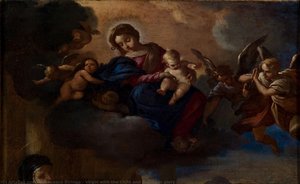
His paintings remain held in significant collections, such as the Pinacoteca Stuard in Parma, where works like Virgin with the Child and angels in glory demonstrate his ability to balance the divine with the tangible. He remains a figure of the Baroque, a man who understood that the most profound truths are often found in the way light hits a surface in a quiet room.
Questions & Answers
What are the birth city and country of Francesco Stringa?
Francesco Stringa was born in Modena, in Italy.
Where can I see all artworks by Francesco Stringa?
Every work by Francesco Stringa on this website can be browsed from the artist's All Artworks page.
How many artworks by Francesco Stringa are available to browse?
You can browse 1 artwork by Francesco Stringa on the All Artworks page.
Where are Francesco Stringa's artworks grouped by art movement?
The movements Francesco Stringa worked in can be seen on the artist's All Movements page, which groups the artworks by movement.