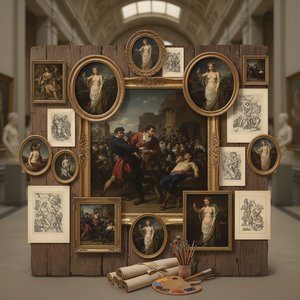
Jean-Baptiste Fortuné de Fournier: Capturing Imperial Elegance Through Watercolor
Jean-Baptiste Fortuné de Fournier (1797 – 1864) stands as a significant figure in French watercolor painting during the Second Empire, specifically renowned for his meticulous depictions of castle interiors—a genre that offers invaluable insight into the opulent tastes and decorative arts prevalent at the time. Born in Nice, France, he descended from Luigi Antonio Fournier, an Italian diplomat, establishing him within a milieu steeped in artistic patronage and intellectual curiosity. His early life fostered a passion for art, culminating in formal training and a dedication to mastering watercolor techniques—a medium favored by artists seeking subtlety and luminosity.
Early Influences & Artistic Training: Fournier’s formative years coincided with the burgeoning Romantic movement, exposing him to dramatic landscapes and emotive narratives. However, he swiftly gravitated towards the neoclassical ideals championed by Jacques-Nicolas Paillot Guérard and Alexandre Cabanel, absorbing their emphasis on idealized forms and precise draughtsmanship.
Castle Interiors: A Defining Genre Fournier’s artistic breakthrough arrived with his fascination for capturing the grandeur of French castles—Saint-Cloud, Fontainebleau, and Villa San Donato being among his most celebrated subjects. Unlike grand canvases portraying historical events or mythological tales, these watercolors focused on intimate spaces—drawing rooms adorned with sumptuous fabrics, dining halls illuminated by candlelight, and corridors reflecting the aristocratic lifestyle of the era.
Technique & Aesthetic Considerations: Fournier’s watercolor style was characterized by a remarkable level of detail and tonal gradation. He skillfully employed layering techniques to achieve depth and atmosphere, meticulously rendering textures—from velvet drapery to polished marble floors—with astonishing accuracy. His palette favored muted hues—primarily blues, greens, and golds—creating an ambiance that conveyed both elegance and tranquility.
Notable Works & Recognition
Fournier’s artistic output yielded several noteworthy pieces that continue to captivate collectors and scholars alike. Among his most acclaimed commissions were watercolors of Saint-Cloud Palace, meticulously documenting the royal residence during Napoleon III's reign. Similarly, Villa San Donato—the papal summer villa in Florence—became a subject of fascination, showcasing Fournier’s ability to convey the grandeur and refinement of Italian aristocratic culture. His works are preserved in prestigious institutions such as the Louvre Museum’s Drawing Cabinet and the Musée du Second Empire in Compiègne Palace, cementing his legacy as an artist who faithfully documented the visual landscape of his time.
Historical Significance & Legacy
Fournier's contribution to art history extends beyond mere aesthetic appreciation; he served as a crucial recorder of social and cultural trends during the Second Empire—a period marked by imperial ambition, artistic innovation, and lavish displays of wealth. His watercolors offer invaluable documentation for historians studying decorative arts and interior design—providing tangible evidence of the stylistic preferences that shaped Parisian society. Furthermore, Fournier’s meticulous observation of naturalistic detail—particularly in depictions of flora and fauna—reflects a broader intellectual movement concerned with scientific inquiry and artistic representation.
Further Exploration
For those interested in delving deeper into Jean-Baptiste Fortuné de Fournier's oeuvre, the British Museum’s collection features a portrait of Napoleon III by this artist (https://www.britishmuseum.org/collection/term/BIOG27664). Examining his artistic influences and comparing his style with contemporaries like Alexandre Cabanel provides valuable context for understanding the broader artistic landscape of 19th-century France. Finally, exploring reproductions of his castle interiors—available on platforms such as AllPaintingsStore—allows viewers to experience firsthand the beauty and sophistication of Fournier’s vision.
By the AllPaintingsStore.com Editorial Team
Art Quiz
There is only one correct answer for each question.
Question 1:
Where was Jean-Baptiste Fortuné de fournier born?
Question 2:
What type of paintings is Jean-Baptiste Fortuné de fournier primarily known for?
Question 3:
Which museum houses some of Jean-Baptiste Fortuné de fournier's artworks?
Question 4:
During which historical period did Jean-Baptiste Fortuné de fournier's paintings depict scenes?
Question 5:
What is a notable feature of Jean-Baptiste Fortuné de fournier’s artwork regarding decorative arts?
Explore the captivating world of watercolor painting! Discover its rich history, essential techniques, influential artists & collecting tips. A comprehensive guide for art enthusiasts from AllPaintingsStore.
Explore the captivating world of watercolor painting! Discover its rich history, essential techniques, influential artists & collecting tips from art experts. A comprehensive guide for enthusiasts.
Delve into the world of Francisco Goya with AllPaintingsStore. Explore 25 iconic paintings – from 'The Third of May' to his haunting Black Paintings. Discover the stories, techniques & emotions behind these Spanish masterpieces. Find museum-quality art reproductions for your home at AllPaintingsStore.com!